


🐖 Today’s issue was brought to you by Betterment’s high-yield cash account. With Cash Reserve, you can save with no minimum balances. New customers can earn a high (variable) APY with a qualifying deposit. Need help starting your emergency fund? Check out my guide.
Paid client. Views may not be representative. See App Store & Google Play reviews. Rate is subject to change. Learn more. Cash Reserve offered by Betterment LLC and requires a Betterment Securities brokerage account. Betterment is not a bank. Learn More.
We’re approaching the time of year when I get the feminine urge to overhaul my entire life, so in the spirit of that grand tradition, I want to show you a mood board for something that’s been in the works for a couple of months but spiritually cooking for much longer:


No, I don’t want to download your app

This is a formal announcement that I have reached my limit with the relentless QR codification of all of life’s processes and am presently organizing an oppositional resistance force.
The other day I had to get set up as a “new patient” at a doctor’s office, a process I’ve repeated countless times over years of Air Force moves but which has recently begun to resemble a set of biblical riddles. You know you’re in for it when the call to schedule an appointment kicks off a parade of emails, each of which includes a set of multistep instructions.
It all starts innocently enough: First, you’ll need to download our partner app Slappadoo, where you’ll be prompted to fill out all of your most intimate personal information. Your password must be at least 20 characters, contain no vowels except for the letter “u,” and include the name of at least one character from a Shakespeare play (no Macbeth). Once you log in for the first time you’ll be prompted to set up two different forms of multifactor authentication, then the system will reset for 30 minutes. Do NOT refresh the browser. As soon as the page reloads you will have 15 minutes to complete nine forms, all of which will ask you the same questions in slightly altered language and culminate in you resolving not to sue us for anything, including death and dismemberment.
After you’re done with the forms, you’ll be prompted in the MORESHIT tab of the Slappadoo app (turn pop-up blocking off) to visit our partner, Kickindanutz, so you can access your patient portal. Be sure to complete your patient checklist no sooner than 72 hours but no later than 48 hours before your appointment time is scheduled to begin (all times in Greenwich Mean Time, the official timezone of Greenland). To access the account, use the preset password, which is the last four digits of your social security number scrambled with the last four digits of your credit card on file (no American Express). You get three guesses.
Your appointment, which is technically just the consultation wherein you will explain—communicating in haiku is strongly preferred but not required—why you’d like to see a doctor, will last 15 minutes and cost 387 USD. No medical care will be administered. Credit cards will incur a 5% convenience fee, avoidable by check, cash, or money order, but only those money orders you can buy at Publix next to the deli section. Upon arrival you will sit for an eleventh-grade precalculus test to establish the power dynamic (No. 3 pencils only). If you’d like to opt out of the test, as is your right, you may do so by bringing one (1) woodland creature (NO raccoons) as sacrifice.
Thank you for shopping with the world’s premier healthcare system. Our investors appreciate your business.
Anyway, that’s how my week is going. How’s yours?

Never thought I’d see the day when one of those lengthy “what it’s actually like to work for this famous person” write-ups would feature the confessions of a man’s personal assistant. I can’t help but feel that if Hasan Piker were a woman, some of his assistant’s tasks—bookending his 10-hour workday with meetings, shuttling his dry-cleaning, and “helping out around the house”—would not be framed so benignly. (AfterMath)

Folks, they’re calling it the “trillion-dollar affair.” The CEO of the chip manufacturer Nvidia, Jensen Huang, apologized in a companywide memo for having an affair with a woman who was, whoops, maybe a spy partaking in a little light “foreign intelligence” (to which I say, can’t a gal have hobbies?). Because the US stock market is structurally akin to that meme of a second-story deck propped up by three decomposing two-by-fours, this man’s extramarital dalliance is on the homepage of nearly every news site this week. (The Cut)
It has come to my attention that earlier this year Huang was making headlines for wearing a lot of expensive leather jackets (“crocodile- or lizard-embossed”), so in retrospect the signs of midlife crisis were there. When Adam Smith said the market would regulate itself, he assumed we’d clock when the trillionaires whipped out the Harley-Davidson fetishwear. Really, this one’s on us.
And while we’re on the subject, I have yet to hear a cogent explanation for what “winning” the AI “race” with China would meaningfully look like, a premise everyone seems to just uncritically embrace. A race implies a distinct finish line, and the only “finish line” anyone ever discusses in this context is the one where the technology becomes sentient and, in short order, sick of our shit, eventually going rogue and killing us all (or, if you prefer the more sophisticated verbiage in the 93-page “investor risks” section of Anthropic’s S-1 filing, to “pose catastrophic or existential risks to humanity”).
If you thought the comments on an article about the rise of part-time “house managers” would contain virtually anything other than smart-alecky retorts about how it’s cheaper to just have a wife/mother/etc., you’d be wrong. (Kidding—there’s at least a little obligatory hat-tipping to the women who have capitalized on the desire to have a third adult paid to manage the home.) One house manager, who earns $120,000/year, described her duties as follows: “Fertilize the fig trees, straighten up the coat closet, fix the coffee machine, tidy the garage, grill the chicken, take the Chanel shoes to get stretched.” (Wall Street Journal)
Last month, 51% of respondents to an NBC News poll said they were “dissatisfied with their financial situation,” the highest number NBC has recorded for this question this century. These stats are old hat by now—mortgage rates and healthcare costs and gas prices, et al.—but what’s notable is where their findings are being acknowledged. This article about the asymmetry of our economy—the top 1% now officially own more wealth than the entire bottom 90% combined—comes not from Jacobin or Current Affairs, but Bloomberg, hardly a bastion of egalitarian thinking. (Bloomberg)

Graphic design software company Canva is going viral for laying off 22% of its staff, but not for the reason you might think: Laid-off staff receive six months of severance pay and get to keep their health insurance for another year, plus a few smaller benefits, like holding onto their work laptops and subscriptions to LinkedIn Premium. (There’s also something about $10,000 grants for entrepreneurship, but it’s not clear to me how many.) It’s being hailed as a ‘master class in how to handle layoffs’ and ‘exceedingly generous.’ It’s a real sign of the times that a generous layoff is being celebrated so widely, and sometimes I fear these events make something that’s profoundly abnormal outside of the US—at-will mass layoffs—seem like a norm that can be rendered acceptable by benevolent corporate behavior. (Fortune)
A take on layoffs that I received a couple of years ago from a former head of HR at a multinational corporation always comes to mind when I read these stories. Based on what he’d seen, he believed that regular employees should have contracts just like the executives:
“I have read employment contracts for employees all over the globe, and other countries provide a level of protection that would make our jobs more secure and create a safety net in the event of a real downturn. It is a normal expectation in those countries for your employer to have a valid reason to let you go that is not just to cut costs.”
And here’s how he explained the American layoff (the “reduction in force”) as a recognizable and straightforward tax-and-stock-price play:
“A RIF (Reduction in Force) is a commonly used tool used to improve margins more often than to recover from a downturn in business. You can be at 70% gross margin on $500M or $3B, and they will cut headcount to get to 71% for the Street [stock price]. The key hidden detail here is that companies are rewarded for it. They can put a plan in place (cut $10M in headcount) and take the full benefit of that plan in the Fiscal Year or Quarter—before a single layoff is communicated to employees. The company is rewarded not just by investors, but also via tax law. The severance and other expenses in a RIF shift the numbers from the expense bucket to the liability bucket, which allows them to benefit from the wage savings, reduce taxes, and spread the cost out over the timeline of the “transformation.” Companies will brag to the Street about paying no tax or low single digits and this is one of the dirtiest of many tools in the toolbox to get there. For some companies it is a tool that is sharp and used often.”

Brotox is here. A “medical aesthetics data and intelligence provider” found that, in Q3 2026, the average Botox-injecting man was spending more per visit ($529) than the average woman ($455). Call it the Hot Goon Hamster Wheel. Gender reparations! A dermatologist explained that the universal signs of aging, like crow’s feet, “look more natural” on a man’s face, whereas his female patients prefer the expressionless, porcelain finish of a glass doll (which is, we are to infer, more natural for lady faces). The former effect is, apparently, harder to achieve, which partly explains the higher price. (GQ)
Been thinking a lot about Emily Sundberg’s four-year anniversary post for her newsletter, Feed Me, in which she mentions that she allows the things she naturally finds interesting to guide the direction of her work. There’s something refreshing about openly refusing the baseline advice of your field (niche down! pick a lane!) and instead filtering whatever you want through a particular sensibility. It seems to me the people who appear most gratified by and consistently inspired in their creative work tend to ignore or otherwise transcend the unspoken “rules” about how to operate in their industry. (Feed Me)
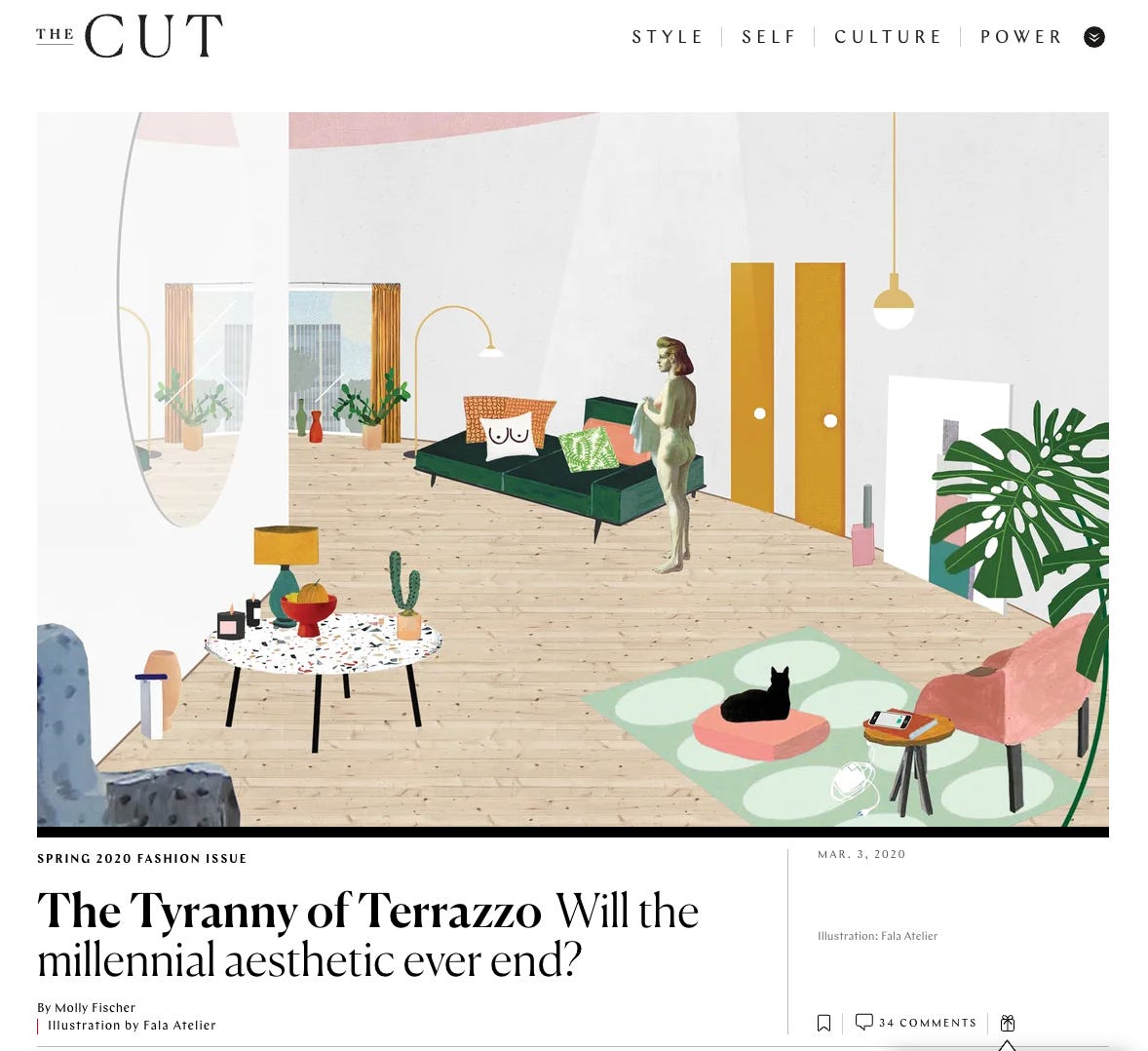
The entire time I was reading this article, I kept wondering how I’d never come across this perceptive and harrowing breakdown of millennial design before. Then I noticed it was published on March 3, 2020, the publishing no-woman’s-land that was promptly buried under a deluge of COVID coverage for the next 12 months. It’s such a fun read. (The Cut)
Just started reading Feel Free (2018), an essay collection by Zadie Smith, which Sarah Haas describes as “not just an example of the essay at the peak of the form’s potential, but a deep understanding of the essay at its core.” Surely this won’t give me a complex! (Los Angeles Review of Books)
Listen, I’d be lying if I said virtually everything I do isn’t in service of the hope that someday David Remnick will give me a ring and ask if I might fancy a byline every once in a while. But it was exhilarating—and sanity-restoring—to hear Smith give him a hard time about how he interviews “far-left” voices in her Radio Hour interview:
“I was thinking about it when I heard you interview Mamdani. Where you were kind of dragging him over the coals a bit about this phrase “democratic socialist.” [...] It’s so odd to me that his politics are considered, in a New York contest, radical, where what you are describing is basically the very least that we imagined in 1946, all over Europe. That social compact that he was trying to describe—of decent housing, equal and free education, and free healthcare—is what I grew up in [in Britain]. I grew up in a context where even somebody like Churchill, his phrase “cradle to grave”...that is the phrase of a Tory in 1943. So it’s always amazing how far from what I would call “the very least we could do” we have moved. To call someone like him a communist is mind-blowing, from a European perspective.” (The New Yorker)
Yours in app-free solidarity,
KGT
The comments on that WSJ are insane, insulting, and I guess should have been totally predictable. This one is great: "And this is why I hide my WSJ password from my wife."
What a gem he must be.
You are so wise and witty! Thank you for your talent!