



Reading last week’s coverage of the World Economic Forum in Davos as an American felt like this:

Today’s issue is particularly heavy on economic policy headlines, and I hope it helps you connect the dots between some of the biggest stories right now. If you could see my tabs, you’d know I’m actually exercising restraint:


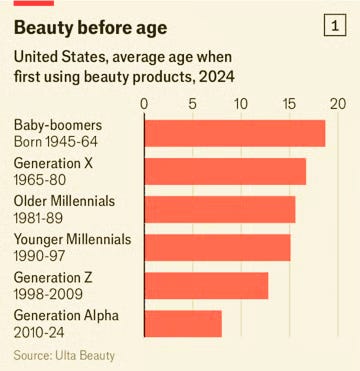
💄 Spending on beauty products worldwide is “far outpacing” the rest of retail. The prevailing theory attributes the growth to social media-driven insecurity, but I think it’s fairer to pin it on the incentive models these platforms have created that transform every user into a commissioned salesperson within a highly visual medium. This article taught me that I began wearing makeup at the exact average age for “Younger Millennials”: 15. (The Economist)
📉 Pay attention to how health insurance stocks are reacting to the news that the proposed 2027 insurer rates for Medicare Advantage (a program which uses public funds to buy private plans for Medicare-eligible Americans) will increase payments by an average of 0.09%, rather than the projected 5%. Medicare Advantage covers an estimated 54% of Americans on Medicare and generated around $500 billion in revenue for the private health insurance industry last year. To put that in perspective, UnitedHealth’s Medicare revenue is more than twice (!) that of its private insurance business. Moments like these briefly reveal the extent to which shareholder value depends on the all-you-can-eat buffet of public funding. (Wall Street Journal)
🧹 Trad wife influencers—and the public’s reaction to them—embody a paradox: Their “performance of ostentatiously elective stay-at-home motherhood incites both reflexive disdain (How can she bear to do just that?) and aggrieved envy (How can she afford to do all that?).” A strange tension is produced when the very thing women fought so hard to transcend—a social mandate that the middle decades of your life be devoted to primary caretaking, regardless of your preferences—is now also economically out of reach for those who may have otherwise chosen it. (The New Yorker)
Brought to You by Domain Money
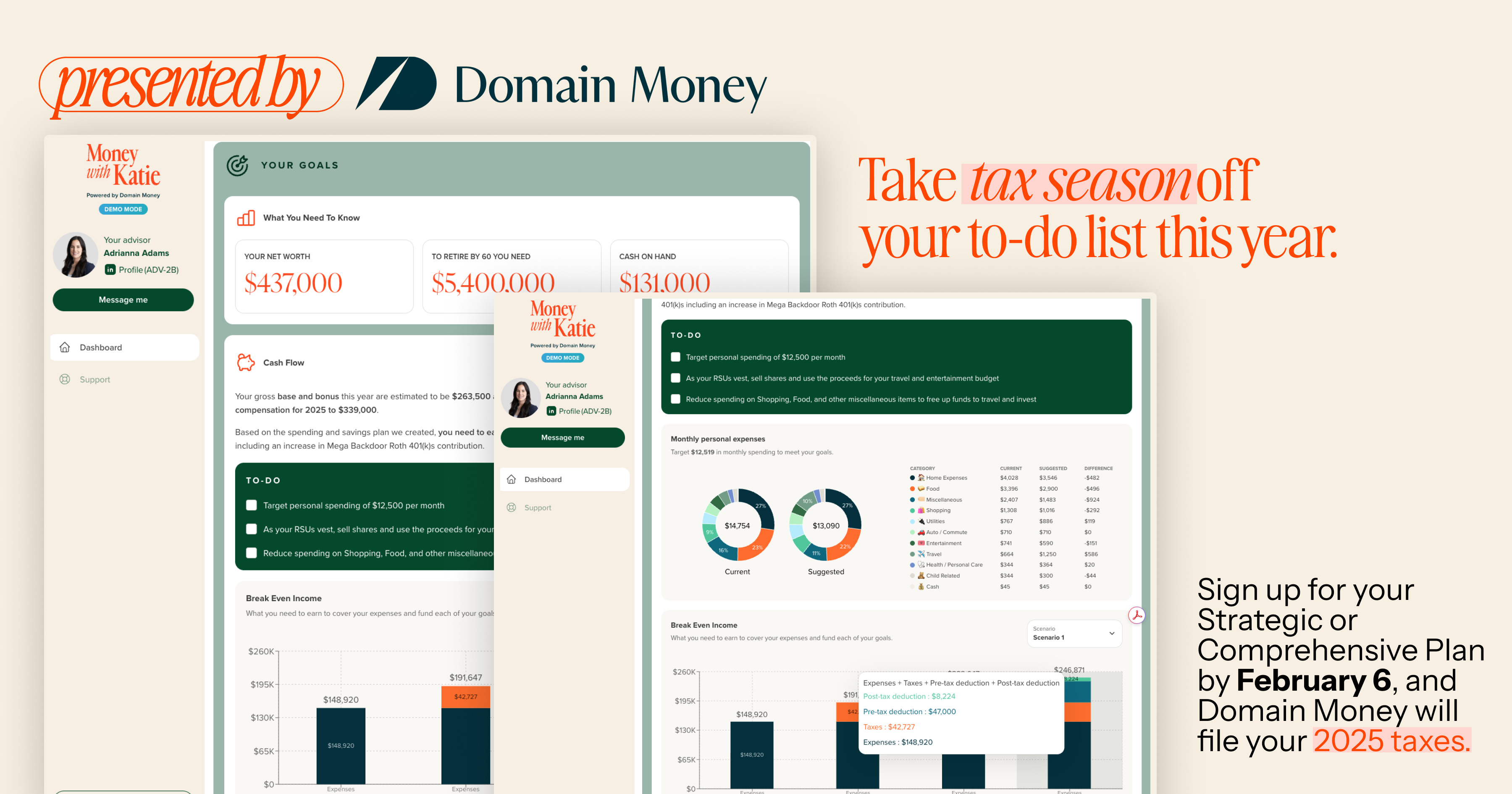
It’s hard to believe, but tax season is already upon us. And if you’re interested in handing off your tax filing this year to my team of CFP® professionals at Domain Money, this special offer is for you.
Normally, Domain Money’s deadline to onboard new clients in time for tax filing is January 31. But they’ve secured a special extension for the Money with Katie community: When you sign up for their Strategic or Comprehensive financial plan by February 6, they’ll take this year’s tax season off your hands. (You’d be in good company: This is the first year where I’ve hired out my bookkeeping and accounting services for both business and our household.)
Here’s what you’ll get as part of the “tax” portion of your new plan:
Filing of your 2025 taxes
Tax planning that’s integrated into your entire financial strategy
Prior tax return analysis to catch missed opportunities
🤓 Book your free strategy session now and lock in tax filing with my team of Money with Katie-dedicated CFP® professionals before the deadline.

🧊 It looks like we’re headed for another (partial) government shutdown by the end of the week. Senate Democrats finally managed to score some deeply discounted spines while rummaging through the bargain bin of American democracy’s fire sale and indicated they’ll vote “no” on more funding for ICE. This glimmer of conviction was, apparently, inspired by the *checks notes* second street execution of an American citizen in less than three weeks. The footage of Alex Pretti’s killing is nauseating, and yet, it feels like critical viewing if we’re to stay grounded in reality. Two signed affidavits from witnesses on the scene—a pediatrician and a children’s face painter—plainly describe the murder and the events that led to it, if you’re not up for watching multiple angles of video documentation. (CNBC)

🎙️ Relatedly, one relevant exchange from Sunday’s episode of Diabolical Lies:
Caro: Not only is this horrific, but this is where all your money is going. I think it’s really important to highlight that, because a smart politician would be using that as a campaign argument: This is why you’re broke. This is why you can’t afford groceries. This is why your healthcare premiums went up. This is why the small businesses in your town are shutting down. This is where your money is going!
Katie: This is one of those weird scenarios where the leftists and the libertarians are together. The Cato Institute broke down the funding, and the hiring budget works out to something like $800,000 per ICE agent.

🇩🇰 Scott Bessent, a man who, notably, believes your average American retiree “owns 5, 10, 12 homes,” called Denmark (and the largest Danish pension fund which recently sold $100 million in US Treasuries) “irrelevant.” The following day, a Swedish pension fund announced that it, too, sold US Treasuries—around 80x the volume the Danish firm sold—over the last year, citing the US government’s “reduced predictability” and “growing government debt.” Willing to let Bessent off the hook for this one solely because he also called Gavin Newsom “Patrick Bateman meets Sparkle Beach Ken,” and unfortunately, no choice but to golf-clap for whichever Treasury intern came up with that. (The New Republic)
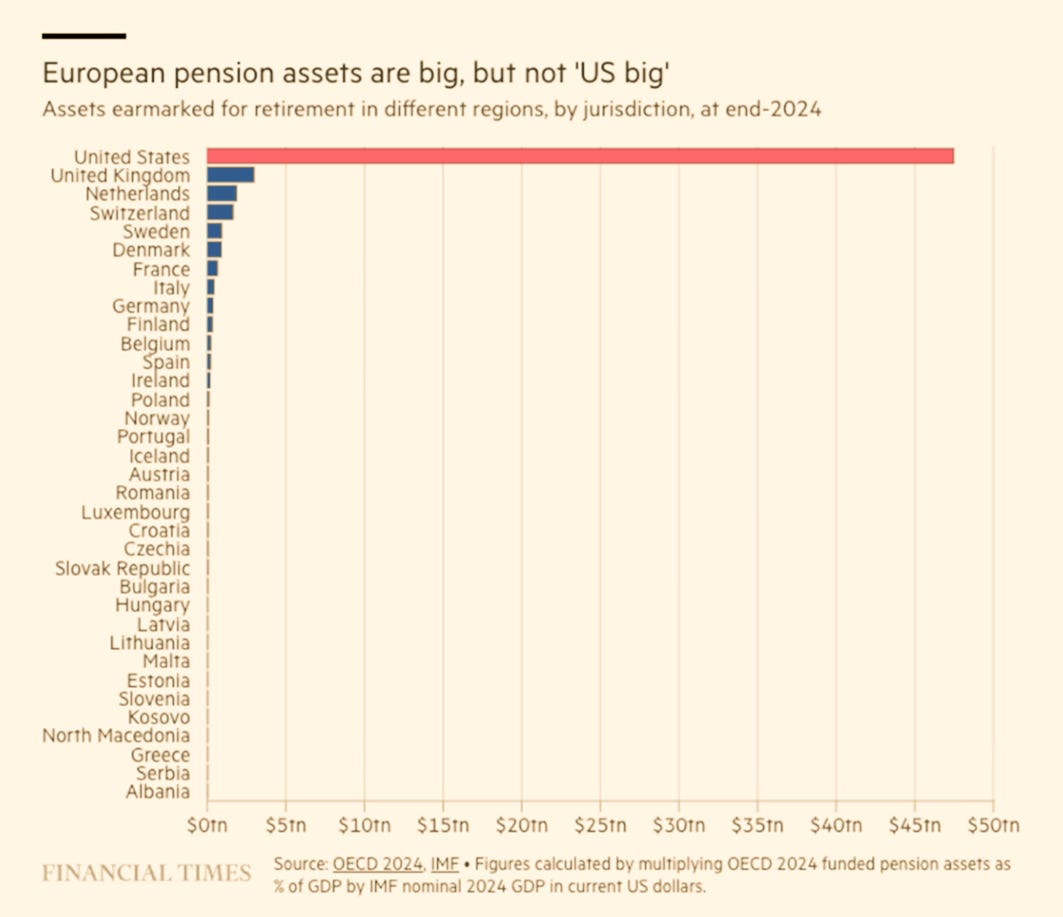
🪛 It’s clear when the size of the Danish and Swedish holdings are contextualized that these moves won’t make a difference. Still, it’s conceivable that such a lever could turn the screws on the US financial system:
If we throw into the mix all private pension assets too, it’s really just the British, Dutch and Swiss pension systems that stand out as being worth more than a couple of CalPERS apiece.
They each own a stack of US assets big enough to cause some damage to valuations if liquidated. But they also have mandates oriented around investment returns and will therefore mostly need actual coercing to dump their US holdings (unless they judge the risks of buying US stocks and bonds has [sic] just got too high). (Financial Times)
🦅 Alex Karp, the CEO of surveillance technology company Palantir, made a passing comment at Davos that connected a short-term fixation on immigration with long-term aspirations for artificial intelligence. His prediction—that AI will render vocational technicians “irreplaceable”—“make[s] it hard to imagine why we should have large-scale immigration unless you have a very specialized skill.” The interviewer interjected about the relevance of a college education before Karp could elaborate, but I had an oh, duh moment watching this interview: Theoretically, the loose coalition of “tech right” billionaires has a vested interest in minimizing how many people are left in the US to compete for whatever jobs remain should their AI aspirations come to pass, in order to maintain some semblance of social cohesion. But as Sarah Jaffe reminds us in In These Times:
The United States has a long history of absorbing workers, particularly from Latin America, when demand is high, and removing them when demand falters. […] The better solution, as striking Hollywood writers proved, is organization.
In other words: Cheering for deportations in this technological climate is a little like celebrating that the train car a few ahead of yours just derailed—it may not be your turn to go off the rails yet, but if the powers that be get their way, you probably won’t be far behind. (Bloomberg)
[T]he fortunes of the rich are being plowed into financial markets to fuel speculative fervor. Financial speculation has always had a limited impact on jobs creation in the real economy. But today, a vast proportion of investment in the US is being channelled into an AI boom that is not creating jobs, but destroying them.
👛 The luxury retailer Saks filed for bankruptcy a few weeks ago and we’re already getting an unusually honest account of what happened. Apparently things had been “unsustainable” since the merger with Neiman Marcus (we have that in common; Neiman Marcus also happens to be the site of all my most unsustainable decisions). My takeaway from reading the dirty details of this debt-financed meltdown: It’s breathtaking how much success in business is determined not by a firm’s ability to run profitably or prudently, but by nearly unfettered access to more capital when shit hits the fan. Now, to the question on the minds of credit card rewards optimizers: Does this mean our AmEx Platinum Saks credit is going away? (Puck)

🔋 Trump may be obsessed with oil, but Chinese batteries will soon run the world. Just 25 years ago, China produced only one-third as much electrical power as the US. Today, it generates more electricity than the US and EU combined. If the US is betting its economic future on AI (it is), this fact is, as they say in boardrooms humming with the depressing din of corporate jargon nationwide, a “showstopper.” (New York Times)
🤝 Speaking of China, believe me when I say I’d trust TikTok more were it owned by Xi Jinping himself than by that Botoxed weasel Larry Ellison. The long-awaited sale was finalized last week.
The new structure leaves ByteDance with just under 20% of the US business, with 15% stakes going to Oracle, Silver Lake and MGX, a state-owned investment firm in the UAE focused on AI. (Semafor)
🙊 Just days later, TikTok users began reporting that videos were being censored. A company spokesperson blamed it on a “power outage at a US data center.” Even if it’s just garden-variety technical incompetence during a platform migration, the timing certainly invites jokes about the irony of neutralizing the specter of foreign censorship just to take the censorship in-house.
David Leavitt, a freelance writer, said that two of the three videos he posted on TikTok the day after the change of ownership received an “ineligible for recommendation” label. One of them poked fun at President Donald Trump, while the other showed footage of anti-ICE protesters filling the streets of Minneapolis. (Washington Post)

🗞️ New York Magazine revived its Classifieds section, and the throwback image is so charming it makes me wish I had been born 30 years earlier. I can only imagine how much more slowly the world must have moved when you had to dial a number and speak to a stranger just to buy something. This is as much an example of nostalgia-based marketing as it is an earnest attempt at helping New Yorkers find a new home for their peanut-shaped benches and Studio54 books. (The Strategist)

📱 One of the side effects of abstaining from posting on social media if you’re terminally online: realizing how much of your personality is reactive to a feed. These 30 “Notes on Not Posting” from a two-month social media break make me want to go dark. (Working Theorys)
🎥 The New Yorker at 100 documentary on Netflix makes me want to pack up my financial persona for good and pursue Old-School World-Changing Journalism. I agree with this review that wishes it would have gone deep rather than wide. That said, I was grateful for all the surprising tidbits—like the fact that Rachel Carson’s Silent Spring was originally published in the magazine as a three-part series, or that John Hersey’s 30,000-word “Hiroshima,” published in 1946, changed the way people thought about the human cost of atomic bombs. I still remember the day I spent two hours at work completely engrossed in Kathryn Schulz’s “The Really Big One,” her 2016 Pulitzer prize-winning piece about the “when, not if” earthquake that will someday devastate the West Coast, or the afternoon in college when I procrastinated by reading Tad Friend’s 2003 “Jumpers,” about the mysterious, suicidal allure of the Golden Gate Bridge—and the stories of those who survived their attempts. (The Hollywood Reporter)
🧭 The singular Ta-Nehisi Coates has weighed in on the occupation of Minneapolis. Much attention has been paid to the fact that ICE killed a white mother, the type of body we aren’t accustomed to seeing gunned down by law enforcement. Coates draws an apt historical parallel between Renee Good and Viola Liuzzo, a white 39-year-old Detroit mother of five who was shot in the head by Klansmen while behind the wheel of her car after marching from Selma to Montgomery with Dr. King and 25,000 others in 1965. In the aftermath, she too was demonized by the US government and FBI. (An undercover FBI informant had been in the car with the Klansmen; the Klansmen said the informant pulled the trigger.) “The revelation of deep human ties, the belief that we are all equally chosen, doomed Liuzzo, Good, and Pretti, as revelation so often does. But it also immortalized them.” (Vanity Fair)
See you next week.

Hey Katie any insights (or even guesses) as to what’s going on in the housing market and when it might meaningfully affect the economy overall? I was just reading this morning that more home sales contracts were cancelled in December 2025 than even the first month of COVID. Anecdotally, it also feels like homes are just sitting for months on the market but still not dropping prices, which seems strange. I understand to some extent the myriad of reasons we aren’t back in 2008, but it still seems weird that economic pressures aren’t causing home sellers to drop their prices more. I would have said lack of demand, but can we even call what’s going on in the home market a lack of demand when so many people want houses? What’s going on here?
The Economist is out here claiming Gen Z is a—checks math—TWELVE year generation? GTFOH. This is stolen Millennial Valor. Gen Z began in 1995 (essentially never having lived in a world untouched by Windows 95 and the PC revolution) and I will die on that hill.
More importantly: this sentence is one of the best I've ever read from you:
"A strange tension is produced when the very thing women fought so hard to transcend—a social mandate that the middle decades of your life be devoted to primary caretaking, regardless of your preferences—is now also economically out of reach for those who may have otherwise chosen it."