



A tantalizing combination of business and pleasure summoned me to Austin, Texas last weekend. The trip’s explicit purpose was a breezy book signing event, but as is the case lately when I’m surrounded by people discussing work or money, a marine layer of AI anxiety seemed to hang in the air. Across dozens of disparate conversations, the story I kept hearing was this: Employees of America’s largest corporations are being tasked—in a demoralizing “digging one’s own grave”-style arrangement—with “integrating AI” into their workflows.
Many of the Austinites I spoke with worked in a place called “the Domain,” a tech hub north of the city that houses a confederation of satellite offices for Bay Area ex-pats. In her illustration of the area, my friend-turned-tour guide conjured an Andreessen-Horowitz-backed Batman villain’s lair, all polished obsidian and Big Bank-sponsored caffeine outposts (the vaunted Capital One Café). In reality, it looks more like a mixed-use shopping mall for “premium mediocre” Instagram brands and companies with market capitalizations the size of small nation-states.

My host worked for one of these Fortune 500 firms and described how her “annual goals”—against which her performance is judged and future compensation is determined—specifically included such AI use. She told me about another friend, employed by a mega-corp we’ll call Shmamazon, who feels suspicious about the AI agents embedded in their work communication channels to “study” their behavior. They’re surveilling not to ensure worthiness1 for continued employment, but to observe how the job is done. The prevailing theory of the case: These agents will eventually replace swaths of them. Reporting from The Information a few weeks ago appears to support this speculation, though an AWS spokesperson wanly rejected the implication that the agents would eventually supplant headcount.
There’s plenty of debate about how seriously to take this threat. Is AI really responsible for layoffs and the slumping hiring rate, or is it just a convenient and novel scapegoat for an existing corporate culture of ruthless cost-cutting? But the answer to that question is beside the point, if the point is how these perceptions are already being processed by employees.
My host described joining an internal committee (“like a friendly CIA,” we agreed) that gathers and elevates feedback to leadership. She was recently confronted by another employee who told her—rather frankly—that at some point, their team was going to need to determine what to do about management’s insistence that they use and train these tools that never need lunch breaks or sick time or sleep. The ever-present threat of layoffs lurked in the subtext of these concerns; apparently, four unexpected rounds of downsizing (sorry, “strategic restructuring”) swept through the organization in the months following a 2025 financial performance that beat Wall Street expectations, leaving employees rattled and paranoid.
AI’s impact on the domestic labor market resembles the process and logic of globalization, unfolding within our borders this time around, a “boom that doesn’t create any boomtowns.” Work is “offshored” to data centers, and the psychological burden of managing the requisite tradeoffs and compromises is outsourced to individual employees, as there’s no coherent narrative (beyond the offhanded omnibus solution of universal basic income à la Serf Bucks) to account for what will happen if people are displaced from employment en masse.
These feelings, warranted or not, are escaping containment. According to Gallup’s recent Global Workplace report, roughly one in five US employees said it was “very” or “somewhat” likely their job would be eliminated in the next five years. (It’s one in three employees for industries like finance, insurance, and technology.) Again, whether these predictions prove true in the future is irrelevant to the accumulating psychic sludge this chronic state of fear is already creating in the present.

Later that day, stationed around a peeling teal picnic table for lunch, commiseration about AI agents trawling Slack channels resumed. My friend’s boyfriend—who characterized his work as classic blue-collar manual labor, a job performed away from a laptop—was unable to relate to the specificity of this concern, so I joked that he was the only person present with real job security. He corrected me: Automation was a serious concern at his place of work as well. The bosses, he said, greased the path for acceptance of the conspicuous introduction of machines by pitching that the workers would still get paid the same amount, even as the machines took on more of their work. He was the only person I spoke with in an active union (“Some of the guys call us Commies”), which had opted to strike to prevent further encroachment. This was only possible because the machines were still slower than the humans they were ostensibly installed to replace, giving the union leverage to throw sand in the gears at a relatively early stage. I thought of a man I met the night before at the book signing: a jovial Google employee in a green Hawaiian shirt who described the comedy of errors that was trying to organize his coworkers despite rampant, covert retaliation from the company, which kept disbanding teams close to the effort.
Resisting automation sometimes feels Luddite and futile, and even the uphill, noble battle of unionizing can seem like the knife-to-a-gun-fight option in the ongoing power struggle between the people who own all the stuff and the people who do all the work, two groups who, as long as they are mutually exclusive, will continue to arrive at these impasses about who innovation should benefit and how.
Because of the singular ruthlessness of getting and keeping a job in the US—an arrangement unique to the land of the free in which an employer can fire an employee at any time for any reason “at will”—risk is always woven into the fabric of employment, and AI is just another iteration of cost-cutting. Still, what strikes me most about the rollout is the flagrancy. Having been away from traditional big-box employment since the end of 2021, I had assumed, maybe naïvely, that corporations would be trafficking in subtle prodding and euphemisms. Instead, conversation after conversation seemed to support a much more direct tack, all but requiring workers to train the “agents” to take over their workload for them. This approach—and the wealth these tools are already producing—is increasingly asserting itself in unapologetic and plainspoken ways.
Nowhere has this been more obvious than in the news following Jeff Bezos’s new AI startup, Prometheus.2 Last month, TechCrunch reported that Bezos was trying to raise $100 billion for a new fund “related” to the startup, which would be used to “buy up companies in major industrial sectors, and, ultimately, modernize and automate them with AI.” This is a very “quiet part out loud” business plan reminiscent of the tone adopted by the US government about Venezuela and Iran, failing to pantomime even the most cursory motions of manufacturing consent. The masters of our universe seem more and more comfortable stating their intentions plainly, a signal that perhaps they believe acceptance of their vision for the world has progressed past the point of intervention, the truth of their power self-evident.
In every anecdote I stumbled upon while in Austin, I could see the way these conflicts were ingested and personalized, how the riddles of navigating these environments (should you risk your job by resisting the mandate for AI adoption, or acquiesce and risk that the adoption will eventually cost your job or someone else’s?) were processed as dilemmas about mindset shifts or résumé positioning or investment strategy. The defining feature of the 2026 job market—even once one obtains employment—is the continuous management of these quandaries, the dissonance outsourced to your interiority where it can be negotiated with privately.
After about an hour of discussing these dynamics at a coffee shop3 before my flight home, my friend mentioned she’d been struggling with a recurring illness all year which she felt unable to fully purge. While she interpreted this as an entirely separate issue from what we had just spent the past two days unpacking in conversations across the city, another interpretation is that her mystery plague is the physical residue of the uncertainty and risk she’d been metabolizing for months. The spiritual experience of this precariousness doesn’t live around us as detached systemic critique, but inside us, as the immune system’s inability to fight off an infection or the pang of anxiety that strikes at 3 AM or a pit in the stomach that arrives every Sunday evening, a psychic weight borne by the only vessel where all of this data is stored and sorted: the body. That’s what usually goes unsaid in speculation about how AI will or will not change us: It already has.
Brought to You by Domain Money

Happy Tax Day to all who celebrate! If the last few weeks included more than a few “oh, sh**” moments as you compiled and submitted a mountain of forms, take tax season off your to-do list next year.
Whether you have equity compensation, are a sole proprietor, or own real estate, you probably have more levers than you realize to control your tax future. Because while getting your taxes filed in time is important, the real magic happens when your tax strategy, investments, and broader financial plan are working together as one finely tuned machine.
Your Domain Money CFP® will provide…
Guidance around stock options like RSUs, ISOs, and other equity-based compensation plans that can have upside and tax implications (oh, and if you’re overindexed in company stock, Domain Money can now help you diversify out of it hands-on with 0% AUM investment management)
Proactive tax guidance in the “Strategic” and “Comprehensive” plan tiers—in addition to tax filing that’s integrated into your financial plan
Prior return analysis to review missed opportunities and how to adjust moving forward
🤓 Book your free strategy session now and get help to avoid suffering tax sticker shock in the future.
An Accidentally Insightful Profile of Lauren Sánchez Bezos

The viral Lauren Sánchez Bezos4 profile—the theme of which can best be described as wow, this chick has the audacity to be super-rich and openly, deliriously happy about it—slipped in an accidentally profound insight about the mythical Ordinary American’s relationship with the .01%. Most of the chatter I encountered about the piece was about how distasteful it is for “capitalism’s concubine” to be so unapologetically happy.
In Sánchez Bezos’s brazen joy, the “unspoken bargain” that once dictated the relationship between normal Americans and the “ultra-moneyed” has finally broken down into nakedly asymmetric honesty. That bargain was as follows: You could be unfathomably rich without people hassling you too much, so long as you did the legwork of (a) pretending not to be very rich, like Warren Buffett still owning his modest Omaha home, or (b) demonstrating a believable desire to give that money away, like Taylor Swift airdropping millions onto food banks at every tour stop.
This profile, in its attempt to humanize Sánchez Bezos as a deeply uncynical and fun-loving Mexican-American woman, inadvertently demonstrates that sometimes villainizing the .01% as dehumanized caricatures makes the reality of their humanity seem somehow exculpatory. It’s confusing and disorienting when interpersonal relationships with the richest people on the planet leave you feeling not disgusted, but charmed.
Emphasizing the unique badness (or goodness) of someone with immense power paradoxically works to undercut any structural analysis, because the plain truth of the matter is that if it weren’t them, it’d be someone else. These individuals are little more than placeholders, like those dinky blue and pink pegs in the Game of Life who (somewhat randomly, in the grand scheme of things) end up atop a mountain of plastic minivans.
If Bezos’s wealth is only corrosive as long as we believe he and his bride are uniquely bad, and that unique badness is why they shouldn’t have such disproportionate control of our collective future, then there’s an implied scenario in which their goodness could make it prosocial. This is why a profile that points out Lauren might be an otherwise likable gal feels threatening—but the personalities and intentions of the Bezii are immaterial. (New York Times)

Ed Bastion, the CEO of Delta Air Lines, spoke candidly about Delta’s premium customers spending in ways that suggest total insulation from the pain caused by price hikes due to rising operating costs. “There’s two consumers out there. Fortunately at Delta, we’re focused on the premium consumer—those with pretty strong economic capability and capacity.” The metaphoric basic economy cabin, however, is “clearly struggling.” (Business Insider)
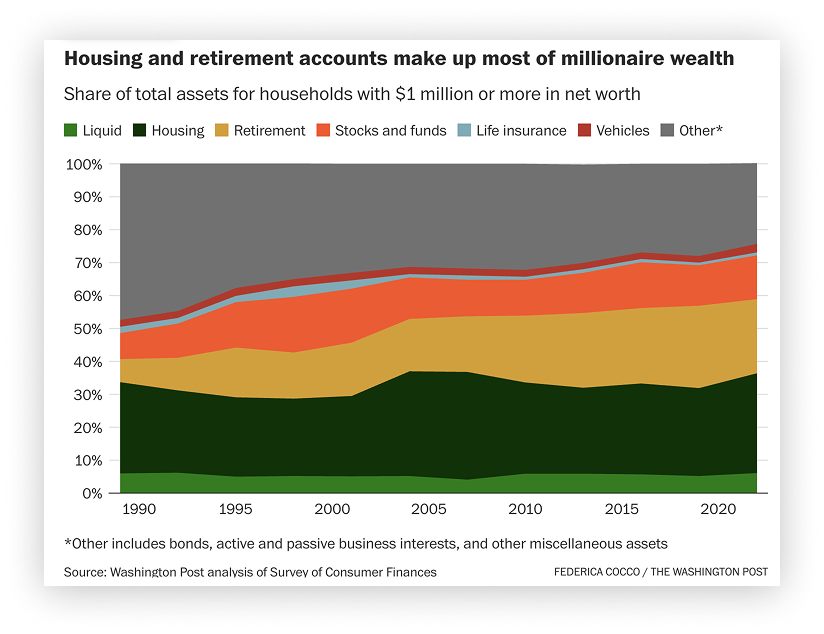
One in six American families is worth at least $1 million, per new Federal Reserve data. Today, a million dollars is worth approximately $480,000 in 1996 dollars, the year The Millionaire Next Door was published. I’d love for someone to rerun that analysis—is simply avoiding conspicuous consumption enough to make you rich?—with the modern labor market, housing prices, and education and medical debt load, and see if it holds up. I have a feeling the results would be very different. (Washington Post)
So thankful for reporting like this that assures me I don’t need to waste any time researching which peptides I should buy to feel good.5 Still, this piece raises genuinely interesting questions about agency and bodily autonomy. (The New Yorker)
Citrini Research, the firm that caused a $200 billion market meltdown after publishing a particularly harrowing AI doomsday scenario, decided to get their own boots on the ground in Iran. Incredibly, they dispatched an analyst to the Strait of Hormuz to “chat up tanker captains, ship crews, maritime brokers, local fishermen and smugglers, and business executives.” This sort of thing probably happens more than you’d expect, but sending a Wall Street suit into a war zone to gather intel for trading purposes is outrageous. (One number tossed out was that a 20% drawdown, or a “fall four times bigger than what we have already seen,” had not yet been priced in.) (Intelligencer)
Robinhood—the “gamified investing” app of yore—was tapped as the brokerage firm partner for the forthcoming “Trump Accounts.” This choice is poetry. (Robinhood News)
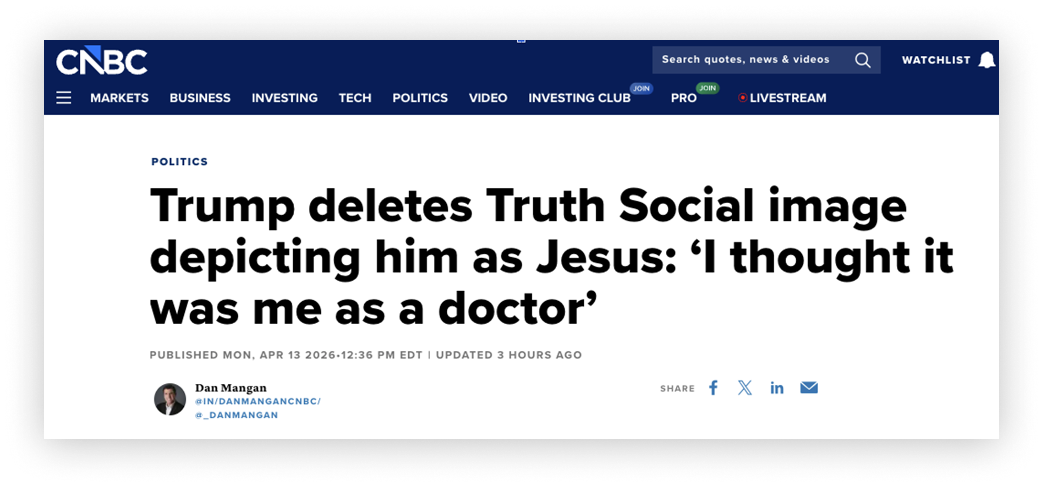
Last but not least, a real CNBC headline that positively tickled me. Let he who hath not made the classic Jesus-or-medical-professional mixup cast the first stone.
Money with Katie is a promoter of Domain, a real client, and receives compensation in connection with sponsorship of this newsletter. This compensation creates a conflict of interest because it may influence the content presented, including the featuring of Domain Money or its advisors. The views expressed by the promoter are their own and do not necessarily reflect the views of Domain Money. This communication is for informational purposes only and should not be construed as a recommendation, offer, or solicitation for the purchase or sale of any security. All financial planning and investment strategies should be tailored to the unique circumstances and objectives of each client.
(chilling in a different way)
In Mary Shelley’s Frankenstein: The Modern Prometheus, “Prometheus” represents a cautionary tale about the monsters that result from human overreach.
Not the Capital One Café
Another woman who seems unconvinced she must either select one last name or hyphenate, and for that, I salute her in solidarity.
More Celsius it is.
The blue collar folks don't get to escape the AI-related-dissonance. I live in rural Wisconsin and we have data centers popping up all over. My husband runs a department with a mechanical contractor but he is still an active union guy -- he sees the jobs/contracts come through and the amount of work (and $$) up for grabs is staggering. Thus, our labor unions are incentivized to support these projects. The dissonance comes because we are learning more and more about the risk of these data centers & their deleterious impact on the environment: noise/light pollution, using our natural resources, the increased energy costs, etc. -- and they are being built right in our own backyards. The same laborers who build these data centers are going to see increases in their energy bills, dried up wells, and hear the constant low "hum" being emitted from the compound if you live close enough. The dissonance deepens when you realize that the union pensions are reliant on a market that is increasingly propped up by these AI companies lending & borrowing from each other.
Oh, boy. This post resonated with me as a former tech employee who lived in Austin and quit her job in January due to severe burnout, among other reasons. My old company then laid off 10% of the global workforce in March and blamed it on AI—the same tools we had all worked ourselves into the ground building.
Unfortunately I think you’re right about the source of your friend’s illness. It’s taken me months to feel safe in my own body again but I’m finally well. Wishing her the best.