


💡 Today’s issue was brought to you by Betterment, the investing platform that can help you maximize potential after-tax returns and minimize risk, tax impact, and busywork. Betterment builds your portfolio around your goals. Let Betterment’s automated rebalancing and tax-loss harvesting get to work for you today.
Paid client. Views may not be representative. See App Store & Google Play reviews. Investing involves risk. Performance not guaranteed. Learn more. Betterment does not provide tax advice. TLH is not suitable for all investors. Learn more.

I accidentally wasted a week trying to understand the mysterious past of a popular business guru. It started as a reacquaintance with a longtime curiosity, then morphed into a much broader odyssey—one that began to feel like a timely encapsulation of how fact and fiction get blurred in the blustery world of entrepreneurship and personal branding, so much so that fiction can become fact.
If you’ve ever been sucked into the vortex of a “making money” guru and emerged feeling bewildered and behind, my vision is that you’ll save this deep dive for your next after-work cocktail. It’s long, so you might need to open the web version to read the whole thing.
Once upon a time, in a land far, far away called 2022, I went for a walk with my dog and slipped down a rabbit hole. It was cold outside—early December—and we were exploring an overgrown trail system in town. As we crunched through a frozen field, I noticed an episode of a show called Young & Profiting in the “You Might Like” section of my podcasts app with an alluring title: “From Soul-Sucking Job to $100 Million in Revenue.” Why not? I pressed play.
I had spent much of the year growing more fascinated by the mystical, you-can-do-it-too “business-building” videos that had metastasized across my feeds in response to my predictable engagement with investing content. The niche unspooled a generous array of opportunities before me: a laundromat, a car wash, an Airbnb, a mobile dog groomer, a lemonade stand. Acquire. Add Value. Scale. Profit. Repeat until you have a portfolio of businesses. This was the future, they said, the only way to build diversified wealth. I was, to put it lightly, overwhelmed by the complexity, a feeling compounded by how simple they made it sound. The only “next step” about which I ever felt confident was consuming more of the content. So there I was, consuming more.
The episode featured an interview with a man named Alex Hormozi. After a few minutes, I tugged my phone from my pocket again and Googled him with numb, pink thumbs, gloves dangling from my teeth. This man was known, Google told me, for building an “empire” with his wife Leila via a “holdco,” or holding company, called “Acquisition.com.”
Satisfied with this answer, I kept listening for more details. With just three minutes to go, Hormozi finally told the host that they have “16 companies in the portfolio,” three of which “added over $100 million a year.” It was not clear to me where these hundreds of millions of dollars came from. I chalked up my inability to understand to ignorance.
Back then, the world seemed to be splitting jaggedly into two camps: people who understood how to generate vast fortunes through Adding Value and taking advantage of the lawless wasteland of early pandemic opportunity, and people who didn’t. Hormozi, like his compatriots, seemed to be moving too fast to pin down. The deeper I burrowed into the business guru universe, the more convinced I became that whatever I was missing would only redound to my financial detriment. Ah, well.
During the years that followed, Hormozi transformed into the brightest star in the grindset cosmos—a true juggernaut, his mass attracting more than 10 million followers across platforms—and I pursued my genuine interests, becoming a person with subscriptions to obscure literary magazines and favorite cultural critics. I mostly stopped paying attention to him and his portfolio of hundred-million-dollar businesses.

Then, last weekend, I joined the herd of sheep trotting to theaters to see Nathan Fielder and Lance Oppenheim’s1 new documentary You Can See Everything, about disgraced founder and fraudster Elizabeth Holmes. The movie is a fever dream, a character study unsure what to make of its principal subject, a saucer-eyed blonde in an ochre-colored cardigan who claims to not understand why she is going to prison.
A key fixation of Fielder’s is what Holmes means when she says her Edison machine “can” run the tests the company claimed it could. She insists she has been misunderstood: The machine is technically capable of doing so, provided the correct “chemistries” are developed. (Fielder doesn’t ask about the secret labs that were used to fabricate test results.) Considering only the facts on display within the film’s sprawling three-hour runtime, one can almost understand the calculus behind such deception: If you misrepresent or exaggerate something long enough, you might be able to buy the runway to pull it off, thereby making it true.
Viewers were quick to point out the irony that Holmes agreed to be profiled by an entertainer who got his big break on Nathan for You, a Comedy Central show about elaborate business scams, where a deadpan Fielder “helps struggling small business owners” by offering outlandish advice designed to squeeze through loophole-sized cracks.2
Part of the genius of Nathan for You was the way it satirized entrepreneurship, depicting it not as a glamorous, Apprentice-like battle for greatness, but as a bumbling grind. Most of his “coaching” consists of either deceiving customers or skirting the law. Although the series ended in 2017, the critique feels even more relevant today: As the prospects for “traditional” career paths look tenuous and uncertain in AI’s shadow, a cottage industry of self-styled success moguls has exploded by offering an alternative path to what is callously referred to, in these circles, as “wage slavery.”
The screening brought me back, all these years later, to the Hormozis, and the broader online universe they inhabit.
The Hormozi mythology is a loose constellation of eye-popping claims that are mostly unburdened by citations. “$100 million” is thrown around with abandon and duly repeated elsewhere. Depending on the interview, their portfolio company Acquisition.com is “on its way to $1B,” or, alternately, a “$250 million portfolio.” They have “scaled and exited” seven companies. They are “entrepreneurs,” “investors,” “founders,” the holy trinity of American Grindset.
The recommendation engine of my YouTube account is hopelessly scrambled from years of researching right-wing media figures between makeup videos and interviews with socialist philosophers, so I reentered the fray of Hustle Bro content this week in the way I often do: enjoying a carnival ride around the suggested video carousel.
Hardest to parse in this irradiated “how to make money” landscape is the precise legitimacy-to-scam ratio. It all has the metallic aftertaste of artificial sweetener, but what feels undeniably real is the sense that one is missing out on some sort of secret about how to thrive in a modern economy. The skeptical viewer knows it’s unlikely there’s a free lunch left unattended on the metaphoric conference table of capitalism, and yet taken together, all the jargon and posturing suggests there must be some “there” there. Curiosity beckons. How could it not, considering?
Not long after I began tumbling down the algorithmic tube slide of business grift, I began getting served Leila Hormozi videos. I started watching.
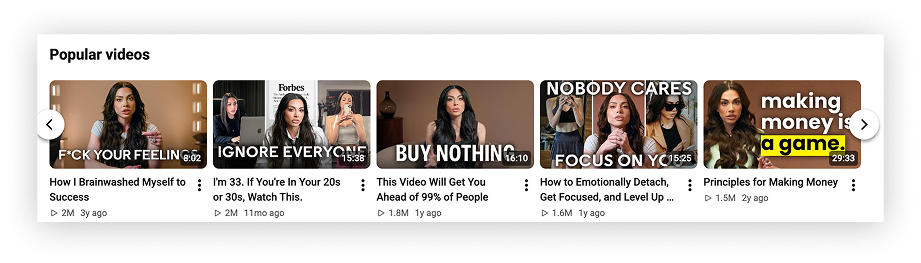
At thumbnail size, Leila resembles a long-lost Kardashian sister, a visual effect enhanced by the SKIMS-toned backgrounds and Forbes screenshots. A video pumped out of the Hormozi universe (hereafter “Hormoziverse”) follows a playbook: It is aggressive, serious, focused, fast-paced. Nine-figure numbers are routinely mentioned as proof of expertise, creating a dizzying haze of legitimacy. She instructs me to:
Brainwash Myself to Success, because
Making Money is a Game. If I can
Emotionally Detach and
Get Focused, I can
Level Up and Get Ahead of
99% of People
which is slam poetry I wrote using text from her most popular videos.
The gruff aesthetics of masculine optimization in Alex’s half of the Hormoziverse are clearly intended to appeal to the aspiring Cybertruck class. His body composition is 78% trapezius and 22% beard, the kind of man who looks like he’d live in Austin and run an Instagram account about stoicism called RETVRN that posts misattributed quotes about the coming downfall of The West.
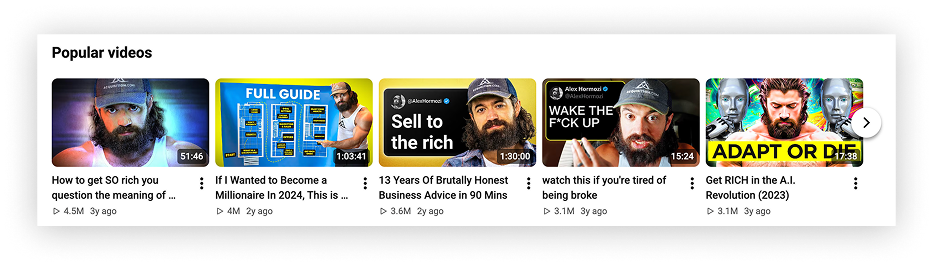
The couple has two podcasts, one that promises to unveil “the many failures and lessons Alex has learned on his path from $100M to $1B in net worth,” and the other, hosted by Leila, which describes the way she “crossed $100M by the age of 28,” and focuses on “the lessons [she’s] learned in scaling big businesses and helping [their] portfolio companies do the same.” Standard stuff.
Alex Hormozi speaks naturally in the language of investment management. I was prepared to mine a deep vein of platitude-rich pyrite when I started digging through the channel archives, but was surprised to find that the advice seemed legitimate, even smart. In one, a business owner calls in and lays out his problem (I can’t quit my full-time job because my mortgage is equivalent to my salary but my business is stuck) and Hormozi, rather adeptly, zeroes in on a tweak to his marketing strategy. In another, he advises the owner of a cleaning company that her real opportunity is lowering her training costs.
If you waterboard yourself with dozens of these clips, as I did, you’ll notice a pattern: Many feature business owners who don’t seem to understand their problem well enough to start looking for a solution, and Hormozi redirects them with the tough love of a stern but fair father figure. I found it hard not to like him, if “liking” comes down to feeling that someone seems competent and in-command.
For years, Hormozi described Acquisition.com—headquartered, appropriately, in Las Vegas—as “a family office,” a phrase which suggests ultra-high-net-worth wealth management. Sometimes, he called it “a holding company,” or “holdco.” (It was the latter definition I first encountered on that cold December day in 2022, around the time he started breaking through as a guest on popular business podcasts, describing Acquisition.com’s $100 million “portfolio companies.”) The model, as he explained in another interview, is using his content to attract business owners whose companies he and Leila can invest in. “We get a lot of companies every day that reach out to us that are looking for investors to either buy a minority or majority stake in the company to help them scale, which is very much what we do,” he says. “So, we are active in our portfolios, so our—I mean, that’s where we make our money, is actively growing the companies themselves and bringing in great people to help scale the business.”
He’s describing a sort of private equity model, but without the debt: Invest in the company, bring in your people, apply your proprietary Business Knowledge, scale it up, profit. His social media is, in this telling, merely an elaborate brand-building exercise for this process. He lays it all out in a 2021 video called “This is my plan to become a BILLIONAIRE,” rattling off the same statistics (sold seven companies, six additional companies in his “holdco,” and the goal to find more businesses to invest in). His enthusiasm is infectious; he can barely sit still in his chair. Just four months ago, his official Reddit page hosted an “ask me anything” that would imply he’s progressing toward his 2021 goal: In a vertical-video dispatch in which he’s speaking so quickly he appears to inhale three times total, he describes Acquisition.com as a “portfolio of companies” that “does over $250 million per year.”
I found it strange that it was almost impossible to find anything online verifying these companies or deals—nearly all of which go conspicuously unnamed—that didn’t come from Hormozi himself. He seemed to appear fully formed, as if by parthenogenesis, as a prolific businessman. Considering the enormity of the Hormoziverse footprint, there’s very little in the way of coverage of their nine-figure business (businesses?) in traditional media, trade publications, or business news wires, and what exists in the blogosphere is typically produced by people who are trying to capitalize on the suspicion (“Is Alex Hormozi legit or just another guru?”) to sell their own schemes.
The blog-posts-slash-sales-material kept assuring me that this was no ordinary guru operation. It didn’t sell expensive programming to aspiring entrepreneurs; there are “no courses, no masterminds, no $5,000 program.” One explained that the business model is “fundamentally different from the typical guru model” because he operates a “holding company” where he and his team exchange their operational brilliance and marketing know-how for equity, echoing the description Hormozi gave in the many videos and interviews I watched. “Instead of selling courses to beginners,” this blog notes, “Hormozi is investing his money and his team’s time into businesses that already have product-market fit.”
But in my attempts to understand more about the fundamentals of Acquisition.com, I noticed that each fan’s blog post seemed to describe a slightly different business, like they were just as confused as I was. In one now-archived, ChatGPT-inflected post (“Here’s what most people miss”) written by a digital marketer, you get the sense that even those who admire him feel a little uncomfortable with his methods. The offer which prompted the blog post was the rollout of Hormozi’s latest book in his “$100M” series—the third, by my count, not including the workbooks—called $100 Million Money Models. Here’s how the online marketer describes the launch, with wincing admiration:
“The offer that he made was a bold one. Remember, he was selling his new book, but packed it and positioned it in such a way that when purchasing you get 12 physical playbooks, a live virtual workshop, lifetime access to an AI tool with all of his knowledge baked in, 1 copy of the hardback book, and then 199 extra copies to share with other entrepreneurs. The price—$5,998.”
Hormozi says the book generated $106 million in sales in 72 hours.
So, I wondered, is his business primarily investing in other businesses, as he indicated in the interviews that introduced me to him and grew his status as Business God over the years? Or is his primary business selling advice to other businesses, and gathering customers for the latter by relying on the credibility generated by belief in the former? By this point in my search, it had grown dark outside my office window. I felt disoriented.
For all the descriptions of the Hormoziverse that insisted it definitely doesn’t have a $5,000 program to sell you, a $5,000 workshop was the first, and nearly only, thing the website tried to sell me. The primary call to action—I’M READY TO SCALE—is to sign up for a “2-day interactive workshop” that promises to deliver “actionable insights.” I kept pingponging between the blog posts, which hailed Hormozi as The Real Deal With Nothing To Sell, and the site itself. Every time, the primary flow delivered me to “apply” for a sales call about the $5,000 workshop.
This development seemed strange. So much of the knowledge I had absorbed by osmosis from (and about) Hormozi seemed to contradict what the website appeared set up to do.
Maybe, I reasoned, the workshop business is new. According to the web archive, Acquisition.com came online in June 2021 with a straightforward message: “Do you want more customers? Hey, I’m Alex. I’m determined to find businesses to help. My only question is, will it be yours?” In the short biography that follows, we learn that Alex and Leila “now spend their time investing in founder-led service-based businesses to help them scale & multiply profits.” The logo, I noted, was a purple pyramid.
Around four months later, the archive shows the message had changed, now stating its purpose as investing in “$3M–$50M/year companies.” By December, they were iterating again: “I’m determined to invest $100,000,000 of my personal wealth to help one hundred $3M per year to $50M per year service-based businesses triple profits over the next five years.” It continues to evolve over the following months, swapping out details and modifying the description.
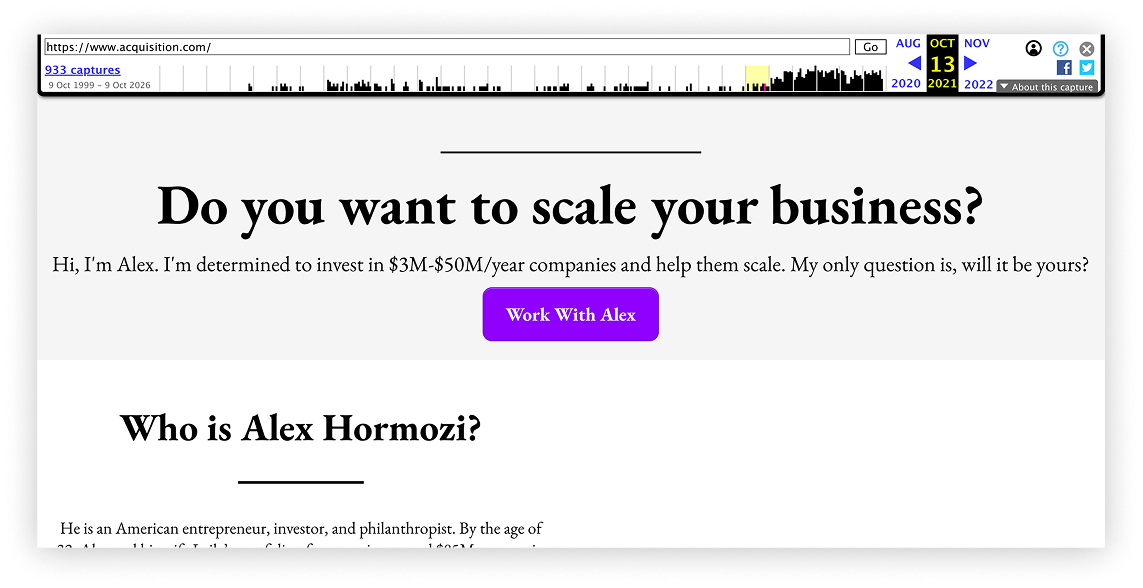
This frenetic morphing of stated intent can be read a few ways. In the charitable view, it looks like iterating to see what attracts the search engines, and rapidly refining the business’s purpose based on what generates interest. In a harsher light, it looks more like a fossil record of a spaghetti-covered wall, a fantasist’s blueprint.
Either way, watching this amateur website undergo monthly copy changes was strangely humanizing. This was not the Business God who now floods the zone with hundreds of pieces of professional media touting his dominant expertise every week, but a man with a 2007-themed WordPress account trying to figure out what his business even was. I found this apparent flailing relatable, even sympathetic.
In August of 2022, the purported purpose of the business becomes something that finally sticks: “I’m looking to invest in one great business per month,” under the headline “Do you want to scale your business?”, which is how it looked when I began seeing him crop up on the podcast circuit. This is how it remained for most of 2023, until the final major pivot in January 2024, when that message was replaced with three options:
I want to sell my business.
I want to scale my business.
I want to start my business.
Before I could choose one, a site popup invited me to apply for a workshop.
Information about the workshop is not easy to come by. I found public reviews (“I paid Alex & Leila Hormozi $5,000 for 2 days of learning and then another $35,000 to keep learning”) that said it was “very much so” worth it, and anonymous Reddit posts (“something’s not adding up”) that concluded it wasn’t. Both noted their workshop had around 100 attendees, each paying $5,000. The event occurs several times per month. (I tried reaching out to four different Redditors who claimed they felt deceived by the workshop, but haven’t heard back from any of them.)
One anonymous user describes becoming suspicious during the event, which is pitched as an opportunity to learn from the Acquisition.com “directors,” who they believed had been hired to advise the portfolio companies:
“Later in the workshop, Alex mentioned they’ve actually wound down most of their acquisitions. That raised even more questions. If they’ve significantly reduced their portfolio, who exactly are all these “advisors” supporting?
The answer became clearer during the upsell portion. We were pitched coaching programs priced at $35K and $100K. I’d estimate at least 30–40% of the room purchased. That’s tens of millions in coaching revenue on top of the workshops.
What’s missing from all this? Any mention of this coaching business in their content. I’ve listened to countless hours of Alex and Leila’s podcasts and interviews. Not once have they clearly stated that Acquisition.com is now, at its core, a coaching company. They continue to talk about helping “portfolio companies,” but never name them (except for Skool).”
After returning home from Vegas, the skeptical attendee describes looking for job postings for Acquisition.com “advisor” roles and noticing the job descriptions—Director of Marketing, Advisory Practice and Director, Business Strategy, Advisory Practice—pertain in their entirety to leading workshops.
There’s nothing illegal or fraudulent about selling business workshops—workshops are not a pyramid scheme—but it seems relevant that the Premium Hormozi Brand sprang forth and multiplied according to the belief that they were managing a nine-figure portfolio of businesses across industries, not just a business that teaches other people how to build businesses.
In an interview with Logan Paul posted this month, Alex revisits his “original thesis” for Acquisition.com: that the content would attract business owners with whom he could do “10, 20% minority deals,” which “ended up sucking.” He tells Paul he did “24 deals in 24 months,” but then “got rid of almost all of them.”
All roads in the Hormoziverse lead back to Gym Launch, the original success on which Hormoziology relies, a business that, as Alex tells it, licensed his Facebook ads strategy to struggling gym owners.
This was the Hormozi duo’s first big success—and the only one I could find any external record for—a business they claim to have sold 66% of at a $46 million valuation in 2021, combined with a supplement line called “Prestige Labs.” (The Businesswire news release confirms that the sale occurred, but does not include these figures or any financial details.)
I was curious what licensing a Facebook ads strategy looked like in practice. To sidestep the Mount Everest of content they’ve generated about Gym Launch in the intervening years, I restricted my results to 2019 or earlier, which turned up a transcript to a 2018 podcast interview with Leila (the audio appears to have been taken down) that paints a picture of something other than a straightforward Facebook ads service. In it, she describes what sounds more like a coaching business:
INTERVIEWER: You’ve created a mastermind group or a group of gym owners are part of your tribe or is it a coaching community?
LEILA: We like to call it a mentorship program. Our first level is our product, Gym Launch, which is literally generating the leads, selling the leads, retaining the leads and reselling the leads which are now customers.
Our second tier is Gym Legacy and that’s what a lot of our marketing and branding out there is. Gym Lords is what they call themselves. We have 427 people in that one and that is our mentorship program.
She tells the interviewer that Gym Legacy—or “Gym Lords”—is a mentorship program that costs $799 per week for three years, which, with 427 members, amounts to $53 million in contracted revenue. A 2019 archive of the site describes Gym Launch as an “award-winning program” that one can join as a “member” to get “tools and knowledge.”
There was just one other business listed by name in the capacious Hormoziverse backstory, an operation he’s described as a “software company” called A.L.A.N. that they “scaled to $1.7 million per month in revenue” and then sold to a private buyer. My initial search for substantiation turned up nothing more than an old Facebook page with 1,200 followers linking to usealan.com, which had long ago 404ed. I figured it was a dead end.
But the revelation that Gym Launch also appeared to be either partially or fully a coaching membership program reignited my interest, and fortunately, the web archive preserved the bones of the A.L.A.N. site. A plain-text rendering of the November 2020 homepage describes A.L.A.N. as a “SaaS solution,” then invites the user to “APPLY NOW!” Signing up, it says, means getting things like “access to a community that’s generated over $1 billion in sales” and “daily coaching for your teams.”
I clicked “APPLY NOW!” to see if I could get a sense for what, exactly, I was applying for (“apply” is a strange call to action for B2B SaaS), and was met with a questionnaire that asked me how soon I’d be able to start “if accepted into the program”:
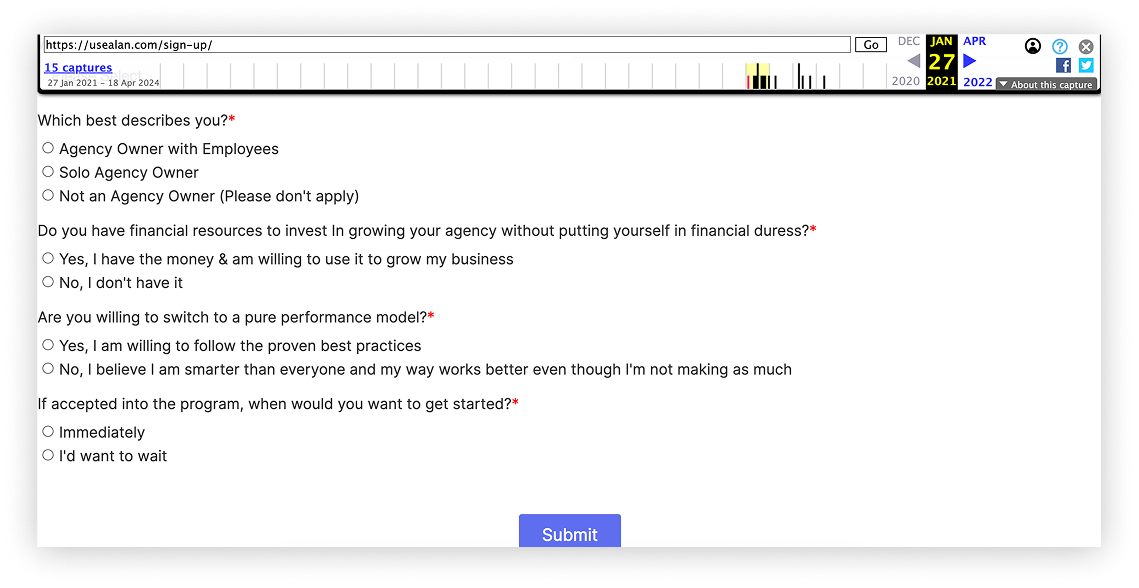
The confusion and shame I harbored in 2022 about my inability to understand, let alone build, a “holdco,” had, by 2026, neutralized into a distant, bemused fascination with the mushrooming world of entrepreneurship content. But by the time I was reading the multiple choice answer, “No, I believe I am smarter than everyone and my way works better even though I’m not making as much,” it had crystallized into a begrudging, clarifying respect: It would appear the Hormozis have been running (and scaling) the same play—a coaching business—since 2018. And who can blame them? It keeps working.
By this point, my emotions had splintered. I suspected that the portfolio company he began describing on podcasts in 2022 could have been a reference to his own collection of coaching businesses, deployed to build hype for what would become yet another coaching business. After everything I’d seen, it seemed implausible that Acquisition.com was ever primarily engaged in or earning millions of dollars from its investment in unrelated businesses.
Then, about a week into my spelunking—I had begun having dreams about the Hormozis—I found a six-month-old video where he, unbelievably, describes the Acquisition.com business plan as almost the precise reverse of what he had explained over the years in the interviews that raised his profile as a business guru with a nine-figure portfolio company.
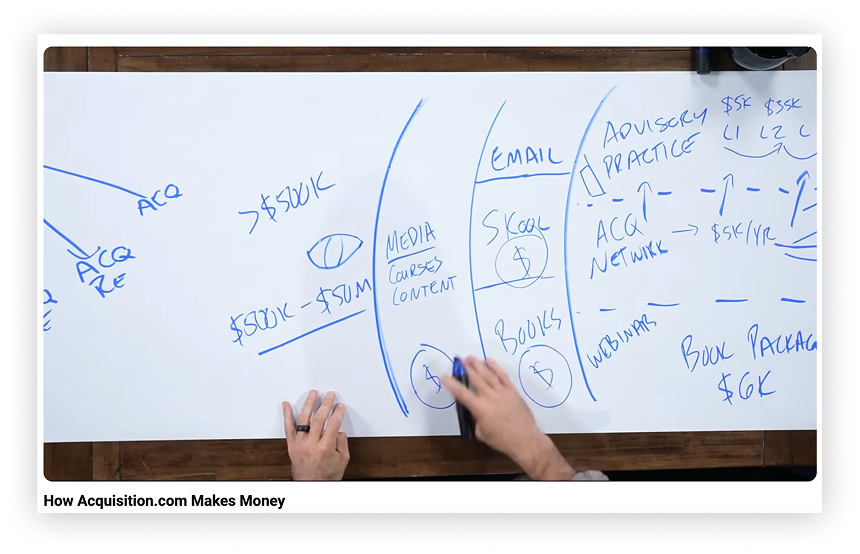
He walks through the first layer, the media arm, that feeds a books-and-courses business, which in turn upsells people to a stable of workshops priced at $5,000, $35,000, and $135,000, which, finally, generates revenue that will—critically, he describes these as future plans—“be deployed” into one of the “various buckets,” one of which is the new “ACQ Ventures” portfolio of companies.
It occurred to me, watching this video about How Acquisition.com Makes Money, that whatever I had stumbled upon had officially reached escape velocity from the strictures of reality. His reputation (seven exits! $250 million portfolio! SCALE!) has been solidified to the point that he is now free to candidly describe how the business actually generates revenue.
I wondered if, when he described his business four years ago on that cold December day, he was pitching a future state vision: This holding company can be worth $100 million, assuming you people come to the workshops.
Toward the end of You Can See Everything, Amanda Seyfried asks Fielder whether he might be covering for “Liz,” because he’s grown fond of her through spending so much time with her. The audience isn’t sure what to make of this exchange, and interpretations have varied widely since the film premiered. In an interview with Wired, Fielder says he’s not even sure what to make of the experience he had profiling Elizabeth Holmes.
That’s a little how I feel after spending the last week in the Hormoziverse. After all, the couple has a legion of devoted fans. Even some of the anonymous workshop attendees on Reddit claim to have gotten their money’s worth. The advice, by my own admission, is often solid, practical, specific. The weirdest discovery, then, is that while I couldn’t substantiate almost any of the claims to his rapid, expansive moguldom (16 companies? Seven? 10? 24?), he’s actually good at teaching—and good at getting people to pay him for it. He has, through moxie and on-camera charisma, appeared to have created multiple million-dollar coaching businesses.
In fields like tech and finance, the line between conjuring a vision compelling enough to generate attention and investment, and outright deception, is disconcertingly thin. There is no more extreme example of this tendency than Elon Musk, who has become the richest man on earth despite—because of?—the fact that he “simply can’t stop making shit up,” per Rolling Stone. He has “exaggerated,” “overpromised,” “misrepresented,” “evaded,” “fabricated,” and yes, lied his way to hundreds of billions of dollars.
And I, despite my extended tour of this vast continent of commerce, am still just a person with a culture and politics podcast and favorite New Yorker staff writers. I do not have An Empire, I do not know how to 10X Profit, and I have never Used Leverage to Scale 24 businesses across Multiple Industries. I feel no more convinced after the last week that the Hormozis have, either, but lucky for them, it doesn’t look like that matters.
The top comment on the breakdown of how Acquisition.com makes money: “Very few people are this transparent in business.”
Thanks for reading.
Did you know Lance Oppenheim is 30 years old? He’s 30 years old. Ugh.
In one episode, he advises a coffee chain to rebrand as “Dumb Starbucks” to skirt trademark infringement through parody. Another features a sports bar that gets around an indoor smoking ban using an obscure “theater law” that allows smoking indoors if it’s part of a play (he installs a velvet curtain and theater seats in the corner so an “audience” can “watch”). You can almost imagine this version of Fielder advising Holmes that it’s not technically lying to say the machine can run the tests.
I’ve worked in the coaching industry for over a decade, both as a coach and in education and all I can say is THESE PEOPLE ARE LIARS. the most successful coaches I know are waaaaay too busy to spend hours each week pumping out content like this. They don’t have hours for podcast, social media content, etc. They have actual clients they are working with, teams they are developing. Many of them are also teaching in a methodology they have trained in.
There is the coaching industry and the coaching grift industry, and they are two different things. Sometimes I feel so perplexed as to why the grifters aren’t more obvious to people.
What a read! This sentence TOOK ME OUT: "the kind of man who looks like he’d live in Austin and run an Instagram account about stoicism called RETVRN that posts misattributed quotes about the coming downfall of The West"