


The technology gods recently forced me to subject all of you poor, unsuspecting readers to the humiliation ritual of email migration, which is a fancy way of saying I needed to ensure my missives aren’t punted into the ether by the spam detectors that guard your inboxes. This involved the eminently reasonable quid pro quo of asking some portion of you to reply and ask a money question. Responses are still rolling in, but it was fascinating to spend the long weekend reading them.
Normally my verbosity limits my ability to do things like this (see also: she has not one but two podcasts), but today I’m committed to a rapid-fire approach that I think will cover a lot of ground. The standard disclaimer applies: I’m not a financial professional nor an advisor nor an expert nor anyone else who has literally any right to tell you what to do with your money, just a person who reads a lot and suffers from early-onset internalized capitalism. That said, from where I’m sitting, any professional who tells you they know definitively what’s going to happen next is also probably full of shit!
A lot of these questions are about managing surplus, which underscores a common complaint about personal finance as a field: It’s an information goldmine if you have some money; it’s virtually useless if you don’t. (This is why Rich Girl Nation jumps almost immediately into strategies for earning more.)
Questions are divided into three categories:
The economic climate
Financial psychology and behavior
Big money decisions
QUESTIONS ABOUT THE ECONOMIC CLIMATE
Q: Is the stock market overvalued and are we in an AI/data center bubble?
A: Probably.
The hard thing about acting on this information comes down to an investing truism: The market can stay irrational longer than you can stay solvent. You can be right that it’s overvalued and right about why, but unless you know when the correction is coming, acting on those instincts is inherently a gamble.
I started worrying about the market being overvalued after the pandemic when it seemed painfully obvious that it was disconnected from our economic reality. Here we are six years later. Had I been waiting for a meaningful value “correction” all this time, I would’ve missed a cumulative 80% return.
A correction will come eventually—that’s for certain—we just don’t know when or how long it’ll last. After 2008, it took four years for the market to recover and “break even” again. After the dotcom bubble burst, it took seven. Those who “held on” would’ve eventually seen their losses restored and their patience rewarded, but there were many logically sound reasons at the time to feel like it was never going to rebound.
I have a less rosy view on the infallibility of investing than most financial writers for two reasons:
It’s obvious that the high returns of the last century were specific to America’s imperial ascendance on a global stage and, to a more specific degree, the USD’s status as the global reserve currency, which created an infinite money glitch for the US government. (“America isn’t a country, it’s a corporation with a military,” as the girlies say.)
Even with all that going for us, retiring during an active and prolonged crash can meaningfully impact your outcomes.
Despite all this, the reason I stay invested (and continue to invest more) is because, to my mind, it’s the best bad option. The alternatives (sitting in cash that’s eroded by inflation; investing instead in hard assets with even more uncertain track records) continue to look less appealing to me. Not everyone comes to that conclusion, but it’s still the risk I’m most willing to take.
There’s a perverse comfort I derive from thinking about how the interests of my retirement accounts are mostly aligned with those of the capital class that puppeteers our lawmakers. Many of the ways “the system” is bad (wage suppression, rent-seeking, profit maximization, etc.) redound to the benefit of “the shareholder.” In the context of your retirement accounts, you’re a shareholder, too.
Hopefully it goes without saying I’d prefer it were not set up this way, but buying your way into the shareholder class with your excess wages is, to my mind, still the best downside protection out there.
Similar question, but with a different approach to the answer: If we all have the same investment advice (invest in mutual funds, etc., and don’t panic; ride out any economic drama), wouldn’t that mean valuations are warped and not reflective of reality? Might this backfire? Are we all going to regret these investment decisions decades down the line?
A: Totally possible.
Michael Green is probably the most relevant critic to cite on this subject. This story in Harper’s about his philosophy is an all-timer.
TL;DR: A bunch of non-price-sensitive investors buy into the market every week with their retirement fund contributions and it has totally fucked with the “price signal.” To oversimplify his theory, the market has become a bit of a pyramid scheme.
The problem, as he sees it, is demographic. The retiring Baby Boomer generation owns most of the market and is pulling money out rather than putting more in. At the same time, younger generations are (a) having a harder getting and staying employed and (b) finding it more difficult to invest once they do. This creates a scenario where you have a bunch of cash flowing out with less flowing in to replace it, and in Green’s telling, this will eventually create an unwinding of the entire thing unless the government steps in.
On one hand, I think his theory makes a lot of sense, and it satisfies my hunch that the whole “something for nothing” logic of the market might ultimately prove unsustainable when the demographics stop working in its favor. On the other hand, there’s basically nothing anyone can do about this problem (a fact Green concedes), and there’s a macabre version of this reality where its implosion is what makes a different and better system possible.
Reading about Green’s theory hasn’t changed my own saving and investing strategy, but it’s definitely made it easier to indulge in the “here and now” and use money for things other than “having more money later”—health, home, time, etc.
Q: It feels like the main reason we are not in a true recession is consumer resiliency. It’s sad—like the government and corporations are seeing how far they can push consumers to just keep quiet and suck it up while we get poorer!
A: I’ll “yes, and” this with a note about abundant consumer credit (Klarna, Afterpay, etc.)—I think we’d live in a radically different economy if access to credit disappeared tomorrow. That would be a catastrophic lever to flip, but credit also seems like a convenient way to keep people on the hamster wheel: Make things unaffordable then financialize the unaffordability.
Q: Given the new Fed Chair appointment, is it better to start investing small installments of my investable savings now, or after the market has had time to settle with the change?
A: Everyone pour one out for the new Fed Chair Kevin Warsh, the man who just discovered your dream job can be a nightmare. This is ultimately a question about market timing, which could be applicable to all manner of current events. Should I wait until we know what’s going to happen…
in this war?
with AI?
whether rates are going up again?
…etc. It’s tempting to assume there will be some point of stasis in the future where the surface of the water will be visibly and obviously calm enough to dip your toe, but the economy is a wave pool, even if the source of those waves is always changing.
Assuming you’re talking about long-term investing, research shows that investing cash as soon as you have it is a better strategy than waiting for what feels like the “right” time, because the market spends more time “up” than “down.” Whenever I have investable cash, I put it all to work right away.
Q: I can afford to contribute to my retirement accounts but I’m having decision paralysis because there doesn’t seem to be any real way to be an ethical investor, but I still get stressed at the tension between opting out of the system and possibly screwing myself and my kids over.
A: This is ultimately a moral and spiritual tension more than a financial one, and it’s one I continue to grapple with (more on that below), but per my previous answers, I ultimately come down on engaging with the “best bad option” and “using your wage income to become a shareholder so you can benefit from the economy that your work makes valuable.”
Q: Given the recent downgrade of the “USA brand” globally, are you diversifying away from the American stock market into other markets or other types of investments? I’m nervous that a different strategy will be needed going forward to maintain 7–9% average real returns.
AND
Q: What is the appropriate amount of diversification? What ETFs accomplish that?
A: I’ve felt uncomfortable with 100% US exposure for a long time. Right now, my primary split is 70% VTI, 30% VXUS, the latter of which is an ETF that invests in the “total world stock market” except the US.
If an expert were here they’d probably tell us that international diversification is less effective than it once was since a globalized economy is so interconnected, but it makes me feel less exposed to our star-spangled instability.

My “work-optional” investment strategy relies heavily on investing in two different accounts: The 401(k) (or similar; an account that offers the option for pretax contributions) and the taxable investing account. If your employer offers a retirement plan, you’re probably covered on the first front just by the nature of being employed—but the taxable investing account is something you have to seek out on your own.
Investing in a taxable account is critical to enabling an earlier-than-59.5 retirement (so critical, in fact, that I wrote this entire post explaining why I think the taxable account could go toe-to-toe with the Roth IRA on some fronts—more on that momentarily).
If you want to get started in minutes with an automated investing account guided by Betterment’s team of investing experts who help prioritize maximizing your potential returns and minimizing taxes, you’ll also get:
Guidance on the tax impact of any withdrawals you make—don’t let the name “taxable” scare you
A properly diversified portfolio of index ETFs suited to your risk tolerance and timeline
Automatic rebalancing, reinvestment of dividends, and tax-loss harvesting
And of course, no limits on contributions, withdrawals, or income
So back to why I think the taxable investing account is so underrated and necessary, here’s the bottom line upfront: It comes down to the upper bounds of the 0% long-term capital gains tax bracket, which—for most people—can be high enough to cover all their spending in retirement. If you’re curious, check out this deep dive.
Get started with your automated, taxable investing account in minutes with Betterment.
Paid client. Views may not be representative. See App Store & Google Play reviews. Learn more.
QUESTIONS ABOUT FINANCIAL BEHAVIOR
Q: What are your thoughts on living off investment income as an early retiree, with no Social Security (yet), pension, or vast fortune, but just “the millionaire next door”?
A: It seems to me the statistically most likely risks are twofold, and neither is “cataclysmic market meltdown”:
Lifestyle inflation; probably not an issue if you’ve invested enough to retire early.
Boredom and lack of purpose; can be a real impediment for the personality type that’s interested in and capable of retiring early.
If you’ve got those two bases covered (and health insurance; I’m surprised that wasn’t mentioned), let it rip.
Q: Any tips for navigating the uncomfortable, rudderless sensation one feels after hitting financial independence and leaving their 9–5?
A: I know this feeling isn’t universal, but it seems more common than its opposite.
Some freedom can be liberating, but an endless expanse of freedom can feel paradoxically claustrophobic and fraught. I was both thrilled and apprehensive about downshifting to a lighter workload and self-employment this year; it was fantastic in some ways and existentially challenging in others. It’s only now, about six months in, that I feel I’ve reached a sense of stability and confidence about how I’m spending my time.
Discomfort with time and space isn’t always a bad thing. Sometimes I find that my moments of most acute restlessness often precede the biggest shifts—so much so that I’ve started to feel like it’s a signal some revelation is imminent. The truth is that your days now lack an externally imposed structure. You might benefit from some forced routine for a little while.
That said, a lot of people (me included) find a lot of meaning in working through problems and a sense of “contributing,” which I think we’re often too quick to write off as capitalist propaganda. (The article “Clocked Out” by Martin Dolan was a cathartic read that affirmed my desire to create and produce as natural and healthy.)
If I were you, I’d implement some time-bound parameters that make the “What now?” feel permissible. For example, for the next three months, my only job is to experiment with my new life, with no expectations for the outcome.
Q: I feel like I’m cruising toward financial independence: decent job, decent savings. But I have this feeling in the back of my mind that I could be doing more. Should I just relax or periodically review to look for opportunities to optimize?
A: You probably could be doing more; the better question is, do you actually want to?
Asking yourself if you’d prefer to go faster (and why) might yield more useful answers than whether further optimization is technically possible.
Q: My husband and I make good money and live in an affordable city but the money goes so fast each month! I plan to ramp up my automated savings so I don’t even see it, but with two kids it’s gone so quickly. How do we rein it in?
A: My initial question would be, what makes you think you need to rein it in? Just the sense that “too much” is going out every month, or something else? Putting some numbers around this feeling might help you identify what specifically is making you uneasy—is there an amount you feel like you should be saving that you aren’t? Are you buying things you later regret? You’re using the phrase “ramp up,” which tells me you already have some sort of automation in place.
It sounds like two things are happening here: You have genuinely expensive obligations (children) and there’s a sense of being out of control. The latter indicates to me you may feel as though you’ve slipped into spending more without actively deciding to, which can feel chaotic and vaguely irresponsible.
It’s worth saying explicitly that I relate to this feeling, and my plan (for this weekend, actually) is to sit down with my May transactions and a highlighter to look for patterns and determine whether it’s my perspective or behavior that needs to shift. It’s about halfway through the year, so it’s a good time to recalibrate.
Q: My wife and I are both teachers earning around $50,000/year. I am content with, and have created a life around, the income I receive and its gradual increases through the years. Is my future screwed if I don’t jump ship and find some sort of high-income job, or am I okay staying where I am?
A: “I am content with and have created a life around the income I receive” is the gold standard that, if achieved, makes everything else possible.
There’s a chance you’ll both get pensions, but I’m going to set that aside for the purposes of answering this question and say: So long as you can save 10% of your income, you are likely to retire on time with the ability to maintain your same lifestyle. Thank you for being an educator.
Q: How does one balance the rising cost of living with the savings goals that would make our standard of living better in the future?
A: The longer I attempt this balance, the more I feel convinced that seeking this equilibrium point is the “practice” of resource management itself (as if money were like yoga)—less a state to reach once than a guiding principle.
A few years ago when I was in my most frugal, accelerationist mode of intense work and spending discipline, I did an exercise where I imagined an ideal week in my life. What time did I want to wake up? When did I want to begin working?How did I want to dress? Where did I want to live? What did I want to eat? You get the picture. I assigned dollar values where possible to my “living large” life.
I had assumed more money was de facto necessary, but defining my “better future standard of living” allowed me to notice that a lot of the stuff I identified as desirable shifts were things I could implement immediately.
On that note: Humans are remarkably adaptable. We grow accustomed to just about any level of “luxury,” such that things that felt luxurious at first eventually just come to feel like our baseline. Sometimes I think this can be misconstrued as advice to never try to “improve” your life, but for me, it just made me think about “upgrades” and saving for the future differently. The material improvements that continue to have a lasting impact that I notice daily—things I would’ve done sooner—are the investments specific to physical and mental health: nutrition, exercise, a coach, a less demanding job. (I’m now shamefully far afield of the question, so I’ll move on.)
Q: Will I ever stop feeling guilty about spending money?
A: No.*
*I think it depends on where your money guilt comes from. I used to self-flagellate over every small purchase but no longer feel guilty about spending, beyond the occasional pang (practice makes perfect…?). That guilt has been supplanted by feeling guilty that I have financial security when so many people don’t. I’ve spent a lot of time this year reading and writing (for a future project) about the morality of wealth accumulation. Turns out there’s some remarkably woke stuff coming out of the Catholic Church on this subject. Stay tuned.
Q: Lots of money advice amounts to automating your savings, but I own a business and my cash flow isn’t predictable enough to automate. How do I streamline and prioritize savings?
A: It’s certainly not in your head; in my experience, being totally self-employed makes predictable investing much more difficult.
My approach is to automate a baseline retirement contribution befitting what I intend to pay myself and spend (even if it’s less than my ultimate “goal”), then manually contribute whatever’s available when I close my books at the end of the month. This year, “whatever’s available” has almost always ended up dedicated to something more pressing (paying off a long-term project; chipping away at my 2025 tax bill), but I’m trying to be patient and remember it takes time for a big, expensive business shift to normalize.
Tacking “check if you can make an additional savings transfer” onto that standard process of reconciling invoices has been a decent forcing function for me.
QUESTIONS ABOUT BIG MONEY DECISIONS
Q: Can you speak about paying for grad school with cash, or investing that cash in the stock market and paying with student loans? My timeline is 3-5 years away.
A: Depends on the interest rate. If you can get a sub-6% interest rate, I generally favor loans over using investable income because liquidity preserves your options. (This goes for paying off your mortgage faster, too.)
For what it’s worth, I’d also get exceptionally clear on the purpose of grad school—is there a solid, evidence-backed case that additional education in your field will increase your earning potential, or is your intention to further your education for personal enrichment? In the former case, the ROI is money, and in the latter, it’s knowledge, but teasing these expectations apart may make the decisions about the associated costs feel cleaner. Often these purposes get conflated in the context of higher education.
Q: At what point (if ever) will you switch retirement funds out of primarily stocks?
A: Right now I’m planning to forget about it entirely until it’s too late, then panic.
This is a question I’d probably divert to my CFP, but at the moment I can’t see a world in which I’m ever in less than 60% stocks, even in retirement.
Q: Vanguard puts out a study with a regular cadence on the improved outcomes of your average investor by hiring an advisor, even an AUM-fee based one—that the net outcome is better for most people because of better habits. What’s your take?
A: I haven’t spent time with these particular studies, but if I were a betting woman, my guess is that the majority of the “alpha” (investor speak for higher returns) comes from having a barrier between you and the “sell” button during downturns.
Personally I wouldn’t be comfortable exchanging 1% of my assets every year for professional assistance, in part because of the 4% rule, which says I can safely withdraw 4% of my assets every year once I reach financial independence. The idea of giving 25% of that withdrawal to an advisor feels too expensive.
That said, I do pay for ongoing financial assistance in the form of an accountant and CFP, but prefer flat fee structures.
Q: What would you do if you had exactly one extra dollar? Not an extra thousand or ten-thousand, but just an extra single.
A: Easy. Origami cat.

Q: Is it wrong to use your 401(k) or brokerage account as an emergency fund? It just feels less touchable so I’m usually much better at that.
A: I’m homing in on the premise of this question that the lack of accessibility is the selling point for you—I presume this means your biggest challenge with building up an emergency fund is “touching the money” too “soon.”
But using and replenishing this type of account is exactly how it should be used. My verdict:
401(k) = bad emergency fund; penalties involved should you actually need it
Brokerage account = serviceable emergency fund; the worst case scenario is you sell something at a loss, but in the meantime, it’s growing
Here’s how money flows through my current setup:
All incoming funds hit my business checking account first and are used to pay my business expenses.
When I “close the books” at the end of the month, I transfer around 30% of that revenue-minus-expenses into a high-yield savings account for quarterly taxes.
I have an automatic transfer set up on the first of every month for my “paycheck” from business checking to our joint checking account, which also receives my husband’s W-2 income. (I’ll do occasional “bonuses” if there’s any excess after expenses and taxes are paid.) I try to keep the balance in our joint checking account at between two and three months’ worth of expenses, as a buffer.
Finally, my Solo 401(k) receives an automated transfer toward the end of the month from joint checking, calculated based on our expected baseline income and spending.
We do all of our spending on our credit cards, which are set to autopay in full from the joint checking account. At the end of every month, I calculate what we’ve spent, update our shared Wealth Planner, and determine what’s left over to invest in our joint brokerage account.
You’ll notice there’s no real “set” emergency fund, unless you count the high-yield savings account earmarked for taxes. This is workable because we have two incomes and keep a couple months of expenses in the checking account as a buffer, but I’d absolutely focus on building up a dedicated emergency fund if we switched to one income.
If you want to see this process in action, I made a free workshop.
Q: Can you please do a segment on Backdoor Roth IRAs?
A: Your wish is my retroactive command.
Q: The quick and dirty way to combine my retirement accounts? I’ve been putting it off for years because it feels daunting and like too many phone calls. Is it really so bad if I don’t?
A: Unless you’re being crushed by fees in some old account, it’s only “bad” in the way that it’s “bad” to have a super messy sock drawer—you aren’t really losing anything (all your socks are in the drawer!) but the lack of organization is probably introducing some micro-friction in your life that you could spend a day cleaning up, then benefit from indefinitely.
I’ve used a service called Capitalize to roll over old retirement accounts into the same IRA (assuming that’s what you’re referencing) six times already, and it’s mostly painless. They call your 401(k) provider for you, patch you into the call when it’s time to approve the transaction, then you receive a check from your provider and a pre-addressed envelope from Capitalize in the mail. You put the check in the envelope and send it on its merry way.
Q: Do you have a rent vs. buy calculator or formula? It would be really helpful in these crazy house times.
A: The best one, for my money, is the New York Times calculator, though it appears they’ve finally thrown it behind the subscription paywall. I did, however, write a bonus chapter of Rich Girl Nation about how to reason through this dilemma if you’d like to take the scenic route.
Q: How much money should I be putting into my savings accounts respective to my income? Is there an agreed upon percentage I just don’t know about? Right now I’m really just going based on vibes.
AND
Q: How much should I be saving from my net income? I know 20% is the “rule,” but I never know if that includes things like 401(k) contributions. It’s easier for me to think about what I should be saving from my net income each paycheck, but I’m having a hard time locking down what that number is.
A: Any money you’re saving from your paycheck before you even see it absolutely counts toward your overall savings rate. (I know the calculation gets tricky because those savings are pretax and the rest is typically calculated post-tax, but don’t sweat it too much.)
My favorite way to think about savings rates is to translate the percentage into something that’s a little easier to wrap our big dumb brains around: time. The chart below shows a post-tax income of $80,000, but it’s all proportional, so the “Save Rate” column and “Years to Get There” column will remain the same no matter what income you use.
From Chapter 3 of Rich Girl Nation:
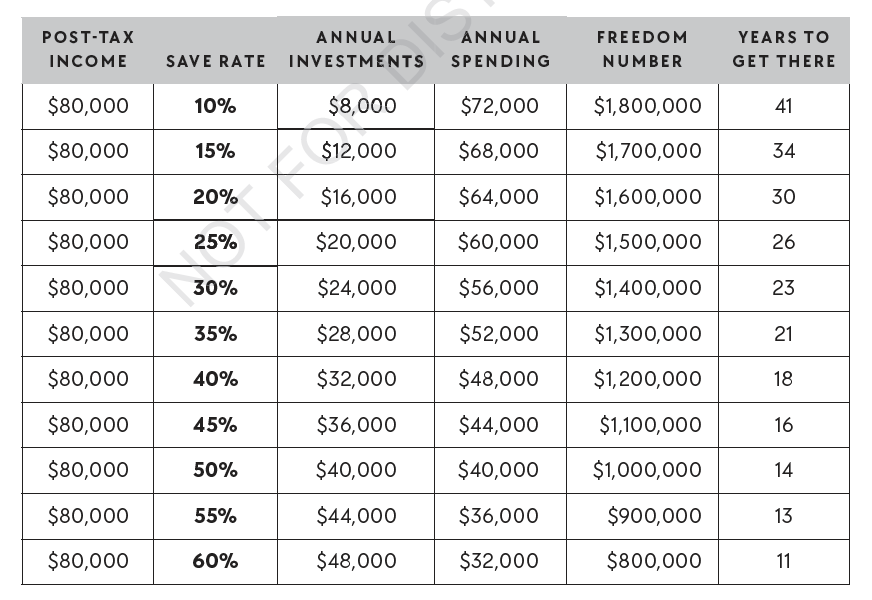
Long story short: Saving 40% of your net income is the point at which you’re going to see diminishing returns on saving and investing more, but saving 20% of your net income means a 30-year working career, start to finish. 10% is likely to produce the standard, 40-year career.
My savings rate has fluctuated over the years and the truth is I don’t know it off the top of my head anymore (my Wealth Planner tells me it’s about 25% at the moment). Once it was clear our investments had reached a point where they were compounding faster than we were adding to them (sometimes called “Coast FI,” because you’re not yet fully “there” but you can “coast”), it felt more reasonable to take my foot off the gas.
Q: Would love updated thoughts on Coast FI! I’ve reached Coast FI and I’m considering going down to part-time hours at a job I don’t really enjoy to work on my own creative pursuits/business.
A: Do it.
(Coast FI: You’ve saved and invested enough that, left alone to compound for a decade or two, you’ll hit retirement with adequate savings—without needing to save and invest anything else. This really frees up the ability to take risks with your paid work.)
A QUESTION I PICKED SO I COULD MAKE THIS MEME
Q: Money with Katie as Queen for a Day: You can build an American utopia. What policies would you mandate? What would the tax structure look like? Which rights should be mandatory to live a dignified life? What kind of changes would you make to ensure that workers own the means of production?
A: First of all, Mao-style parades every morning. I want to gaze out at a crowd of people holding up my picture on bedazzled wood posts. That’s an obvious starting point.
My utopia would need to do a few things:
Center the belief that all human beings have equal dignity and deserve basic economic rights
Preserve incentives and reward systems
Decentralize power and decision-making more effectively

I started answering this question and it became too long, so instead I’m going to dedicate a future newsletter in its entirety to this subject.
Thanks for playing and helping me appease Sir Google.
Set your investments on easy mode. Open your taxable Investing account with Betterment and get a properly diversified portfolio of index ETFs suited to your risk tolerance, automatic rebalancing, and tax-loss harvesting in as little as 3 minutes.
I miss your voice talking about finance in my ear 💚
Loved this HOWEVER! If you keep your old 401k with an old employer you ARE losing something. Per Kelly Klingaman, CFP®, RLP®:
“When you rollover old 401k and HSA money into your current plans, this means you’re no longer paying what are often excessive administrative & management fees on the old accounts that your prior employer used to cover for you when you worked there 💸” - Kelly Klingaman, CFP®, RLP®
You also have no control over how that 401k is invested and would have more control if you rolled it into an IRA. So even though it’s a pain, it’s worth rolling over an old 401k to either your current employer’s plan or an IRA. Save it for a really rainy day.