



LAST WEEK, SOCIOLOGIST CLARK RANDALL AND I convened on Google Meet to discuss his Jacobin article, “No, We’re Not All to Blame for Poverty,” a critique of Matthew Desmond’s Poverty, by America (2023). The book’s conceit is that poverty persists in the US in part because it benefits the otherwise blameless upper-middle class. Randall counters in his piece that Desmond is “misidentifying the engine of this [class] division as those with varying amounts of relative privilege,” rather than attributing it to the engineers themselves. Since Randall also studies public finance, inequality, and the politics of pensions and 401(k)s, I used the opportunity to bombard him with a few related questions, like whether investing in the stock market eventually transforms a respectably beleaguered wage worker into an unsympathetic “capitalist.”
My curiosity was born from a never-ending debate in the philosophically inclined, left-wing flank of personal finance’s standing army: If you believe the exploitation of workers is a feature, rather than a bug, of the system’s plumbing, doesn’t the act of personally amassing capital violate your stated belief? Gee, one might uncharitably say, for someone who hates capitalism so much, you sure seem to enjoy suckling at the teat of capital! While this dilemma almost certainly makes the self-indulgent and (sorry) neoliberal mistake of politicizing the personal, it’s reasonable that some feel as though critiquing capital while capital pays the bills emits the undeniable stench of hypocrisy.1
But the type of investing we do as members of the wage-earning public, Randall told me, lacks the defining features of true capitalist accumulation, like profiting from someone else’s labor instead of doing the work yourself. Even a very high-earning employee who invests in a 401(k) is not “becoming a capitalist,” he reasoned, by the very nature of their status as someone else’s employee. I pressed him for a more specific delineation—aren’t the profits from stocks technically created by someone else’s labor, too?—and he paused thoughtfully, then directed me to the mechanism by which this sort of retail investment happens. In terms of Gen Pop’s access to the stock market, he said, “we’re bag holders,” largely providing the “exit liquidity” for real capitalists.
His analysis sidesteps the trouble of ascertaining the precise location where prosperity shades into excess within the gradations of middle-class security; it concedes that while those with retirement plans and mortgages may enjoy radically different levels of comfort from those in poverty, their lives are not structurally different. Nobody loves a prolonged, catastrophic crash more than Warren Buffett, he said by way of explanation, and nobody hates one more than an almost-retired millionaire who’s just spent their entire life working and investing prudently. When billionaires like Buffett famously “buy low” during downturns, implied on the other side of the transaction is someone who’s selling low—most often, hordes of regular people who may have no other choice, because they either need the money now or don’t have the time to ride out further losses.
Most retail investors use an elegant device called an index fund to build wealth over time, a product that “passively” tracks a collection of stocks selected according to a set of rules. But words like “passive” and “rules” erroneously suggest a bland objectivity, obfuscating the fact that someone is actively shaping where the money flows.
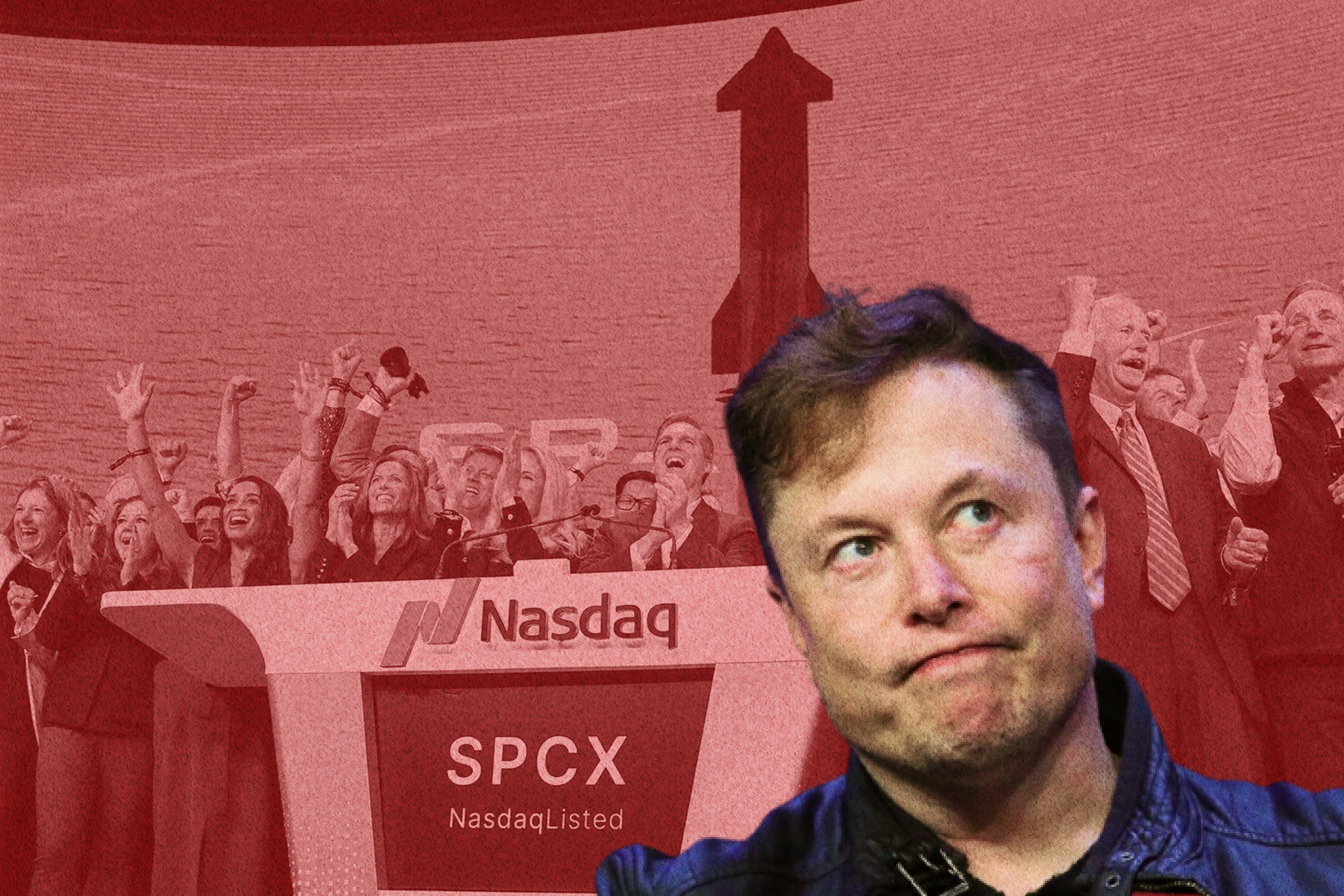
For a recent case study in bag holder capitalism, consider the SpaceX IPO, the largest in history, at an almost comically unjustified $1.77 trillion valuation. In the past, Nasdaq enforced a three-month waiting period before a freshly public company could be considered for inclusion in the Nasdaq-100. Former Fidelity fund manager George Noble writes that this waiting period existed to give the market time to deflate the IPO hype and determine a real price, thereby protecting the average retirement saver “from being forced into untested, illiquid stocks.”
But a suspiciously timed Nasdaq rules change called “Fast Entry”—circulated for a perfunctory “consultation” in February and approved March 30—shortened the waiting period for including mega-cap stocks in tried-and-true indexes like the Nasdaq-100 from its customary three-month delay to just 15 trading days. According to a scoop from Reuters, the timing adjustment appeared to be Nasdaq’s answer to an explicit request from SpaceX for early index inclusion, which “gives companies increased access to the deep-pocketed institutional investors who typically buy sizable positions for their own index funds.” In other words, inclusion in a major index guarantees that a stock becomes a “buy.”
Under the new rules, SpaceX—which briefly made Musk a paper trillionaire—joined the Nasdaq-100 a few weeks ago, which meant every index fund tracking the Nasdaq-100 (like the popular QQQ) was “required to buy SpaceX shares almost immediately after the IPO,” writes Rudro Chakrabarti for Moneywise, and during “an engineered liquidity squeeze” at that.
A related easing of CRSP’s eligibility rules for index inclusion (about public “float,” or how many shares have to be available to the proles) meant the CRSP US Total Market Index—the benchmark that the ubiquitous Vanguard index ETF VTI tracks—added SpaceX after just five trading days. Noble, the former Fidelity fund manager, called these changes “the most shameless structural manipulation of a major index” he’d ever seen. “45 years in this business and I’ve watched Wall Street find creative new ways to separate retail investors from their money in every cycle,” he writes. “But usually they at least try to be subtle about it.” Rules changes aside, this is just how it’s designed to work: Forbes notes dryly in its coverage of SpaceX that, of course, a major expectation going into any IPO is that “early and major investors”—the capitalists—will “make a killing from selling some of their shares to retail investors [...] at soaring prices.”
Automatically including SpaceX in major indexes just weeks after its overhyped IPO all but ensured an inflow of zombie buyers like me, whose automatic transfers purchased it in accordance with the new rules. Those who bought it thanks to their VTI holdings (added June 18) paid approximately $185 per share; those who added it via QQQ (July 7) paid $149. Today, it’s trading at around $115.
The broad strokes bear a spiritual resemblance to a crypto rugpull, which unfolds with a mind-numbing predictability: A new “coin” is launched and hyped, a flood of new entrants buys it and pushes the price up, and then early investors dump their “shares,” thereby “pulling out the rug.” Those left in the aftermath are, pitifully, said to be “holding the bag.”
The difference with SpaceX, of course, is that the “flood of entrants” isn’t composed of gullible basement dwellers actively choosing to load up on $TRUMP and Fartcoin, but regular investors dollar-cost averaging their inflation-battered paychecks into individual retirement accounts. In this case, it’s less about immediate, coordinated dumping—there are “lock-up” rules to prevent that2—and more about, as they say, the principle of the thing: changing the rules of the game to reward hype, forcing an outrageous overvaluation on retail investors, and trailblazing for OpenAI and Anthropic in the process, both of which are racing toward IPOs of their own.
The SpaceX exposure inside VTI and QQQ is still small (around 0.14% and 1%, respectively), but analysts expect its presence to grow over the coming months—not because the value of the underlying asset is growing, but because of how a stock’s weight in an index is calculated. Next week, those lock-ups will start expiring, which means pre-IPO SpaceX investors will begin selling their shares. “As the number of shares in the public market increases,” Tom Lauricella writes for Morningstar, “index fund investors will find that SpaceX is becoming a greater share of their portfolio.” Analyst Zachary Evens says that SpaceX’s presence in funds like QQQ is likely to balloon, estimating that by the end of September it’ll be weighted similarly to Walmart, a (profitable) business with 38x SpaceX’s revenue.3
This nakedly HODL-brained dynamic underscores a fundamental truth about the relationship between retail investors and capital-C Capital, particularly with respect to indexing, which has become, practically speaking, the backbone of our retirement savings system: Capital deeming something a “sell” automatically makes it a “buy” for everyone else. That, Randall would say, is the difference between a wage worker methodically investing for the future and a capitalist. One is hoping for modest returns in exchange for unknowingly providing exit liquidity; the other is Elon Musk.
This issue was brought to you by Poshmark.

Buying secondhand is great for a few reasons that you can pat yourself on the back about, like reducing waste, extending the lifespan of a piece, and still getting a high-quality item, probably for a fraction of the cost. On Poshmark, you’ll find items from brands like Loewe, Zimmermann, DÔEN, Hill House, Farm Rio, Vuori, and more.
For example, I’ve been loafer-curious for years, but the style I liked was too expensive to justify buying new. I found them on Poshmark—the listing had the Posh Authenticate badge, which means they went through an authentication process—for less than half the retail price, an unworn “factory reject” pair thanks to a barely-there scuff.
And if you’re in the process of simplifying your closet and want your items to have a second life, too, it’s easy to sell on Poshmark. Back when I worked at Southwest—where I had access to a shipping label printer—I practically ran a Poshmark resale operation out of the mail room. (Has the statute of limitations expired on admitting this?)
Shop and share your style on Poshmark today.

“Should I leave my low-cost-of-living city for the opportunities of a high-cost-of-living place?”

I plucked this question out of my “Reader and Listener Feedback” folder during a particularly feverish inbox purge this weekend and felt called to answer it in today’s ‘sletter. (The following has been shortened for clarity, anonymity, and #KGTHouseStyle.)
Should we continue living in a low-cost-of-living area near our family, or move somewhere “more exciting” for all those big-city opportunities everyone swears by? (We work remotely.)
Right now, our rent costs 12% of our gross income. Moving to a high-cost-of-living city would make that number jump to about 25%, which means less travel, tighter room for childcare, and everything else that comes with city life. Meanwhile, staying put, we’re investing the maximums in our 401(k)s, saving another 5–10%, and still enjoying 30–35% for guilt-free spending. Hard to argue with that math just to chase a vague sense of “more opportunity.”
How would you frame this tradeoff between low-cost-of-living near family with more travel and breathing room, vs. high-cost-of-living with energy and access? How do I make peace with staying put and tune out the noise telling me I’m missing out?
MY INITIAL INSTINCT IS we need to define “opportunity” more precisely. In my view, having copious discretionary income and being near family (assuming you like them) are both massive “opportunities” for quality of life.
If by “big-city opportunities” you mean the chance to ascend a career ladder, I assume that means you’d be happy to swap your current remote work situation for (ostensibly) heading into an office, hence the relocation component. If not, the vague sense of potential career progression might be overstated and dissipate upon further inspection, but it depends on your field.
If you simply mean the opportunity to experience new things (“energy and access”) and you’re willing to pay a premium for that, then it sounds like you could make it work—albeit with less financial wiggle room, since about 40% of your “guilt-free” money would be reallocated to housing. Still, you have a lot of breathing room already, so I don’t think the money is (or should be) the true deciding factor here.
I got the sense from your question’s framing—particularly the comment about “making peace”—that you’re less concerned with making this choice and more interested in accepting the choice you’ve already made to stay put. I once read that your experience of where you live is primarily defined by your immediate surroundings (that is, your neighborhood), and in my life, this has been true. Having lived in two different parts of Denver just a couple miles apart, I watched my lifestyle change drastically between locations—even within the bounds of the same “place.”
All that to say, I think location comparisons must also be considered in the micro, outside of the “big city”/“small town” binary, to be truly useful: Living walking-distance to a city center, near a beautiful park, or above a particularly fantastic coffee shop, for example, can radically alter your experience of a place. (I’m a slut for mature trees! Approximately 78% of my mental health outcomes are dependent upon seeing nature outside my window.) If you’re craving more energy or a change of pace but don’t feel entirely sold on the tradeoffs required to uproot yourself completely, is it possible there’s somewhere else in your own town that you might enjoy more?

Four words: Hill House Nap Dress. (Not sponsored nor an affiliate, just a genuine discovery made this weekend whilst trawling Nordstrom with my more fashion-forward sister-in-law, Maverick.) Apparently everyone knew about this signature design except for me. It feels sacrilegious to tell you about not one but two purchases in a publication ostensibly about personal finance, but given enough caffeine I think I could spin this into a “manage your money well and you can splurge along the way” lesson. I went a little overboard and got two: the Ellie and the Charlotte. Dresses are such an easy way to look put together without (a) actually trying or (b) suffering the indignity of a waistband.
This week on Diabolical Lies, I mounted (what I hope is) a fair-minded critique of the book-cum-aspiring Democratic Party platform Abundance. Caro, for her part, bravely and endearingly fumbled through an elaborate mixed metaphor to explain supply and demand.

The funniest thing I read on the internet this week was Father Karine’s “an open letter to my dog who, if i’m being completely honest, lowkey kinda sucks.” Tears in my eyes.
Super cool, boss man:

 Tiktok failed to load.
Enable 3rd party cookies or use another browser
👠 Discover new and pre-loved fashion on Poshmark. Buying secondhand reduces waste, extends the lifespan of a great piece, and can often mean getting a high-quality item for a fraction of the original retail price.
...even if the accusation most often functions as a built-in defense for the status quo.
Sorry for the David Foster Wallace-length footnote, but for more on the legitimacy (or lack thereof) of the lockup period, I enjoyed an analysis called “Nasdaq’s Shame” from an anonymous finance writer who goes by the name Keubiko:
“Some may argue ‘But the lock-up period is 180 days! The initial index squeeze happens on Day 15. The market will have months to find real price discovery before the insiders can actually sell!’
Nonsense.
Yes, the initial Day 15 squeeze will inevitably cool off. But by waiving the seasoning period and jamming this low-float behemoth into the index immediately, you have completely corrupted the baseline. You’ve forced passive indexers to buy at the absolute top of an engineered liquidity squeeze. You have established a manipulated, artificially elevated price floor fueled by forced buying.
For the next five months, the stock will be based on a highly distorted market structure, driven in part by continued passive inflows (barring a market meltdown).”
For context, SpaceX’s “value” at its IPO was approximately 94x its 2025 revenue—a year in which it lost $5 billion—while Walmart, whose net income was higher than SpaceX’s total revenue, is valued at approximately 1.2x revenue.
Tax wealth not work! Gary Stevenson🔥
This piece is so good and I’ve been thinking about this for years. OG actual capitalists have a vested interest in Americans of all stripes not just being in favor of capitalism, but in identifying themselves as capitalists. I think there is something here related to temporarily embarrassed millionaires and our widespread feeling that our duty in life is to ascend to a higher class. Thanks for taking this topic up and adding to the conversation around it. I wrote about it here in my piece “are you a good rich person?” https://thepostwealthproject.substack.com/p/are-you-a-good-rich-person