

I did something recently that I’ve never done in my career as a writer and podcaster: focused all my energy and time on a singular project for three straight weeks.
Since February, I’ve been working on a book proposal for an essay collection about…well, that’s the problem. Articulating a pithy, one-line characterization of its core themes—disillusionment, cognitive dissonance, self-implication, fairness, contradiction, morality, striving—has proven challenging so far, hence the dedicated three-week Thought Binge. My brain feels like a soggy beach towel draped over a lawn chair in the sun, now partially dried in an awkward contortion.
The most time-consuming part of my writing process is research, so today I’m sharing a summer reading list of sorts: the 18 books that have shaped my writing so far, and the most surprising, memorable, or valuable takeaways from each. Titles are organized less by how I assume the publisher would classify the book and more by the particular reason I found it resonant, challenging, or worthwhile.
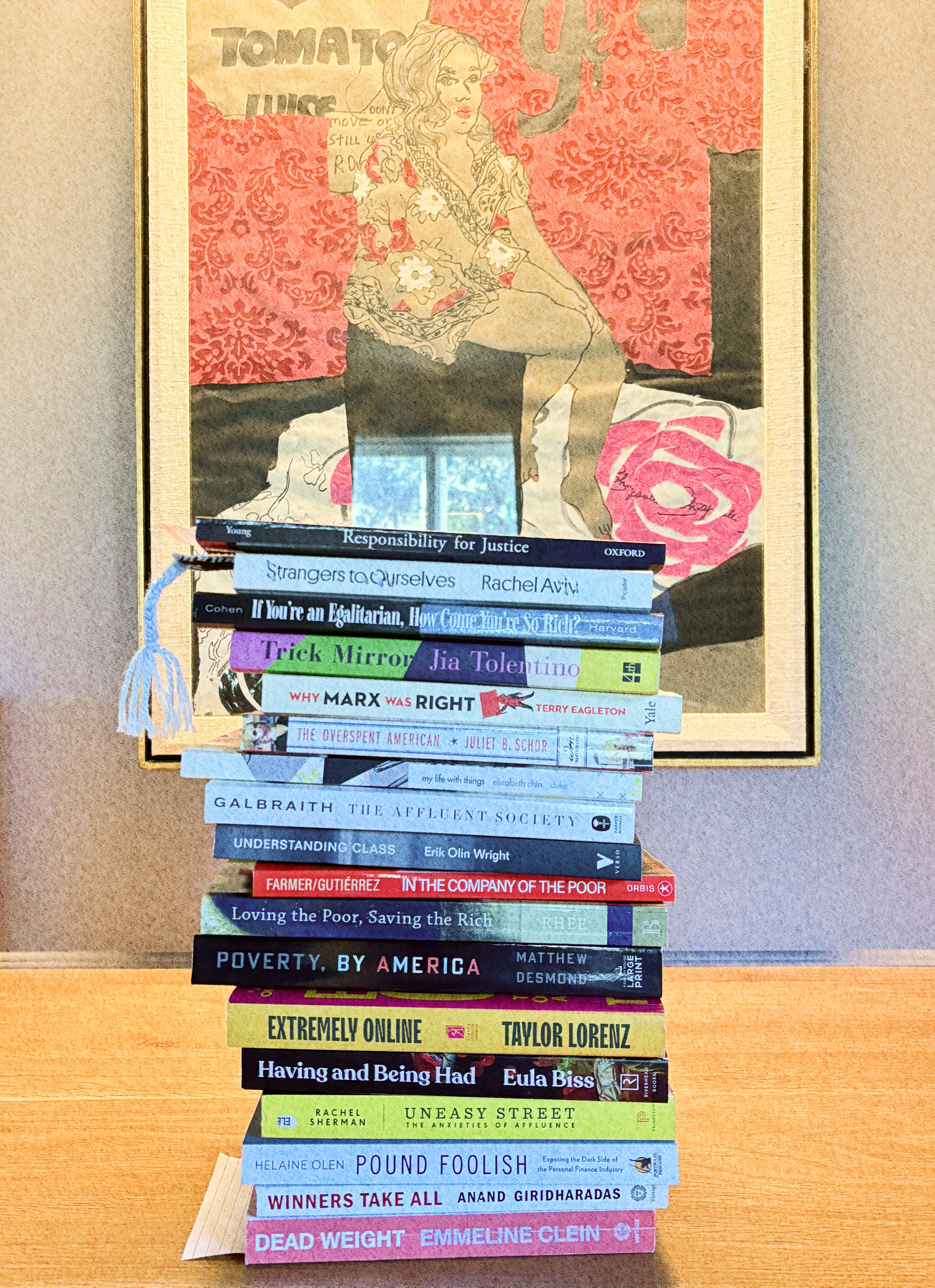
Do you feel like I’m cheating you by dumping a bunch of research in your lap? A little like ramming a grocery cart full of ingredients into your shins when you were promised a thoughtful, restrained four-course meal?
Hopefully in two more years—give or take—it’ll be time to eat.
This post might look better in your browser or Substack app; it accidentally ended up being quite long.
—––– CLASS PERFORMANCE —–––
About: the invisible scorecard we use to judge whether someone is inhabiting their socioeconomic status properly
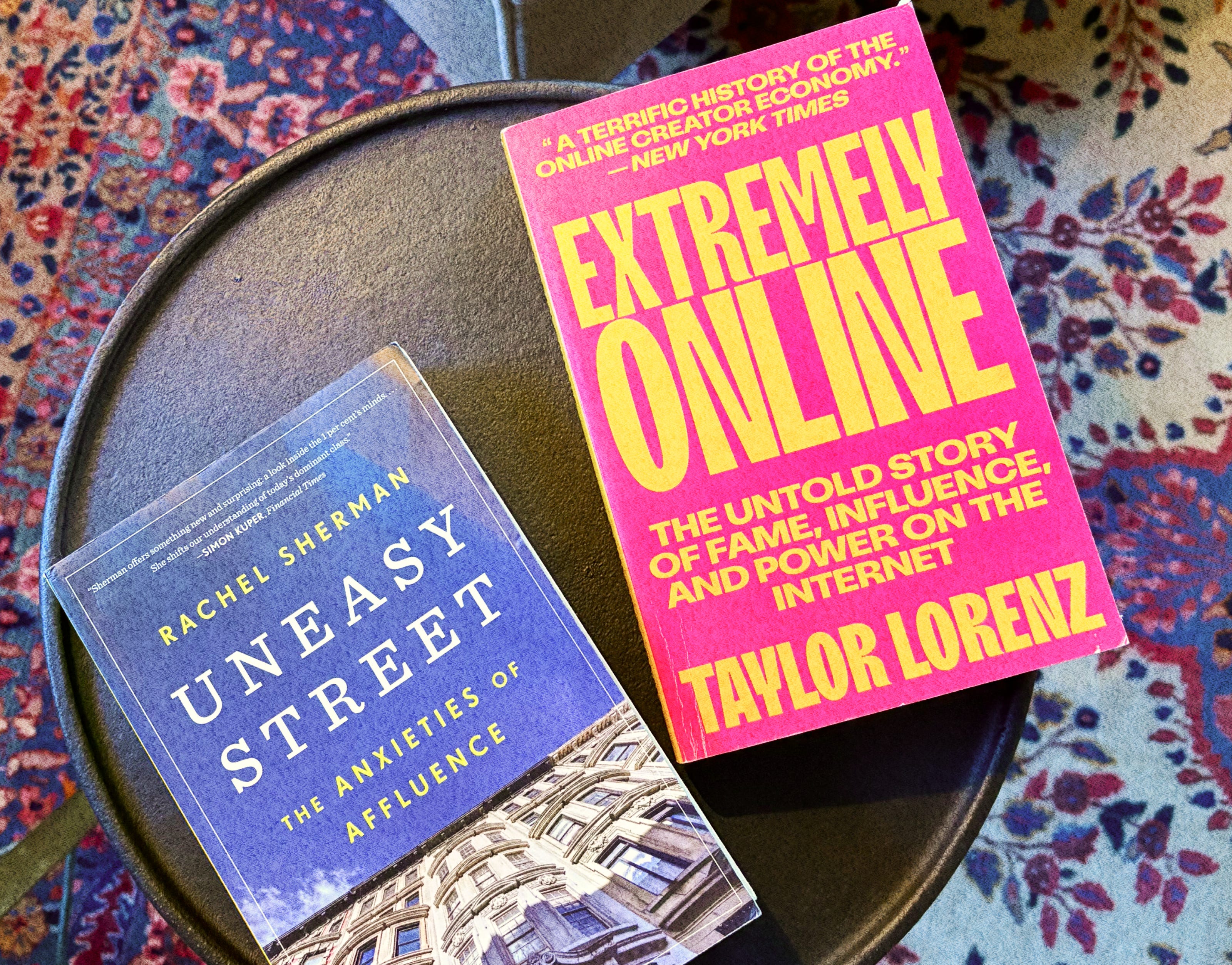
Uneasy Street: The Anxieties of Affluence (2017) by Rachel Sherman
There’s almost too much to say about Uneasy Street, but at times this book felt like an X-ray. Sherman interviews wealthy New Yorkers and finds that they’re often absorbed—to a shocking degree—with “occupying their privilege legitimately.” People justify their good fortune in a few recurring ways, she finds: working hard (which legitimates any excess they may have), spending “prudently” (in other words, performing “reasonable” consumption), and demonstrating “awareness” (also known as checking your privilege).
Sherman infers that her respondents, many of whom earned more than $1 million per year, defined “real” affluence as not having to worry about money at all, rather than possessing a particular amount of it. In that sense, simply channeling financial anxiety—no matter how absurd, given the circumstances—was how the respondents reinforced their connection to the middle class. That the very wealthy are neurotic about locating themselves in the “moral middle” reveals, I think, that our culture’s attitudes about wealth are often in conflict with one another.
Extremely Online: The Untold Story of Fame, Influence, and Power on the Internet (2023) by Taylor Lorenz
I picked up Extremely Online because I was researching an essay about influencers and how they best illustrate some of our bizarre expectations around class performance, as well as the tightrope they must walk to remain likable (Véronique Hyland astutely identified this as “the precise titration between aspirational and relatable” in her 2023 profile of Alix Earle, a phrase I keep returning to).
Lorenz’s book is the most worthwhile history of the social internet I’ve encountered so far (Get Rich or Lie Trying by Symeon Brown had a similar premise but ultimately wasn’t what I was looking for). Her examination of the monetization of the “mommy blogger” led me to a 2011 profile of one such internet pioneer in The New York Times which identified the central dynamic between influencer and audience that I find so fascinating:
“[I]f [affinity for your blog] is based on trust, do you violate that trust by introducing commerce? Readers of personal blogs return again and again for the connection, the feeling they really know the writer—and ads can break the ‘we’re all friends here’ mood.”
This element of the mainstream social internet—monetization of your personhood—is such a given now that it was almost jarring to see this tension considered so earnestly. It’d be easy to conclude the answer is “no,” given how influencer careers financed in this way ultimately exploded, but I think it’s more complicated.
—––– CONSUMPTION —–––
About: the centrality of consumerism in American culture and our inscrutable relationship to it
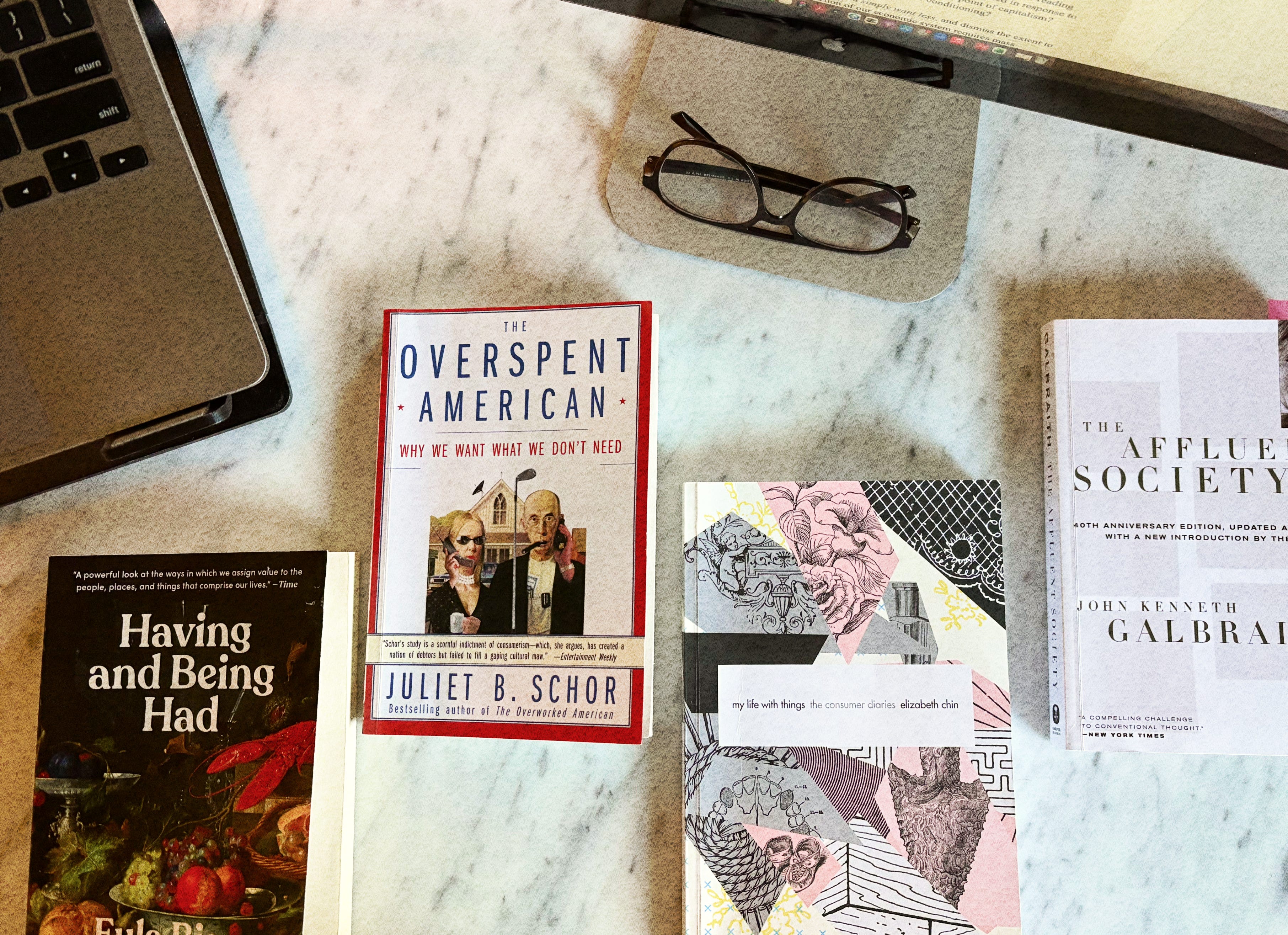
My Life with Things: The Consumer Diaries (2016) by Elizabeth Chin
Anti-consumerism is such a pervasively moralized sentiment that I’m always interested when a writer attempts to study how their anti-consumerist beliefs deviate from their lived experiences of desiring and acquiring. Chin is writing from personal experience, but the contradictions she explores can be extrapolated: Few would deny sharing the normative belief that naked materialism is sordid and shallow, and yet the continued functioning of the American economy depends, to a large degree, on a majority of us conveniently forgetting all about that pesky, high-minded minimalism when Apple releases a new iPhone.
The real revelation of My Life with Things, for me, was that even Karl Marx, the most famous anti-capitalist to ever live, embodied this contradiction from time to time: “Marx—like myself—was complex and contradictory, espousing one sort of vision of the world in his intellectual work, while immersed in an utterly different one in his day-to-day life. What kind of committed communist, after all, lives in an upscale London suburb, throwing coming-out balls for his marriageable daughters?”
Having and Being Had (2020) by Eula Biss
Because Eula Biss is not an economics or financial writer by trade, language itself becomes a layered source of meaning in her short essays about “the discomfort of being comfortable,” or the sense of complicity a formerly working-class person feels after ascending into the security of the middle or upper-middle class. There’s one particularly memorable passage about how distraught she felt while signing up for her 401(k) plan at work:
“I want nothing to do with this, I think. But I want to retire. The adviser is assuring me now that even if the market dips, even if it crashes, it will come back up again. Given time, he says, it always comes back. I ask him if he can imagine this system of investment coming to an end. No, he says, your money is safe. But that’s not what I’m asking. I’m asking if there’s any way out of this.”
The Affluent Society (1958) by John Kenneth Galbraith
Classics like these provide surreal reading experiences because they feel like discovering the original text of our present-day conventional wisdom. (I didn’t include Thorstein Veblen’s 1899 The Theory of the Leisure Class in this list because I cannot in good conscience even appear to recommend that you sit down with something so dry, but similarly, that dusty little treatise gave us “conspicuous consumption.”)
One of Galbraith’s biggest contributions in this book is his theory of the advertising and consumption cycle: “The process by which wants are satisfied is also the process by which wants are created. The more wants that are satisfied, the more new ones are born.” Interpreting this for the influencer age was thrillng.
The Overspent American: Why We Want What We Don’t Need (1997) by Juliet B. Schor
Schor’s theory of American precarity is that we want (and buy) too much shit. I think this case would be more difficult to make today given how much more expensive “the basics” are (housing, healthcare, education), but it’s likely Schor would point to at least one of those—housing—and say it proves rather than undermines her theory of “an expansion of desire and expectation.” To hear Schor tell it, mass production and mass media coalesced (not altogether different from Galbraith’s theory) at the same moment the income distribution yawned open. As a result, those with the highest incomes and flashiest lifestyles became consumption pacesetters for everyone else.
This diagnosis seems fair enough to me; humans are mimetic creatures. Though I get the sense reading Schor that she feels some disgust as she catalogs the way our desires have expanded in response to an industrialized, globalized economy. Fair enough—but isn’t that the (alleged) point of capitalism? Innovation, a downward cost curve, microwaves and air conditioning becoming commonplace over time?
Analyses like these typically conclude that’s why you should simply want less, and dismiss the extent to which (as Galbraith would’ve put it) the mass production of our economic system requires mass consumption. Contentment with what you have is antithetical to the (current) structure of our economy. Nevertheless, her case is strong, and I could see the germinating seeds of the FI/RE movement in her description of “downshifters.”
—––– POVERTY —–––
About: poverty as a structural fact of a system whose primary selling point is its unparalleled ability to produce prosperity
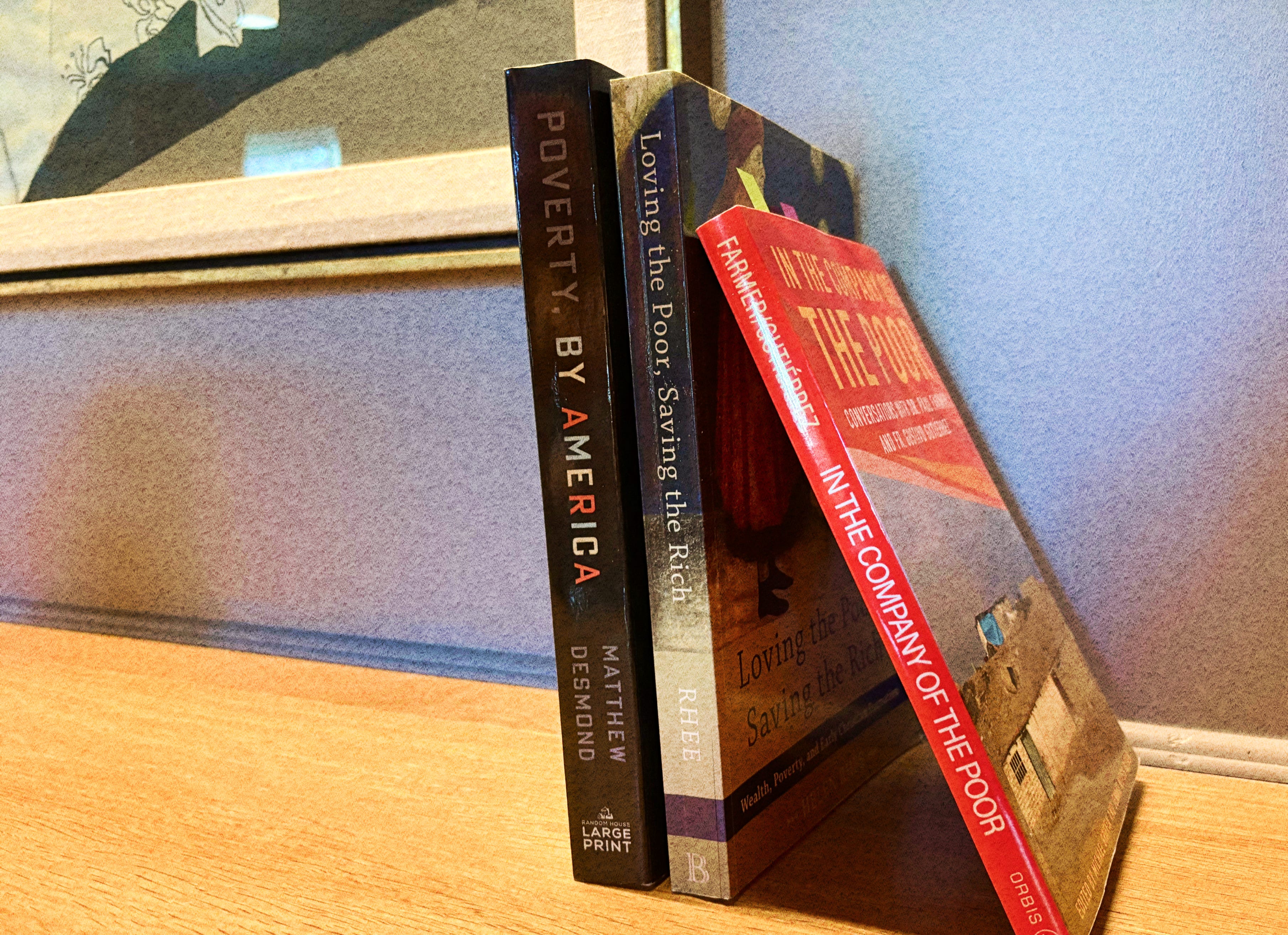
In the Company of the Poor: Conversations with Dr. Paul Farmer and Fr. Gustavo Gutiérrez (2013)
I picked up In the Company of the Poor to learn about an interpretation of Catholicism called liberation theology, which views oppression of the poor as the most urgent “structural sin” of modern life. Liberation theologists like Gutiérrez and Archbishop Oscar Romero (canonized in 2018) teach that “social and political action” in solidarity with those living in poverty is a “mandate” of the Christian faith, which makes it not well received by those “uninterested in…the political dimensions of following Jesus.”
For now, all I’ll say about this one is that it went a long way in explaining my attraction to a particular politics of redistribution. It’s noteworthy—and maybe not coincidental—that Catholicism is having such a cultural moment in the midst of our heightened awareness of economic inequality.
Poverty, by America (2023) by Matthew Desmond
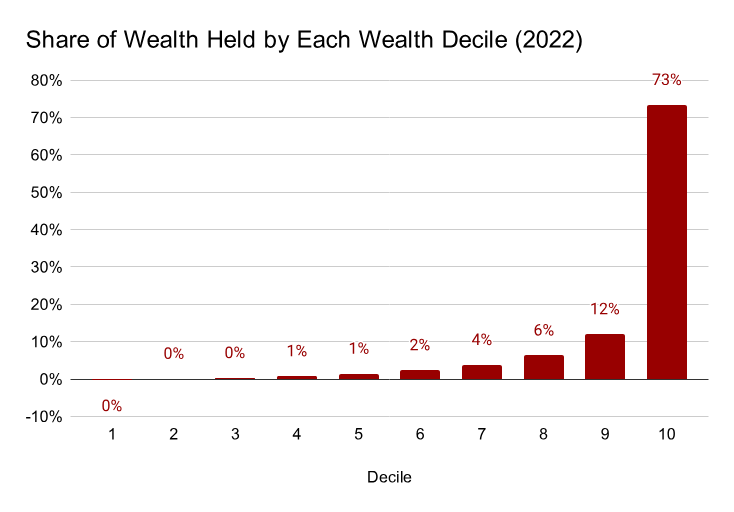
Poverty, by America diverges from the style and tone of Desmond’s first book, the Pulitzer Prize-winning Evicted: Poverty and Profit in the American City, and it received a fair amount of criticism in wonkish circles for its methodology in measuring poverty. But I found it valuable for one thematic choice that felt brave and true, something that has stuck with me since my first reading in 2023: Desmond’s incisive clarity about the fact that poverty persists in large part because the middle and upper classes benefit from the deprivation of the lower class.
Not everybody finds this connection compelling. One review—“No, We’re Not All to Blame for Poverty” by Clark Randall for Jacobin—was so vehement in its disagreement with Desmond’s thesis (which he called “individualized guilt dressed up as political-economic analysis”) that I reached out to him to discuss it. We’re meeting later today.
Still, sometimes you see a chart that makes you go hmm, and yet…:
Loving the Poor, Saving the Rich: Wealth, Poverty, and Early Christian Formation (2012) by Helen Rhee, PhD
I mostly read this to supplement In the Company of the Poor to better understand the Christian history of wealth redistribution and, as Rhee put it, “the social responsibilities of the Gospel.” Rhee—a professor of the history of Christianity—writes about “sufficiency” and “common enjoyment” but leaves these definitions mostly open to interpretation. As a worldly student of Hedonic adaptation (the tendency known as “lifestyle creep” in personal finance parlance), I know it’s a slippery slope to permit yourself to define what “sufficient” means; that “sufficient” itself is not a static benchmark. To put it plainly: There’s no obvious place to stop when there’s always more available.
She seems to recognize this problem of relativity, too, in her commentary about how rich Americans are when considered in a wider context: “A vast majority of Americans, who belong to the top 5–10 percent of the richest people in the world by a global standard, identify themselves as the middle class yet without a firm sense of economic security or contentment.”
This list is continued after a message from today’s partner, Betterment.

I have a confession to make: Despite transforming my entire identity into that of Personal Finance Personality, I haven’t had a traditional “emergency fund” in years. I was living fast and loose with my money either (a) in my checking account or (b) in an investment account set to a 90% stock allocation, with no in-between. Because of this, I never had any real reason for saving meaningfully in a dedicated high-yield cash account.
With my major lifestyle shift to self-employment, that changed in 2026. Now I’m absolutely lousy* with high-yield cash accounts, each earmarked for its own special use case: my taxes, for one, now that I’m setting aside a whopping 30% of everything I earn. It would pain me too much to watch that money rot in checking, earning nothing. (If you’re not sure how to start and fund your emergency fund, check out this new 2026 emergency funds deep dive!)
With Betterment’s high-yield cash account called “Cash Reserve,” new customers can:
✅ Earn up to a 4.00% variable APY with a qualifying deposit—that’s nearly 10x the national average—on the same platform where you’re growing your investments.
🤩 Save with no fees or minimum balances.
👼 Feel assured that up to $8 million (joint) or $4 million (individual) is FDIC-insured (though I can’t think of any scenario in which I’d ever recommend keeping millions in cash; go with God, comrade). That’s 16x what most banks offer.
Open your Cash Reserve account today and start saving for tomorrow. You can even create multiple savings goals and use Betterment’s automated tools to help you achieve them.
🥳 Put your cash to work with Betterment Cash Reserve and earn up to a 4.00% variable APY with a qualifying deposit.
*OK, I have two. Still, that’s an infinite increase over zero.
Paid client. Views may not be representative. See App Store & Google Play reviews. Rate is subject to change. Learn more.
—––– ECONOMIC PHILOSOPHY —–––
About: how people who think for a living dissect the logical basis of questions about economic justice
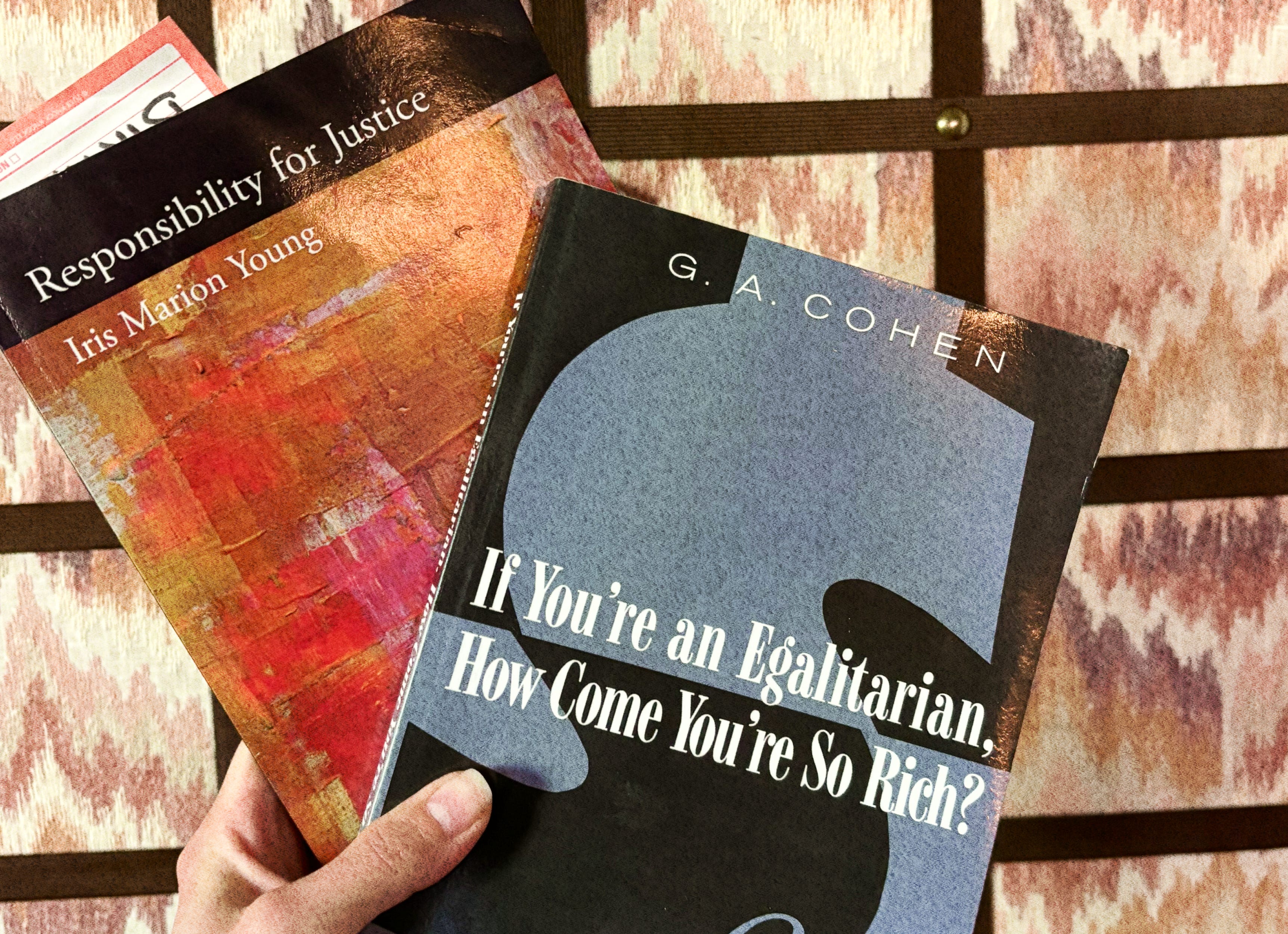
If You’re an Egalitarian, How Come You’re So Rich? (2000) by G.A. Cohen
“I now believe that a change in social ethos, a change in the attitudes people sustain toward each other in the thick of daily life, is necessary for producing equality, and that belief brings me closer than I ever expected to be to the Christian view of these matters that I once disparaged,” writes Cohen in his introduction.
The title of this one grabbed me immediately, for obvious reasons, but it turns out it’s a book of philosophy lectures in which only the final lecture takes on its titular question directly. Reading philosophy often makes me want to swallow a package of weed gummies and watch the most insultingly overwrought reality television imaginable, but when I power through, the most common effect is a sense that my certainty in literally anything is misplaced. (Reading philosophy is like: And what exactly is meant here by “certainty”? Allow us to discuss for 3,000 words.)
In the last lecture, Cohen turns his attention to the question of the rich egalitarian—if A believes in equality and A is also rich, is A’s behavior consistent with A’s belief?—and then sets up and deconstructs a few common ways to deflect the question. (Frustratingly, he never arrives at a concrete answer, but at one point he breaks the fourth wall and concedes it’s likely not a hot topic for philosophers of egalitarianism because working philosophers are, broadly speaking, much better off than most.)
Responsibility for Justice (2014) by Iris Marion Young
I’m still working my way through this one, but I chose to read it because I saw a review that praised how Young thinks about “the complex relationship between individual responsibility and structural injustice.” So far the most salient point I’ve taken away is that “luck” (typically considered no different than random chance) in financial outcomes—e.g., this person is lucky to be talented in a way that often generates high compensation in our society, like being particularly adept at, say, trading derivatives for a hedge fund—ignores both the structures that make those talents the ones worthy of high compensation as well as the backgrounds that tend to allow someone to develop and exploit such a talent in the first place.
– CRITIQUES OF PERSONAL FINANCE & PHILANTHROPY –
About: how the status quo justifies and defends itself in the ways that are most lucrative and convenient for those benefiting most from it
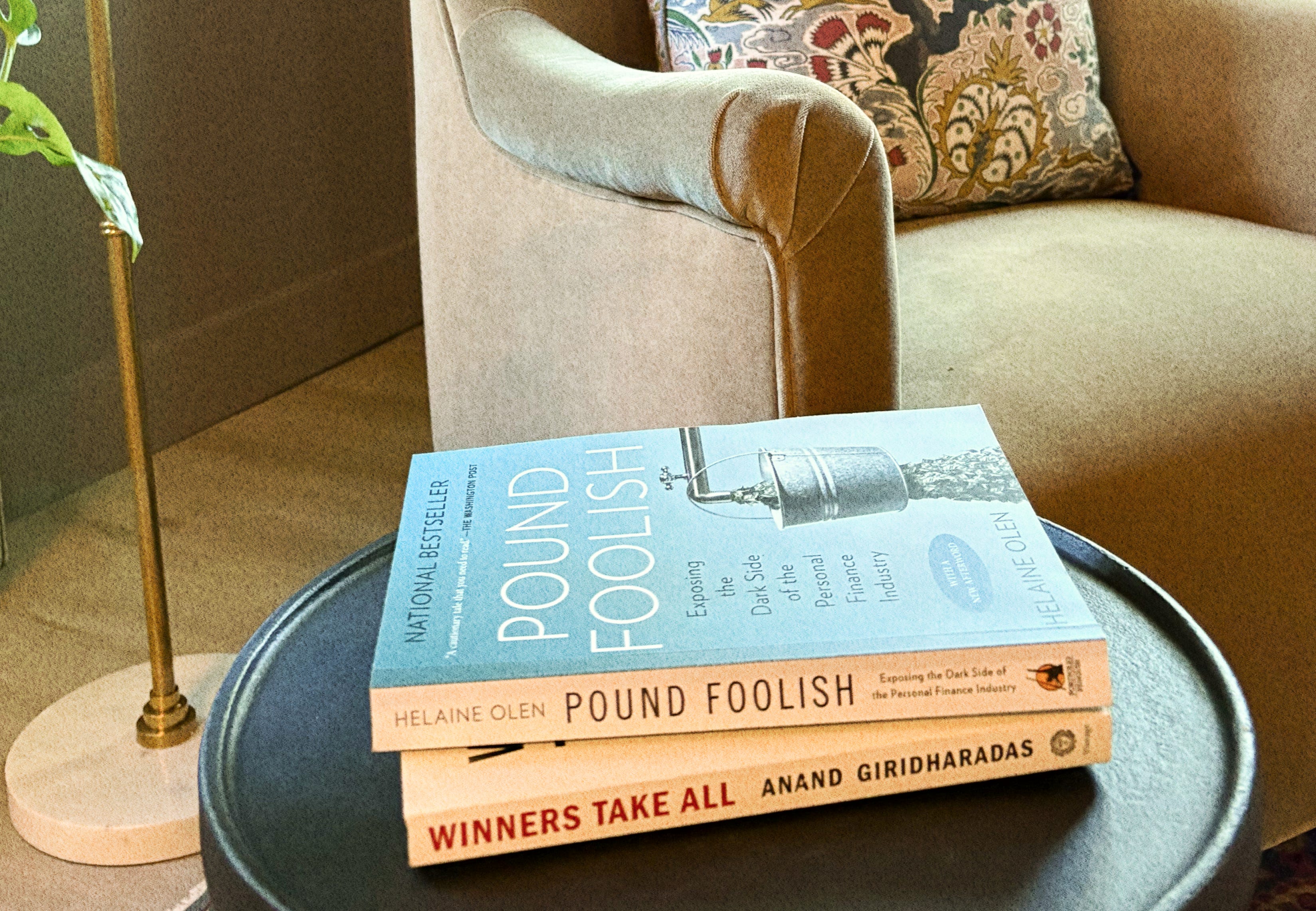
Pound Foolish: Exposing the Dark Side of the Personal Finance Industry (2012) by Helaine Olen
It’s surprising that Pound Foolish has remained relatively lonely in its willingness to investigate the conventional wisdom that financial literacy “works.” “By almost every available measure,” Olen writes, “the financial literacy of the American public has remained dismal in the almost two decades since the movement began.”
It’s not clear whether her assessment is based on demonstrated financial knowledge when polled or actual financial outcomes, but the real trouble is the tenuous relationship between the knowledge and the outcomes: A 2014 metastudy of 201 previous studies attempting to quantify the relationship found that efforts to improve financial literacy “explain only 0.1% of the variance” in behavior when controlling for things like “psychological traits,” and that virtually any discernible impact entirely vanished after 20 months.
This suggests that learning about money often doesn’t directly translate to doing better, and while I think it’d be ridiculous for me to say that knowing how to manage money doesn’t matter, it seems clear enough that knowledge alone is rarely sufficient if you don’t have surplus in the first place.
Winners Take All: The Elite Charade of Changing the World (2018) by Anand Giridharadas
Giridharadas is a former McKinsey consultant who applies a critical eye to the market-friendly notion that the sort of wealthy do-gooders who congregate at the Aspen Ideas Festival will fix our problems through personal philanthropy, a tack he says mostly serves to deflect calls for democratic redistribution or “predistribution.”
In his interview on Pitchfork Economics, he gets into a satisfying spar with host Nick Hanauer about what he calls the “sonorous Obama-esque claim” that change always feels positive-sum to everyone: “I think we have to overcome the cultural pressure we feel—and we all feel it if you’ve been part of the culture of the United States within the last 40 years—to reassure rich people that there’s not genuine loss involved.” Again, this throughline (which also appears in Poverty, by America) undermines the neoliberal consensus that everything is win-win.
This idea seems potent and subversive to me whenever I encounter it because it echoes the relational nature of class; that class isn’t an attitude or an absolute sum of money, but a description of your relationship to society writ large. (One author below, Terry Eagleton, writes, “To point out that some people are destitute while others are prosperous is rather like claiming that the world contains both detectives and criminals. So it does; but this obscures the truth that there are detectives because there are criminals.”)
– CULTURAL CAPITALISM & MISC. –
About: just some damn good writing
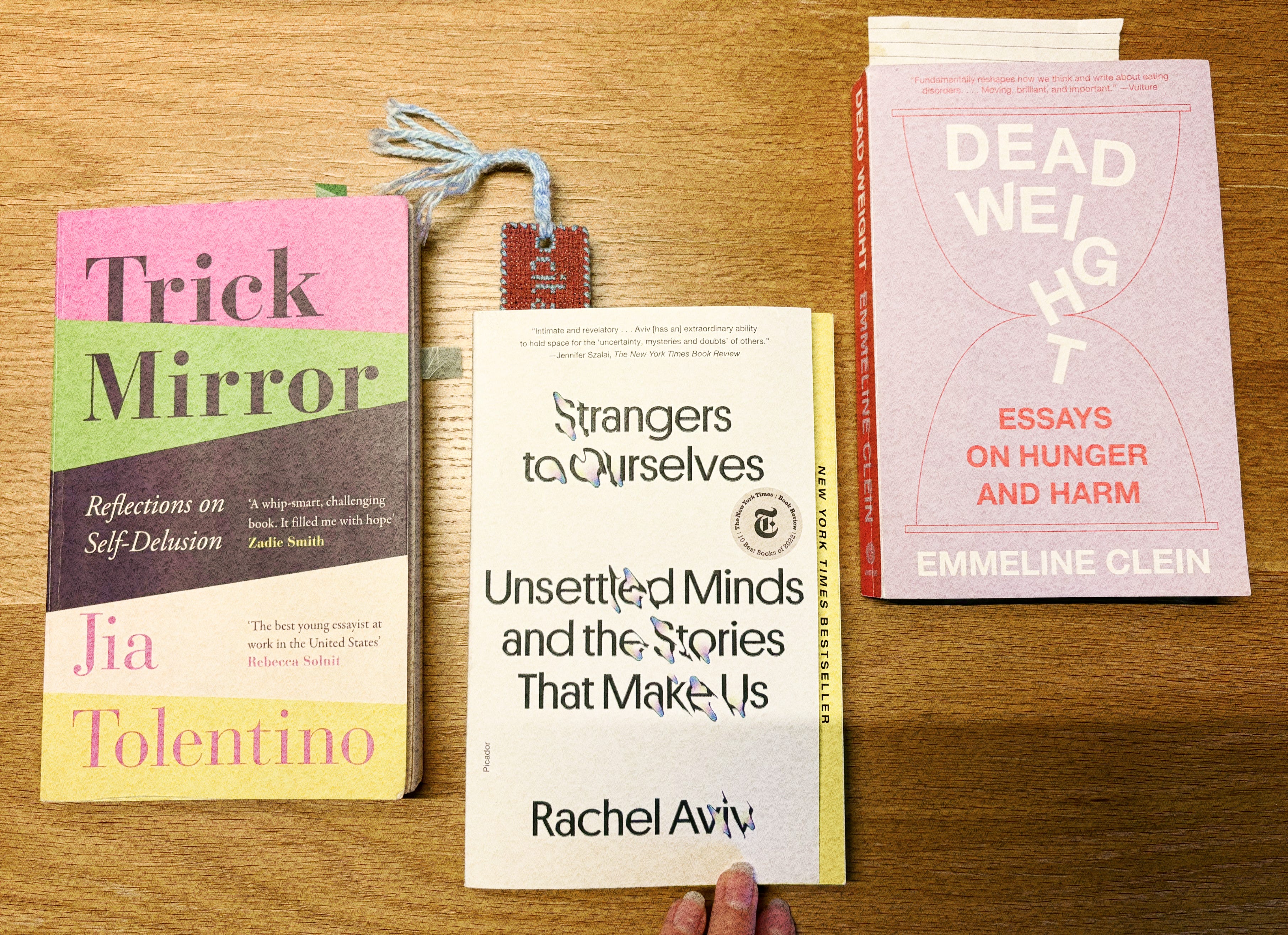
Trick Mirror: Reflections on Self-Delusion (2019) by Jia Tolentino
Of course I returned, as I often do, to Trick Mirror, mostly for the writing on a sentence level. The fifth essay, “Ecstasy,” has loomed large in my imagination since I first read it. Tolentino compares her evangelical upbringing in a Houston megachurch to her later ecstatic experiences with drugs like MDMA and wonders whether she’s always been prone to giving herself over to experiences—religious or hallucinogenic—that dissolve the self.
I also had to revisit “Always Be Optimizing,” her essay about how women are “genuinely trapped at the intersection of capitalism and patriarchy,” though this case felt less compelling after recording our most recent Diabolical Lies episode: Caro argued (rather persuasively) that the benefits which supposedly accrue to those who partake in the more fringe elements of beauty culture (say, Botox) are tenuous at best.

Dead Weight: On Hunger and Harm (2024) by Emmeline Clein
This collection of essays was eye-opening and at times grotesque, given the elements of self-harm. I read it as a model for blending memoir-style storytelling with deeply researched cultural criticism. My favorite essay—and the one I believe to be technically strongest—is called “Red Virgin, Red Heifer,” which, at the risk of oversimplifying, connects the religious impulse of Clein’s Judaism to the development of her eating disorder. Some of the writing is stunning:
“In middle and high school, anorexia tasted holy, at least when I said the word aloud, whispered it in bed as I browsed Tumblr or recited it silently in my head, my Shema. That x sound, slinky. Blank like I imagined a sacrament cracker, sawdust in my mouth but a spark in my step.”
Incidentally, the sentiment reappeared in the prologue of Strangers to Ourselves: Unsettled Minds and the Stories That Make Us by Rachel Aviv (2022), which I just started reading on Monday. Of her decision (if you can call it that) to stop eating shortly after Yom Kippur at six years old, Aviv writes, “The decision retained the religious energy from the holiday and carried an aura of martyrdom.”
––– POLITICAL ECONOMY –––
About: class theory from philosophers like Marx and Weber
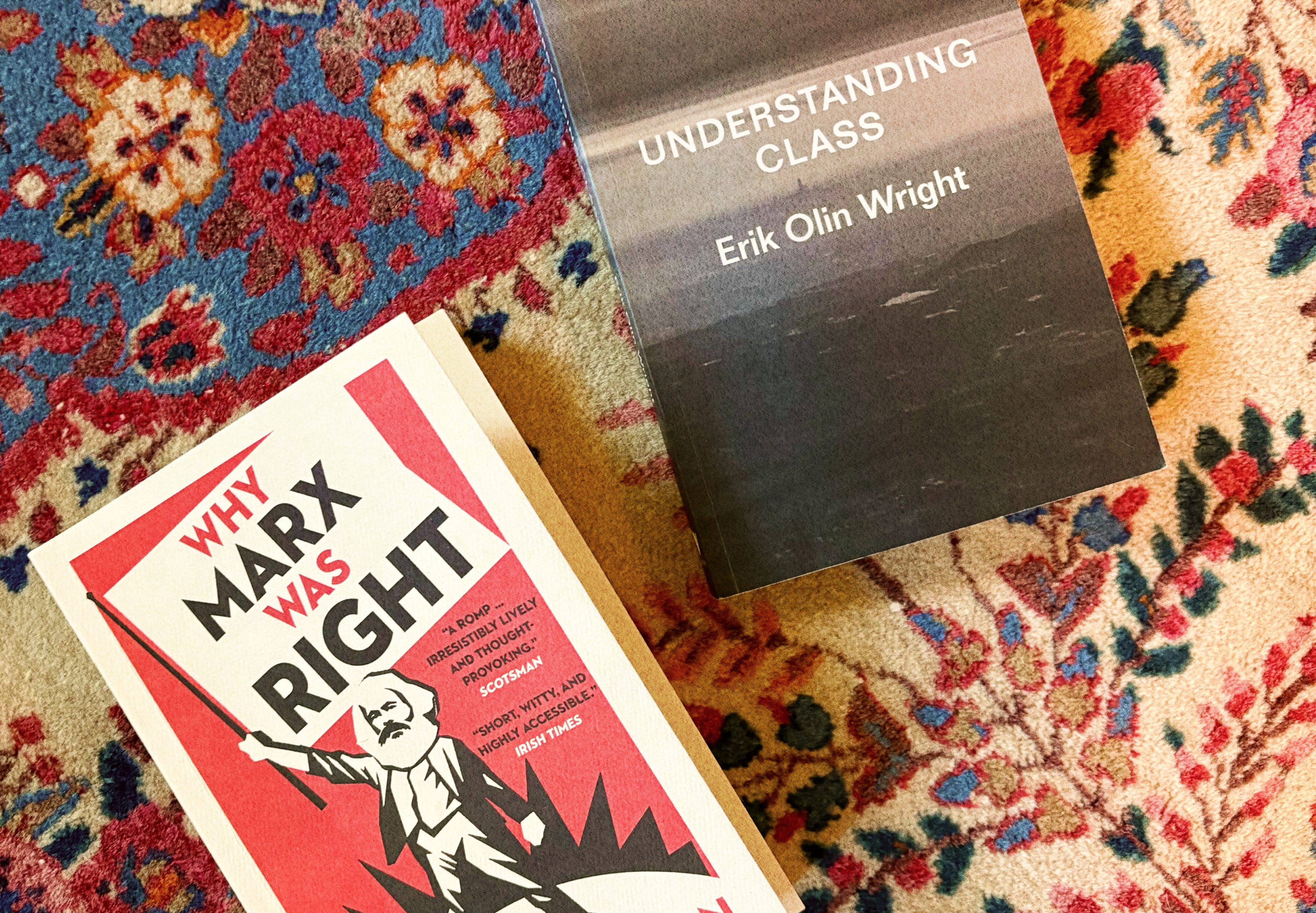
Why Marx Was Right by Terry Eagleton (2011)
You may have gathered from the sections about poverty and Christianity that the moral dimension of wealth accumulation interests me, and it wasn’t until I read Eagleton’s accessible primer that I realized this inclination makes me a Bad Marxist.TM
Marx was skeptical of moralism, or the tendency to abstract absolute values from their concrete historical context and hand down judgments accordingly. The general conceit of Marxism is that it’s the structure of a political economy, not personal virtue, that determines outcomes (you’ll notice this is a philosophical break from Cohen’s comment in the If You’re an Egalitarian… section). “One might say that the free flourishing of individuals is the whole aim of his politics, as long as we remember that these individuals must find some way of flourishing in common,” Eagleton writes. “This, one might claim, is Marx’s morality from start to finish.” This book and Cohen’s were a room-spinning shot-chaser.
Understanding Class by Erik Olin Wright (2015)
This one is on the more technical side and I read it a while ago, so I had to rely heavily on my notes to shake things loose. Different theories of class developed in response to different kinds of questions, which is why our understandings vary so much. Some theories suggest class can be identified from the material conditions of an individual’s life alone, while others suggest it’s definitionally relational, determined by access to resources that others are excluded from—how much “control” you have over “the lives and activities of others.”
In these relational understandings—the ones I personally find most reflective of reality—“the economic advantages people get from being in a privileged class position are causally connected to the disadvantages of people excluded from those class positions,” a concept that’s easy to grasp if you’ve ever cruised through a gated community around 8 AM on a weekday and seen the domestic workers filing into their places of work.
I also thought this basic breakdown of the levels where power is negotiated was useful:
At the systemic level of power, conflict is over what game to play (e.g., capitalism vs. socialism)
At the institutional level of power, conflict is over the rules of the game (e.g., American capitalism vs. Scandinavian capitalism)
At the situational level, conflict is over the moves of the game (how to best realize your interests under the existing rules; to this I’d add American personal finance as a perfect example)
That’s all—for now. Happy reading.
🤓 Earn up to 10x the national average on your savings. With no fees, no minimum balances, and up to $8 million (joint) or $4 million (individual) in FDIC insurance, start saving for tomorrow, today.
Betterment is not a real bank. The reason they can say up to 4mil is FDIC insured is because they split your money across multiple banks in the background. If those banks go under, you lose your money, because Betterment themselves is not a bank. Perfect Union has released explainers on this, I recommend checking out their YouTube. People have lost a lot of money keeping their funds in not-banks that claim FDIC insurance; but it’s actually a tangled web of not-banks to invisible banks that can fold at any time.
Thank you for sharing this with us, Katie.
As a former professor in ethics and public policy, I'm familiar with several of the writers and traditions on your list. A few thoughts:
-Schor's earlier work, _The Overworked American_, is a better book than her _Overspent American_. Similarly easy (for the lay reader), quite original during its time, and I think it would align with your interests.
-I second Sharon's recommendation of Piketty. But rather than beginning with his recent work, I would start with his celebrated 2013 masterpiece, _Capital in the Twenty-First Century_. It sounds dry and boring, but is anything but. He weaves in history and literature to trace and explain the evolution of capital's (and capitalism's) role in contemporary society. I'm guessing you would find yourself thinking about it long after you finish it.
-Giridharadas is a fine young thinker. If you haven't seen his recent NYT Oped on "the Epstein Class", it's well worth a read.
-GA Cohen is a brilliant philosopher. I used his work extensively during my own graduate work in the 1990s. If you're interested in other more philosophical treatments of this issues, would be happy to discuss with you.
Thanks again for sharing this. I'm a big fan of all you do, and am looking forward to see how your career evolves!