



Spotted whilst trawling Facebook Marketplace for lamps:

Today:
The government says prediction markets are fine, actually
The Supreme Court says tariffs are not fine, actually
High earners pretend their Venmo is broken
Homelessness rates may be up to six times higher than official estimates—and Oregon’s direct payment approach shows promise
The Pope’s anti-capitalist musings
Old people own the economy
…and more.

🍎 Student loan forgiveness on income-driven repayment plans is taxable again. Note that this change doesn’t apply to the Public Service Loan Forgiveness program. Still, if you expect to qualify for debt relief this year on an IDR plan, you may want to begin saving for next year’s tax bill now. Quick math: Multiply the forgiven amount by your federal marginal tax rate. (CNBC)
💰 Temu Gordon Gekko (Chairman of the US Commodity Futures Trading Commission) Xeeted1 a full-throated defense of “prediction markets.” In this post, which has the pallid sheen of a hostage proof-of-life video, you’ll learn prediction markets “provide useful functions for society” by enabling “everyday Americans”—you know, the ones who are currently betting on rush-hour traffic and whether Trump will utter the words “six seven” this week—to “hedge commercial risks, like increases in temperature and energy price spikes.” (X)

🃏 The era of Kalshi and Polymarket headlines reveals a stark contrast between investing and gambling, and from where I’m sitting, even shorter-term thinking will be the consequence. When you invest, you are placing an implicit bet: that the share you’ve purchased will be more valuable in the future. Prediction markets make the bet explicit. Why buy stock if you can bet for (or against) a company in real time, and with greater specificity: on the particulars of earnings calls, whether an executive will get Epstein’d, etc.? Unlike in the former exchange, you don’t have to become an owner to make money from a fleeting prediction about a business’s future. I’m still on the hunt for a non-reactionary take on all this, by the way. Come through! (New York Times)
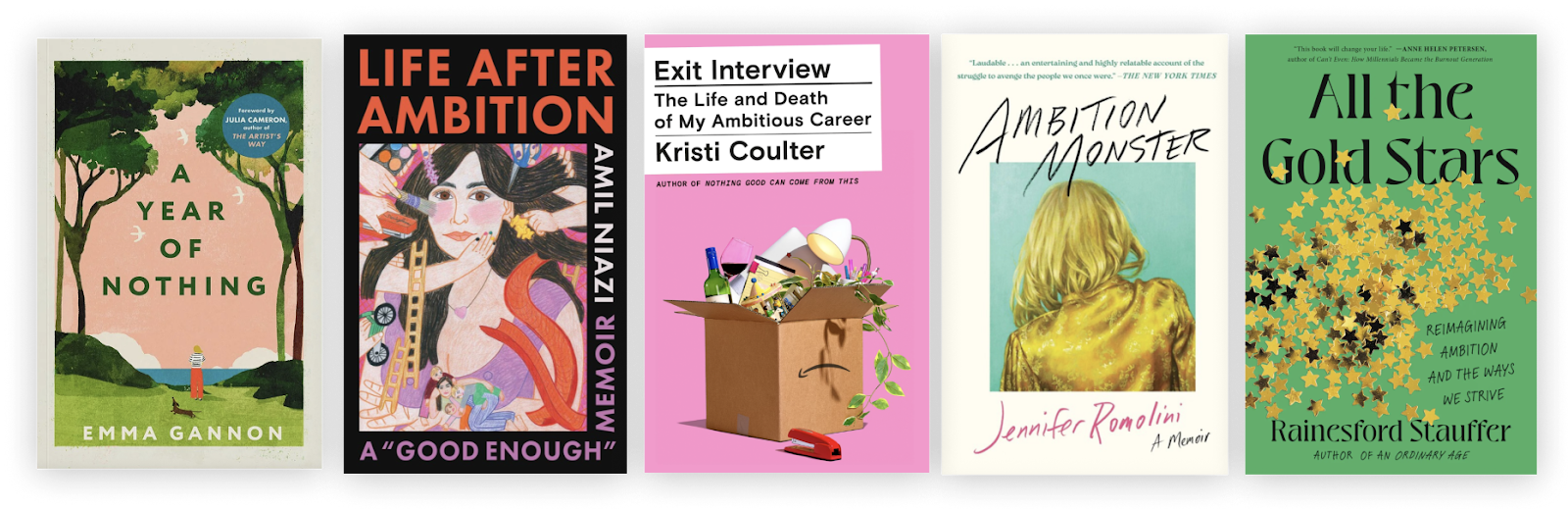
📚 The “burnout memoir” is the hot new literary trend, supplanting the ambitious career guides of the 2010s. These anti-ambition manifestos are a contradiction in terms, as this article notes, because the selling, writing, and publishing of a book requires a “rabid amount of ambition.” It seems like whatever climate we’re destined to enter next—after the Lean In and “lean out” waves recede from our weary shores—will be the best balance for this genre.
The appeal of these burnout memoirs is not unlike that of traditional addiction memoirs—gory details, lurid rock bottoms—but instead of wild nights and risky sex, we get lonely all-nighters and desk-bound panic attacks.2 (Bloomberg)
🇩🇰 Still thinking about this quote from a recent piece about Denmark:
[M]ost Danish citizens can afford to think about their purchases in [terms of ecological sustainability and helping the less fortunate]: “The social safety net here is such that Danes feel life itself can hardly go wrong. If everything fails, they still have a house, a decent life, so they really have the freedom to look at other things—to act on their values.” (The New Yorker)
💬 Tell me: Does it become easier or more challenging to act on your values as you accumulate more money? I’m particularly interested in hearing from people who have experienced an explosion (or collapse) in earnings. Feel free to comment, or reply to this email if you’d prefer to wax poetic in the privacy of my inbox.
👀 In related news: Forty-eight percent of Americans who earn more than $200,000 per year admitted to having recently pretended a payment app wasn’t working to avoid paying someone. This is higher than the rate (39%) among those earning $100,000 or more. (Harper’s Magazine)
Brought to You by Domain Money

Last year, I interviewed Adrianna Adams, my Domain Money CFP®, on The Money with Katie Show, armed with a slew of your unanswered Rich Girl Roundup questions. Because as much as I wish I could claim the title of “financial professional,” I took one look at the stack of CFP® study books when they arrived in the mail and said, Actually, I’ll stick to podcasting. (Don’t worry, I’ll still give you my unprofessional opinion as long as you promise not to sue me for it.)
Today, I’m tapping Alicija, one of the pros on the Money with Katie team at Domain Money, to weigh in on a reader question.
Caitlyn L. asks: We were able to budget and save enough for me to stay home with our new baby for the first year, and I’m so happy to do this. That said, I still want to start investing and continue planning financially for our future. I have about $60,000 in a 403(b) and $11,000 in a checking account for emergency spending while I’m staying home.
What’s the best way to make that money work for me? Is there anything different we should do with my husband’s income during this time?
Alicija answers: Congratulations on the baby and being able to plan for a year at home! My first thought: How many months of expenses does $11,000 cover? While you’re a single-income household, I’d recommend keeping six months of expenses at the ready in a high-yield savings account as your emergency fund. Prioritize building up that balance before investing anything else.
As for the money that’s hanging out in your 403(b), since this money won’t be used until you formally retire, you can invest these funds with an aggressive strategy—think 70% US stocks and 30% international stocks (yes, no bonds!).
Katie’s Unprofessional Two Cents: Six months of expenses in cash may sound extreme, but I’d echo Alicija’s opinion that single-income households need fatter emergency fallback funds—especially with the conditions of our current labor market.
Aside from that, the only other thing I want to point out is the possibility for a Spousal IRA while you’re away from paid work of your own. If you’re able to save six months of expenses before the end of the year and have additional extra savings available, you can open a Spousal IRA for yourself and fund it with your husband’s income. Spousal IRAs work in much the same way regular IRAs do (contribution and income limits, etc.), but they allow parents who work inside the home to invest for retirement in a tax-advantaged way, too.
Have a question that you want a CFP® to answer? Add it in the comments.
🤓 Book your free strategy session now to work with Alicija or another planner on my team of Money with Katie-dedicated CFP® professionals.

⏪ In its first major rebuke of Trump’s executive power, the Supreme Court has ruled tariffs are a no-go, but that doesn’t necessarily mean refunds will be forthcoming. Tariff revenues were expected to offset somewhere around half of the $4 trillion cost of the OBBBA over the next decade. What a waste the last 12 months of discourse will prove to be if this amounts to a true Uno-Reverse. (Wall Street Journal)

🧸 Oregon, the state with the second-highest rate of “unsheltered unaccompanied youth,” gave just $1,000 per month to unhoused people aged 18–24. Within two years, 94% of them had housing.
Gabrielle Huffman, a Bend resident, said the program helped her move into a place where she could heal, grow and plan for a sustainable future. “Just one year after completing [the program], I’m in my own place, halfway through a business degree, focused on building a stable, secure foundation for my daughter and myself, and working toward becoming a nonprofit leader who supports her community.” (The Oregonian)
🛋️ If you count the couch surfers staying with friends and family because they can’t afford a place of their own, the true “homelessness” rate in the US would be six times higher than the official figure. The author of the new book There Is No Place for Us: Working and Homeless in America follows Matthew Desmond’s Evicted playbook of immersing oneself in the circumstances of grinding poverty to produce an intimate portrait of how it degrades one’s humanity. This is the type of writing I’d do if I weren’t such a coward. (Dissent)
🤖 The tendency to dismiss large language models’ comprehension ability is beginning to mirror the “climate debate” of 20 years ago, Dan Kagan-Kans writes. (He’s referring specifically to the “This thing isn’t happening, and if it is happening, it isn’t bad anyway” logic.) This piece made me think differently about the common narratives surrounding AI right now, particularly in light of the question I raised last week about the source of our aversion. Of note: The commenters on this remain unconvinced and indignant. (Transformer)
🧦 McDonald’s was the largest seller of socks for one week last year, when a Grinch-themed holiday campaign moved 50 million pairs. The humiliating stench of contrived enthusiasm always wafts off earnings call transcripts. Bear witness to this shareholder kink: “The Grinch returned after first debuting in Canada in 2024. The campaign, which came to life in several markets in 2025, drove extraordinary excitement, sparking sellouts and becoming a true holiday moment for millions of families.” A true! Holiday! Moment! For millions of families, no less! This is yet another “Gushers wouldn’t be Gushers without the Black community.” (Motley Fool)
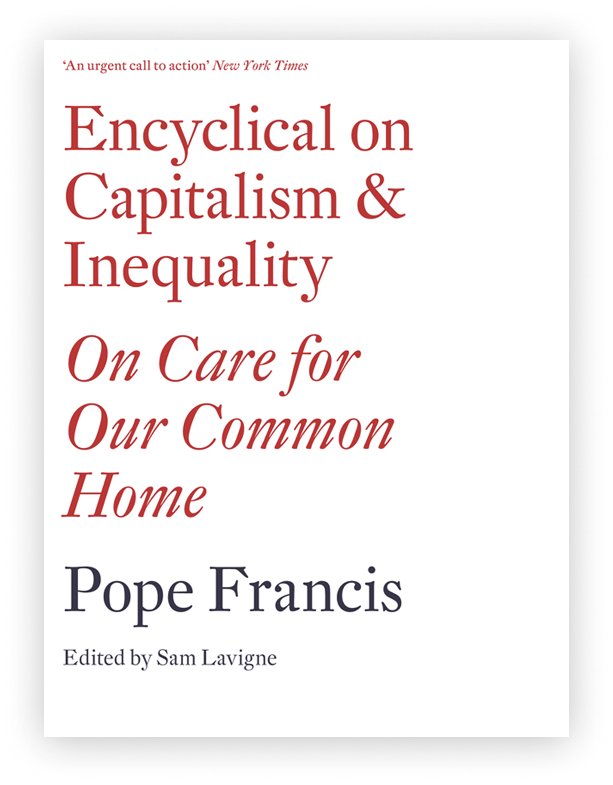
🔔 As part of the joyous and expansive process of book research, I discovered that Pope Francis wrote books critical of capitalism. When I say “woke,” you say “pope”! (Woke) pope! (Woke) pope! Maybe that’s why JD Vance decided he had to go. The ebook is available for free. (Verso Books)
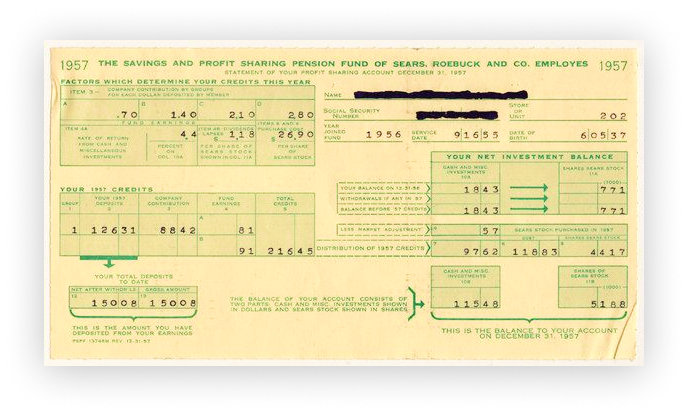
📘 If Amazon’s 1.56 million employees owned as much of their $2.24 trillion company as 1950s Sears workers owned of theirs, every Amazon worker would have stock worth around $359,000. Sears set aside 10% of pretax earnings for an employee profit-sharing plan, and eventually employees owned roughly one-quarter of the company. Sears salespeople regularly retired with more than $1 million in today’s dollars, Nelson D. Schwartz and Michael Corkery write.
Companies like Procter & Gamble, S.C. Johnson, Hallmark Cards and U.S. Steel all embraced profit-sharing and were part of a corporate movement to encourage the practice, he said.
Among some leading executives in the early to mid-20th century, Professor Blasi said, “there was a notion that wages were not enough and workers had a right to share in the fruits of their labor.”
A major takeaway from historical comparisons like this one is that we wouldn’t need to talk about wealth taxes today if our economy had distributed wealth more fairly over the last few decades. As we discussed last week, the American tax system is already pretty effective at progressively taxing labor income, which is why a declining labor share of income creates a conundrum for both households and government. (New York Times)
❤️🩹 Facts like those above make arguments like this one, which implies a spurious correlation between a more robust welfare state and falling incomes, appear particularly lazy. Frankly, I’m tired of reading op-eds of this nature in supposedly serious financial publications. To suggest the growth that occurred in the 30 years immediately following the Great Depression—a postwar economic boom born out of an extreme historical low point—somehow proves that the later invention of a welfare state was at best unnecessary or, at worst, destructive of some incentive to work, is not only disingenuous in its framing, but conveniently elides instances in which programs produced their intended consequences (like Social Security reducing the poverty rate among older Americans by 75%). It’s especially frustrating because there are so many valid and productive critiques to be made instead: benefits cliffs, the inefficiency of means-testing and administrative overhead, privatization, inconsistency. That pieces like this still appear in reputable (British) magazines is wild. The thrust of this argument—which implies you can either have robust wages and dignified work or a social safety net—feels so distinctly American. (The Economist)
📈 Speaking of the 55+ crowd: They’re the only group for whom household wealth hasn’t fallen since 1989.3 Those 65 and older are thriving to such a disproportionate degree that their circumstantial differences are illustrative:
They’re covered by Medicare, so health costs are less of a concern despite health issues becoming more prevalent. What if Medicare for All became a national priority? Healthcare jobs accounted for all net job growth in the last year.
They receive around $29,000 in federal benefits on average each year (inclusive of healthcare), which is “five times what [the government] spent on every child under 18,” and have benefited from compounding returns because they’ve been invested for decades. What if every American child were provided with “seed capital” at birth, available beginning at age 18 or else when a person might need resources to begin adult life? (This isn’t altogether different from the coming-in-July Trump Accounts, the brainchild of my arch nemesis and fellow lover of beach vacations, Ted Cruz.) Better yet, what if we made the key to social mobility—quality education—a right instead of a privilege?
They have the highest rates of home ownership. What if the US took a radical, Vienna-like approach to housing?
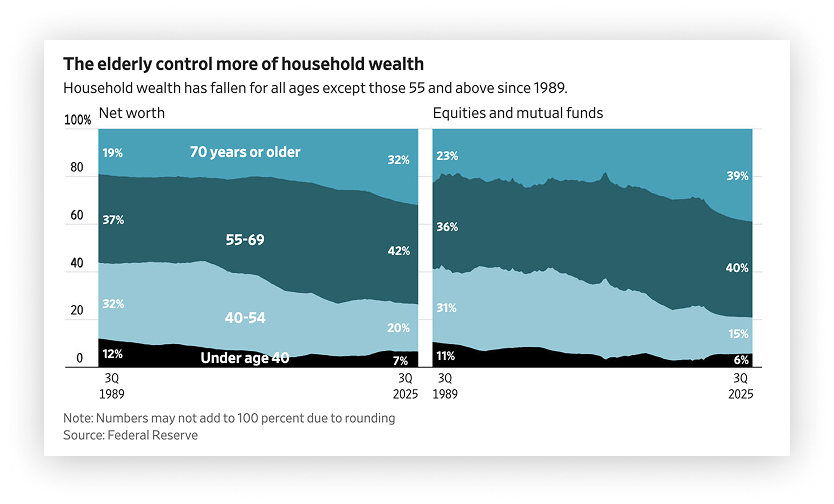
Of course, it’s not revolutionary to suggest that broad access to healthcare, capital (or a reasonable path to it), and housing are the magic ingredients to a stable and prosperous society, but this “the 65-and-older crowd owns the economy” conversation is further support for these national priorities. (Wall Street Journal)

🪀 Toy Story FIVE? Folks, what are we doing here? (Fine, I admit it: A Toy Story premise in which the toys have to fight an iPad for attention is funny.) (Pixar)
🌋 This is what it would’ve been like to live in Pompeii in the hours before (and after) Mount Vesuvius erupted. Apparently upper-class Pompeians laid—rather than sat—down to eat. Going to have to try that. In other ancient class-based reflections, I didn’t know gladiators were slaves who were forced to fight to the death. Is this something I would’ve known if I’d ever watched Gladiator? (Aeon)

🔨 I don’t know who Clavicular is, and at this point, I’m afraid to ask. There are a few lenses through which to parse this viral curio and the cultural degeneracy for which he is, supposedly, an avatar: In one accounting, the “looksmaxxing” trend transforms the tragedy of beauty standards that have long plagued women into farce, becoming immediately recognizable as life-diminishing and absurd. In another, we see the outcome of a teenage boy spending 14 hours per day online. To me, the real story is the one revealed in this quick BBC conversation—that 950 (!) short-form video mercenaries, empowered by a seven-figure (!!) monthly marketing budget provided by edgelord streaming platform Kick, have seeded the internet with “clips” of Clavicular making outrageous claims. Today, it is virtually impossible to infer organic popularity from the seeming ubiquity of an online trend. This is Money with Katie, so I’m going to put forth a third lens: Nathan Robinson draws parallels between the men who are obsessed with their “sexual marketplace value” but, strangely, not interested whatsoever in sex itself, and the way in which capitalism incentivizes the accumulation of fortunes so vast that the desire to make more money eclipses the desire for the things that money can buy. (Current Affairs)
⛺ I want to write an entire essay about the ending of Alone Season 11. Without spoiling anything, the notion of money as a barrier between you and your work will stick with me. (History Channel)
See you next week.

Advertiser Disclosure: Money with Katie is a promoter of Domain, a real client, and receives compensation in connection with sponsorship of the newsletter. This compensation creates a conflict of interest because it may influence the content presented, including the featuring of Domain Money or its advisors. The views expressed by the promoter are their own and do not necessarily reflect the views of Domain Money. This communication is for informational purposes only and should not be construed as a recommendation, offer, or solicitation for the purchase or sale of any security. All financial planning and investment strategies should be tailored to the unique circumstances and objectives of each client.
I don’t know what we call this now.
I’m going to write a book called “Yep, Still Striving”
It’s because all other wealth began immediately flowing to Taylor Swift following her birthday on December 13, 1989
Oh 100% it’s easier to act on your values when you have more money. As someone who went through a drastic collapse of earnings and then explosion of earning in two years (hello surprise pregnancy and 4 month NICU stay!), it’s so much easier to act on values when you have more money. Like the New Yorker article says, I’ll still have a decent life if everything falls, so I can look at purchase options through a lens of values instead of pure price.
I do think the mistake is thinking it’s merely the money that gives you the ability to act on values, when money amplifies whatever values you currently hold. And if you’ve never sat down and defined those before, you can immediately get inundated with lifestyle inflation, too-generic money advice, and keeping-up-with-the-Joneses noise that can crowd out those values when suddenly you have more money than you spend on necessities. It’s easier to define your values when you don’t have as many things vying for your money all at once.
I wonder about the burn-out memoirs. It's one more variation of "the workplace is broken" theme, along with some of the tradwife content. I'm all for the idea that we need to have lives that are not dedicated to work, and I absolutely know that the workplace will not love you back. But someone needs to stay! We still need to fix the work and the workplace and not just leave (which is impossible for most people anyway) or even just quiet quit.