



Humor me: If money were no object, what’s the shameless luxury you’d spring for? Think big and tell me in the comments. As someone who works from home, is presently charged with the care of a puppy in his shark phase, and frequently feeds herself things that have little nutritional merit beyond being technically edible, mine would be a professional house manager who doubles as a home chef. (If you’re thinking sounds like you want a housewife who’s also your mom, guilty as charged.)
Today’s issue goes out to a reader who replied to last week’s newsletter saying, simply, “You have lost your mind.” A mind? In this economy? A Google search of his email address tells me he’s a 68-year-old man named Michael. Someone kindly come retrieve your dad.

🧰 There’s a way to reclaim “work ethic” from the capital class’s toolbox, Martin Dolan argues, where it’s currently a weapon of psychological warfare used to make workers feel they must constantly justify being paid at all. Pride in one’s work—or emotional and economic ownership—doesn’t have to be “a vehicle of inequality.” This pleasantly meandering essay, which spends some time with the “bullshit jobs” framework and partially reviews a book called Hijacked: How Neoliberalism Turned the Work Ethic Against Workers and How Workers Can Take It Back, teased apart my discomfort with being a critic of capitalism who finds so much pleasure and reward in working. (The Point)
🧓 Expiring marketplace health insurance subsidies have Americans “afraid to age” in the United States. Alternatives include crossing the border for care in Mexico (the irony), membership-based direct primary care plans (somewhat promising), and potentially the most expensive of all: hoping nothing bad happens. The US healthcare system is, to my mind, the most acute expression of how much absurdity and abuse the American people will tolerate from the government and private industry. I have a grandparent in the VA system right now and another in a private hospital system, and to hear my dad tell it, the difference in their experiences is “night and day.” The VA is one of only two purely socialized healthcare systems in the world. The other is Cuba. (Bloomberg)

🎢 S&P 500 subindexes tracking dividend or “low volatility” stocks might be a better hedge against an AI bubble than bonds, gold, or other alternatives right now. Given my age and general laziness, I’m not going to reallocate my portfolio because of short-term(ish) concerns—but with the recent announcements from big tech companies that they intend to spend another $660 billion on AI this year, it’s reasonable to consider divesting from that black hole of a bet. (The Economist)
🪧 January 30’s ‘General Strike’ (scare quotes necessary) didn’t materialize. Former guest of the show Eric Blanc says that’s because it was primarily organized by student groups, rather than unions and other legitimizing organizations of workers. When the multiracial working class is so preoccupied with cost of living and precarious, at-will employment, mobilization is a challenge—though it’s been done in this country before, and in a time without labor laws or Signal chats. (Jacobin)

🚪 “There is a God.” That’s what I said aloud when the latest episode of If Books Could Kill appeared in my podcast feed, covering the famed compendium of Boomer Frugality Mythos The Millionaire Next Door. Turns out the survey data used for the book specifically selected for middle-income low spenders (and curiously omitted the high-income, high-roller households) to reach its moralizing conclusions about who becomes a millionaire and how. The postscript—which revealed that following the raging commercial success of the book, both authors purchased brand-new luxury cars—was the perfect chaser. If you need a laugh, don’t skip this. (If Books Could Kill)
✍️ While software engineering jobs take a hit, the rise of “slopaganda” is—I can’t believe I’m typing these words—fueling a mid-six-figure salary comeback for writers. Coders, step aside. Hanna Horvath of Your Brain on Money called my attention to this development.
Amid all chatter about gen AI taking jobs, the ease with which gen AI spits out content has ironically revved the demand for human communicators. [...] Creatives are becoming “the high-value person in tech now.” [...] The best defense against automation, some argue, will be a liberal arts degree. (Business Insider)
Excuse my French, but let’s fucking go. In search of one of these vaunted writer roles, I perused open positions at OpenAI. Behold, a copywriter job that pays up to $295,0001:

If you can’t beat surveillance capitalism’s robotic world takeover, join it, etc.
Brought to You by Domain Money

✅ A Certified Financial Planner (or CFP®) Professional, which is the ultimate nerd status for a financial advisor
✅ A model that does not involve sales commissions for certain investments or financial products (or, God forbid, “load fees”)
✅ And most importantly, a flat or project-based fee structure, rather than an assets under management (or “AUM”) fee of 1% or more
Domain Money checks all three of these boxes, particularly the last one. That typical “1%” planning fee may look small, but as your portfolio grows, it’ll sneakily become the biggest expense in your budget. Don’t accidentally overpay for financial advice.
A few recent Rich Girl nation wins: One member switched her family’s 401(k) contributions to pretax, saving $10,400 in taxes in one year, over three times her annual Domain Money fee. Another moved $100,000 from cash to investments and saw a $3,500 gain in just one week, covering the cost of her entire plan almost immediately.
The Domain planning process encompasses everything you’d expect from a financial planner, plus more comprehensive services that typically involve expensive fee models:
Guidance around stock options (RSUs, ISOs, and other equity-based compensation)
Strategic tax preparation and filing
Behavioral coaching during market downturns and asset location strategy that minimizes the unnecessary risk that can be easy to overlook when doing it yourself
Plus, for those of you who reside firmly in the “I just want someone else to tell me what to do so I never have to think about it again” camp: Your Domain Money CFP® will now manage your investment portfolio for you if you’d prefer to hand it off entirely, and still with only a flat fee, never an AUM fee.
🗓️ Earn up to $1,500 as an investment bonus to help jump-start your portfolio from day one.

🗞️ When Jeff Bezos bought the Washington Post in 2013, he was worth about $25 billion. That’s not nothing—but it’s a lot less than his current $250 billion fortune, making this quote about his early days with the Post, the outlet that once broke the Watergate story, so notable:
“In the beginning, he was wonderful,” Sally Quinn, the veteran Post contributor and wife of its legendary executive editor, Ben Bradlee, told me of Bezos. “He was smart and funny and kind and interested. He was joyful. He was a person of integrity and conscience. He really meant it when he said this was a sacred trust, to buy the Post. And now I don’t know who this person is.”
One’s commitment to honor and integrity likely sours long before the first $100 billion, but the present slash-and-burn operation at the Post is an abject lesson in the futility of erecting a critical pillar of society atop the sustained largesse of the benevolent billionaire. A well-funded Fourth Estate, while imperfect in its corporate-captured form, is central to a functioning democracy. (The New Yorker)
🏦 The latest Epstein file dump feels too immense to cover in the depth it deserves, but Rachel Cohen observed the Justice Department’s current tack suggests a “too big to fail” approach. There are simply too many predatory powerful people in these files for accountability to feel possible. The overwhelming depravity and sporadic redactions are, in that respect, more like gloating than honest disclosure. (Instagram)
🎤 The pop “idol” industry in countries like Korea and Japan organizes itself via “enforced sexual purity, parasocial entitlement, and female infantilization fetishes,” which—surprisingly—tells us where US pop culture is likely headed. This piece lays out the parallels between how capitalism has ravaged Japanese culture and quality of life, and what’s currently unfolding in the United States:
Rather than culture, I believe that this “weirdness” is more attributable to Japan being one of the first nations to enter late-stage capitalist collapse. The cultural stagnation seen in the US now, was actually predicted decades ago in Japan. Americans now exist under the same structural precarity and economic pressure that produced the “quirkiness” seen in Western perceptions of Japan.
In stripping this argument of the gender essentialist creepiness that so pervades it in the US and naming capitalism, rather than feminism, as the culprit, the decay of free time, leisure, and relationships is stark. (Drops in the Ocean)

👹 A pro-billionaire rally in San Francisco attracted a peak of 20 “protesters,” which is approximately 20 too many. Attendees brought signs scrawled with Cato-friendly slogans like “INCENTIVES MATTER” (true enough) and “BILLIONAIRES BUILD THE FUTURE” (give me a break). Imagining billionaires as a disenfranchised group in need of an awareness campaign is straightforwardly hilarious, but in a twisted way I sort of get it: The one thing this class can’t buy is public support. The organizer, a 26-year-old who trains AI models and was himself likely trained on the Atlas Shrugged audiobook looping while he slept, joined centrist liberal pundits like Matt Yglesias in the grand tradition of using one’s body like Peter Thiel’s personal meat shield. He stated that he “wanted to stand up for what he believe[s] in” because “no one else would do it.” Dustin Moskowitz, the billionaire cofounder of Facebook, asked for his name to be removed from the affiliated pro-billionaire website, linking to the last time he replied to one of these weird nerds trying to give him a nonconsensual tongue bath. “The class is malignant and should be maligned,” he wrote. (Wall Street Journal)
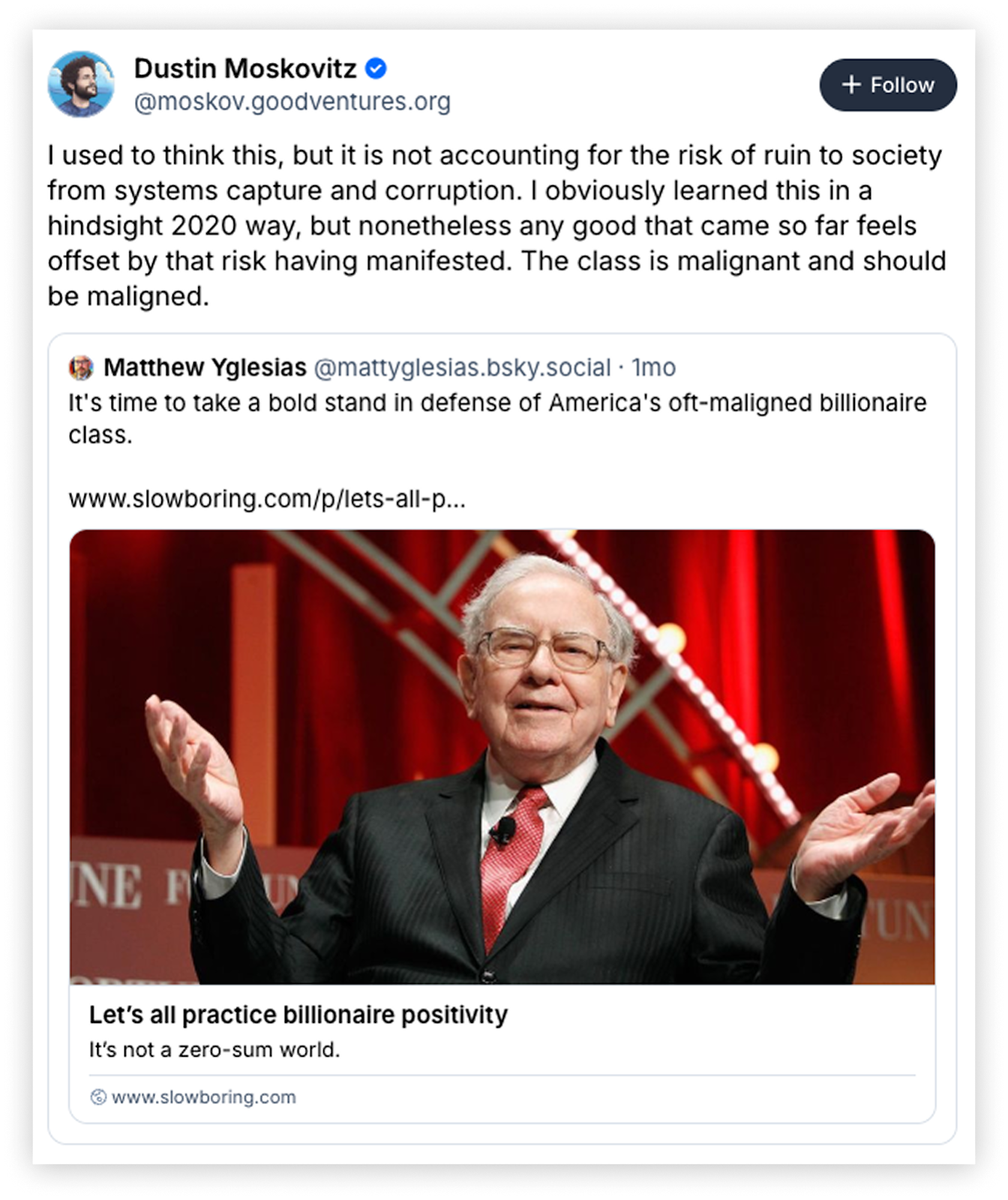
✉️ As for the millionaires and billionaires, 400 have signed a petition calling for higher taxes on the super-rich. Signatories include 13 Going on 30 heartthrob Mark Ruffalo.2 Grace Blakeley, author of Vulture Capitalism, explained, “The problem is no longer whether extreme wealth is fair, but whether a society organised around it can continue to function at all.” (The Independent)
An excerpt from the letter:
“You already have a simple and effective solution, supported by millionaires and the public alike. Stop squandering the time we have—tax the super rich. [...] As millionaires who stand shoulder to shoulder with all people, we demand it. And as our elected representatives—whether it’s those of you at Davos, local councillors, city mayors, or regional leaders—it’s your duty to deliver it. So tax us. Tax the super rich. [...] Millionaires like us refuse to be silent. It is time to be counted. Tax us and make sure the next fifty years meet the promise of progress for everyone.”
If the US’s wealth were distributed perfectly evenly, every American family of four would have a net worth of $1.89 million. Though an equal distribution of this nature would likely never be possible (nor, I’d argue, necessarily ideal or fair), it contextualizes that there’s unequivocally already more than enough in this country for everyone to live a dignified life.

🐈 The research that suggests cats think humans are just bigger cats is endlessly charming to me. An animal medium once described to me how Sam Cat perceived our family: “He’s showing me all of you on your own pedestals,” she told me, “but his is a little higher.” Tracks. (National Geographic)
📱 The imperialist expansion of short-form video to far-flung corners of the internet (and the clipped soundbites of discourse it produces) has suffocated direct and vigorous political debate, Nathan Robinson argues. Who would’ve thought we’d ever be nostalgic for a time when online arguing was more high-minded? In this recent interview, David Remnick sits down with Ben Shapiro—one of the last remaining media figures attempting to keep the “conservative public intellectual” tradition alive in the Hulk Hogan era of the Republican party—to press him directly. Shapiro’s explanation of how he came to hold a conservative worldview is reasonable enough, even if our present circumstances make a tedious parceling out of personal responsibility feel pedantic. (Current Affairs)
Shapiro: The difference between right and left—in my definition of it—is that the right acknowledges that when people fail, because human nature is fallible, very often that is your own responsibility. And the best way to actually treat that problem is to self-correct. And the left, because they have, I think, a rosier view of what human nature is, tends to attribute to systems that which I think more properly lies in responsibility with the individual.
I disagree with his definition as well as his conclusion, which I happily share with you in the spirit of debate!3 Elsewhere, Shapiro laments that conspiracism has overtaken the conservative movement, a diagnosis that isn’t necessarily wrong as much as it’s about 40 years too late. For as long as I’ve been alive, the party’s priorities have seemed devised from a defensive crouch, shaped in paranoid response to shifting dangers foreign and domestic. And now that we know there actually was a cabal of sick fucks trafficking children and teens in their down time from hedge funds and international politics and production houses? It’s hard to argue that conspiracy theories are the problem.
📹 About that Super Bowl ad for mass surveillance…
Unlike, say, data analytics giant Palantir or some other high-profile surveillance companies, Ring is a surveillance network that homeowners have by and large deployed themselves. (404 Media)

💭 In the next episode of Diabolical Lies, I’m setting out to prove that a down-the-middle “centrist” political perspective is, largely, a myth. This essay by rayne fisher-quann, “Centrist Imaginations,” was a masterpiece start to finish; when I imagined her writing it, I pictured her eyes closed, channeling wisdom from the same place my animal medium downloads messages from Sam Cat. Her writing here feels so clear and effortless that I know the piece must’ve actually required a tremendous amount of effort. (Internet Princess)
In the meantime, enjoy this week’s episode:

See you next week.

Advertiser Disclosure: Money with Katie is a promoter of Domain, a real client, and receives compensation in connection with sponsorship of the newsletter. This compensation creates a conflict of interest because it may influence the content presented, including the featuring of Domain Money or its advisors. The views expressed by the promoter are their own and do not necessarily reflect the views of Domain Money. This communication is for informational purposes only and should not be construed as a recommendation, offer, or solicitation for the purchase or sale of any security. All financial planning and investment strategies should be tailored to the unique circumstances and objectives of each client.
listen, everyone has a price
yes, this is still the most notable thing he’s ever done, in my former teenage girl opinion
despite the leftism my own adult intellectual discovery process led me to, I feel like my upbringing allowed me to understand the conservative perspective—on the level of emotional appeals, at least—in a way that kids who grew up in liberal households may not
Update: my mom texted me after reading this and goes “what does the house manager chef role pay? I have 40 years of experience” lol
If money were no object, I'd support my physical and mental health like a professional athlete: personal trainer, physical therapist, massage therapist, performance psychologist, nutritious prepared meals.