



The failure of Spirit Airlines, Doreen St. Félix writes in The New Yorker, represents “the death of leisure for the non-leisure class,” a reference to Thorstein Veblen’s 1899 economic treatise, The Theory of the Leisure Class. As I happened to have a copy on my desk for an unrelated project, I cracked it open. The book begins like this: “The institution of a leisure class is found in its best development at the higher stages of the barbarian culture; [...] In such communities the distinction between classes is very rigorously observed.”
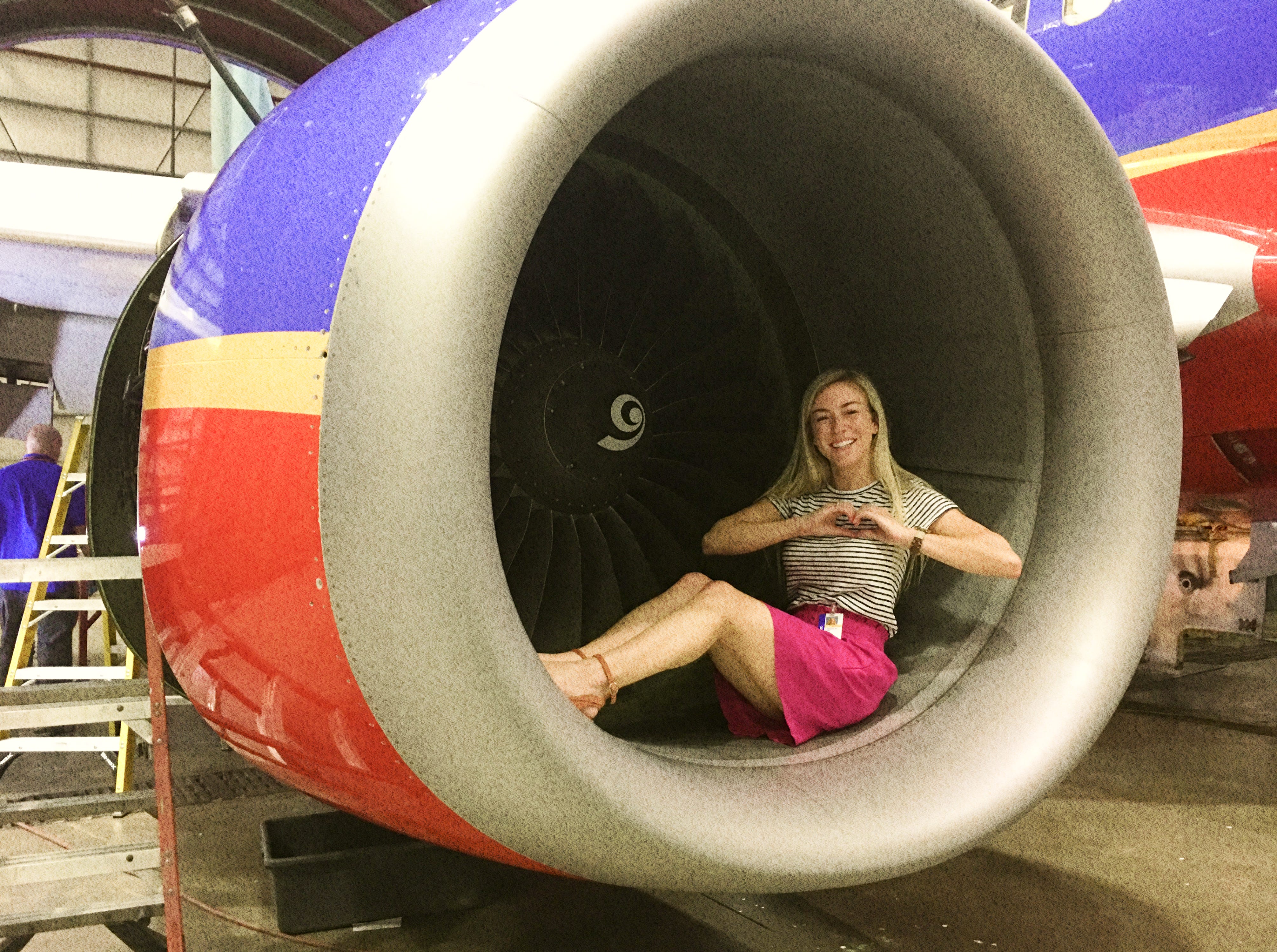
Nowhere is the distinction between classes more rigorously observed than on an airplane, where you’re physically separated into aptly named “classes” based on how much money you forked over for your ticket, then treated accordingly. At Southwest, we liked to say our radically egalitarian fiefdom was all First Class.
The more time I spent reading about Spirit’s recent demise, the more it came to strike me as an accidental allegory. Its complex, multicausal collapse provides a readily weaponizable narrative no matter your partisan1 commitments, but ultimately, I think it’s most instructive as a story about American culture’s evasive yet nakedly contemptuous relationship with things that scan as “lower class.”
In an origin story that’s a little too fitting for the debauched reputation that would eventually plague it, Spirit Airlines started flying in 1983 under the name “Charter One” to shuttle the denizens of Detroit to gambling destinations like Atlantic City and Las Vegas. Its “controversial ads” were designed not for the “high-class travelers,” but for what Spirit saw as its “working-class audience,” according to Business Insider. Known formally as an “ultra-low cost carrier”2 and informally as the “Walmart3 of the Sky,” Spirit offered a stripped-back product to the unfussy proles, a valuable presence in a country without a public option.4 By the end, its schedule represented only about 3% of domestic flight capacity, its significance more symbolic than operational.
Still, in the domestic routes it served, Spirit provided roughly three in every four “ultra-low cost” seats available. The administration reportedly considered buying a 90% stake for $500 million—“only if it’s a good deal”—but, in a conspicuous break from the time-honored American tradition of bailing out airlines amid cycles of mismanagement and bankruptcy, a combination of internal political and external industry pressure intervened: Spirit should be “allowed to fail.”
Examine the coverage long enough and a few repeated statistics assemble into a seemingly straightforward narrative of demand drying up. You’ll learn it was, as of 2020, a chronically profitless firm, endeavoring to attract budget-conscious travelers in the context of an airline industry increasingly geared toward more posh offerings. You’ll learn it had filed for bankruptcy twice in the previous 20 months. You’ll learn that nearly 17,000 employees had income and health insurance one day and not the next, waking up to ceased operations with no advance notice or severance. One quarterly report cited weak domestic leisure travel demand, which is Airline Speak for “people aren’t flying for fun as often as they once did.”
This is a marked divergence from the assessment provided by the luxe carriers. Delta’s CEO, a man who “looks like he was born on CNBC,” noted a couple months ago that the company’s target demographic—premium leisure travelers—were, practically speaking, totally insulated from economic strain. Of the four legacy carriers, Delta has most enthusiastically embraced the lucrative status anxiety game of which Veblen warned in 1899, courting customers who are “probably the highest end” of the K-shaped economy, as one Delta executive puts it, and evidently eager to prove it. The airline has savvily refashioned itself in the image of the 10% of Americans who do about 50% of the spending and own about 68% of the wealth, a group for whom there’s functionally no limit on their purchasing power. As a result, according to Intelligencer, Delta reaps 55% of industry profit with only 20% market share. “The industry is moving toward elite clientele,” a veteran network planning and scheduling executive told Ben Ryder Howe. “Eventually the big airlines will minimize the main cabin and”—these next words are load-bearing—“let Frontier and Allegiant handle those people.”
In the aftermath of Spirit’s sudden disappearance, you’ll encounter pieces mourning the downward pricing pressure of “the Spirit Effect,” named for the way prices decreased by an average of 20% whenever Spirit entered a market, and pointing out that even those who didn’t select the lowest-cost option still benefited from its presence in the marketplace. Others make the (related) observation that it was “the most ridiculed mode of conveyance outside of the Segway,” as Dave Schilling puts it for The Guardian. That ridicule is of particular interest. As Vanessa Ogle writes in a piece called “I Grew Up in Poverty. Spirit Airlines Was My Lifeline,” flying on Spirit often meant—via the transitive property—becoming the butt of the joke yourself. Comparisons to Walmart and Waffle House, after all, are intended not just to conjure an idea of what the service is like, but who you might encounter in these spaces: those people.5
Then there’s the matter of a TikTok joke-turned-grassroots movement that raised more than $335 million in non-binding pledges from the public in an attempt to buy the failed airline. “With more than 250 million adults in the United States,” Yahoo! Finance explains, “it would take only a slice of them chipping in around $30 to $40 each, roughly the price of a budget Spirit ticket, to buy the airline outright.” This is the logic animating all public ownership, existing in that “blurry zone between internet stunt and genuine public yearning” (and, in the case of the National Football League, an ethos that produced the community-owned Green Bay Packers). The effort has support from Spirit’s flight attendants’ union.
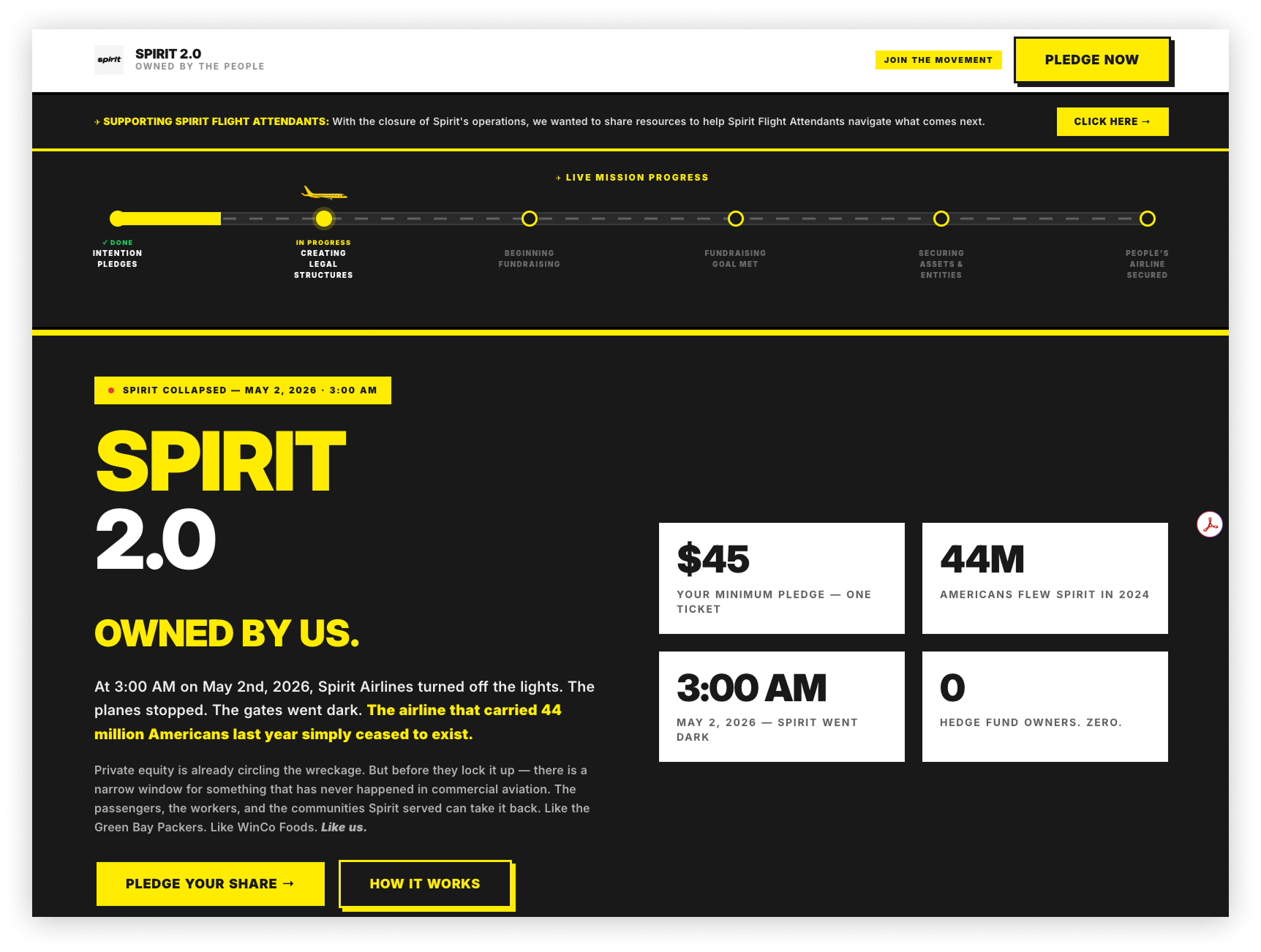
The bemused coverage of this development has ranged from the tone a local news station might adopt while reporting on a particularly precocious Girl Scouts troop all the way to downright hostility. One particularly tut-tutting piece can barely contain its derision for the “champagne-capitalist Gen Z-ers who preach socialism while still living on their parents’ dime,” displaying all of the disdain and virtually none of the finesse of a Tom Wolfe-style send-up that—it needs to be said—is completely nonsensical from start to finish. (The correct epithet is “champagne socialist,” not “champagne capitalist,” as the latter is just known as “capitalist.” The y’all so broke you live with your parents insult inadvertently reinforces the logic it’s criticizing: Why might a group that’s so economically fucked they’re forced to rely on their parents be interested in a different economic system?) This easy mockery—reducing a desperate, backchannel attempt to prevent private equity from pillaging the wreckage of yet another public utility to nothing more than the wanton plaything of a spoiled, secretly elite underclass—is the same dismissive those people sneer, this time partially concealed by a more sophisticated, pseudo-populist gloss.
One compelling interpretation of the Spirit collapse says that products and services designed almost exclusively to appeal to lower- and middle-class people will fail as our economy further squeezes their capacity for discretionary spending.6 But in Spirit’s case, this analysis mistakes an effect—lower- and middle-class people spending less—for a cause.
While it suffered a calamitous hit in 2020, Spirit’s revenue since then doesn’t tell the story of customers who are uninterested in flying. Between July 2023 and July 2024, Spirit had the second-highest customer growth in the industry as measured by passengers flown. (Just a few months later, it filed for bankruptcy and started cutting system capacity. Management deserves scrutiny. The CEO was paid a $3.8 million retention bonus the week before the 2024 bankruptcy filing.) In 2025, Spirit filled a higher percentage of its seats (78.4%) than my alma mater Southwest (77.4%) but still trailed the legacy carriers, which hovered closer to 82%.
To the extent it had fewer customers in the last 18 months, it’s largely because it was selling fewer seats, not because the target demographic for low-cost air travel suddenly pivoted to Comfort+. That Spirit’s fate was downstream of a flying public clamoring to pay more for a cushier offering might be a convenient framing befitting the slide deck of a Wall Street analyst or whoever formulates Ed Bastian’s on-air talking points, but not one that seems supported by the evidence of Spirit customers’ own behavior. This isn’t a demographic choosing between Spirit and Delta; it’s one choosing whether to fly at all.
Maybe that’s why the memes about the airline and its customers often devolved into overt classism and racism, the company “mocked as ‘ghetto,’” as Kahlil Greene puts it. Perhaps it can partially explain why it was “allowed to fail,” as United CEO Scott Kirby lobbied to Transportation secretary Duffy when the administration was weighing the bailout, a failure that imposes the most direct costs on low-income and working-class people. Whether that strikes you as a broader commentary on who and what bailouts are typically concerned with protecting depends on where you’re sitting on the plane.

…all delivered via your dedicated CFP® professional. I totally DIY’d my entire financial life for years, in no small part because the alternative—paying a percentage of my assets to an advisor in perpetuity—was so stunningly unattractive to me. (Read enough personal finance books, and you learn quickly that overpaying for financial advice is the cardinal sin of money management.)
But after a coffee with a CFP® professional friend a couple years ago who asked about the coverage size of my umbrella insurance policy (narrator: she didn’t have an umbrella policy), I realized there were probably gaps in my plan that could cost me later.
I began working with Domain Money in 2023 and recently revamped my retirement plan for self-employment with Adrianna Adams, my Domain Money CFP® professional. I asked her to run several income scenarios based on bad, better, and best projections. The main question I wanted answered: How much can we spend each month without undermining our future progress, depending on these various scenarios? I wanted the optimal retirement investment strategy—and what I could confidently spend guilt-free.
Other Rich Girl Nation clients have had similar wins: For one client, redirecting $7,000 annually with the Backdoor Roth IRA strategy is projected to generate $5,000 in tax savings over the next decade. Another found that through a $900/month redirection of excess spending, their retirement timeline shortened by two full years, without sacrificing anything meaningful.
Get guidance around stock options, tax prep, investment portfolio management, and more, with your Domain Money CFP®.

(I’m hijacking7 this section for an extended aside on the whole JetBlue merger political football specifically, because newsletters are benevolent dictatorships and yours truly rules with an iron fist.)
Was Spirit’s fate sealed with the blocked acquisition?
In the end, a lot went wrong: Much of Spirit’s operational edge came from flying its aircraft for more hours each day, thereby generating more revenue per plane. It also happened to fly a disproportionate share of leased A320neos, which were impacted by a badly timed Pratt & Whitney engine recall that resulted in dozens of jets being taken out of service. (Financially, this is comparable to leasing an expensive car that you intend to pay for by driving Uber, then immediately discovering it needs a time-consuming repair.)
Operational troubles aside, after the airline went under last week, the Wall Street Journal editorial board swiftly and predictably convened to declare this another fatality of “the antitrust left” and the “Biden Justice Department,” referencing a 2024 ruling against the JetBlue acquisition. (The prevailing framing that Judge William Young was some woke Biden puppet is curious, considering Young was appointed to the bench in 1985 by Ronald Reagan.)
In the Journal’s telling, JetBlue’s attempted purchase of Spirit was a “lifeline,” language that suggests the altruism of a rescue plan. This framing is echoed in the Fox News coverage that reported the Democrats “killed a business deal that would have saved the airline.” In the latter’s rosy accounting, the deal would’ve bestowed the flying public with the gift of “the best of both businesses, leveraging JetBlue’s global scale in service of Spirit’s low prices.” This benevolent narrativizing of the deal—a “lifeline” to “save” the business—makes it sound as though Spirit was clamoring to be acquired by JetBlue, seeing no other path forward for delivering its ultra-low fares.
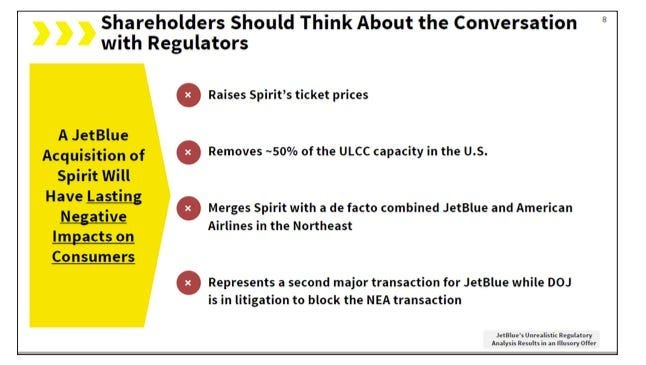
This assessment is hard to square with an “improperly redacted” internal document that showed JetBlue calculated they could raise Spirit’s fares by “up to 40%,” functionally eliminating their ultra-low cost competition. The Spirit board “oppose[d] an acquisition by JetBlue” and urged shareholders to reject the offer (they wanted to merge with fellow ultra-low cost carrier Frontier instead). At issue were, among other things, 99 overlapping nonstop routes, meaning a merger between the ultra-low cost carrier and the merely low-cost carrier would likely result in an overall reduction of service and higher prices.
Hindsight is, as they say, 20/20, but if Spirit believed it was going to fail without the JetBlue merger, it could’ve deployed the parachute of the “failing firm” defense. It didn’t. Instead, it explicitly indicated it had a plan to return to profitability. That plan depended on fuel prices remaining at about half their current levels.
Money with Katie is a promoter of Domain, a real client, and receives compensation in connection with sponsorship of the newsletter. This compensation creates a conflict of interest because it may influence the content presented, including the featuring of Domain Money or its advisors. The views expressed by the promoter are their own and do not necessarily reflect the views of Domain Money. This communication is for informational purposes only and should not be construed as a recommendation, offer, or solicitation for the purchase or sale of any security. All financial planning and investment strategies should be tailored to the unique circumstances and objectives of each client.
The news prompted Transportation secretary Sean Duffy to tweet the other day—every last one of his 250 characters capitalized—that the failure of the business was downstream of THE DEMOCRATS who prevented two competitors from becoming one, a decision which he concluded, bewilderingly, resulted in “less competition.” To hear his predecessor Buttigieg tell it, the most proximate cause is the doubling of fuel prices from the Trump administration’s war in Iran. And now you’re up to speed on the political football game!
In the airline world, there are “low-cost carriers” (JetBlue, Southwest sometimes) and “ultra-low cost” or “budget” carriers (Spirit, Allegiant, Frontier). This distinction is relevant in the broader “JetBlue acquiring Spirit” conversation.
Alternately: Waffle House
By public option, I mean an airline owned by the government of a given country, like Air France or Emirates, to cite two popular carriers.
There’s an interesting counterpoint to my entire argument that a better writer than me could make about how Spirit also sort of embodied and entrenched the idea that experiences intended for people without money should be shitty and subpar. But this is not that essay.
This fear would appear well-founded. The bottom half of the country collectively possesses only 2.5% of its overall wealth.
This metaphor may be in poor taste considering the surrounding subject matter and I acknowledge that but I’m not changing it because (a) benevolent dictatorship and (b) what a verb!
Fantastic analysis!
People like me won’t pay more. We will simply not fly.
The reason I read this publication: "a reference to Thorstein Veblen’s 1899 economic treatise, The Theory of the Leisure Class. As I happened to have a copy on my desk for an unrelated project..."