



Inflation is back and outpacing wage growth, allegedly for the first time in years. This is—to understate it—not the sort of economic update the masses were clamoring for.
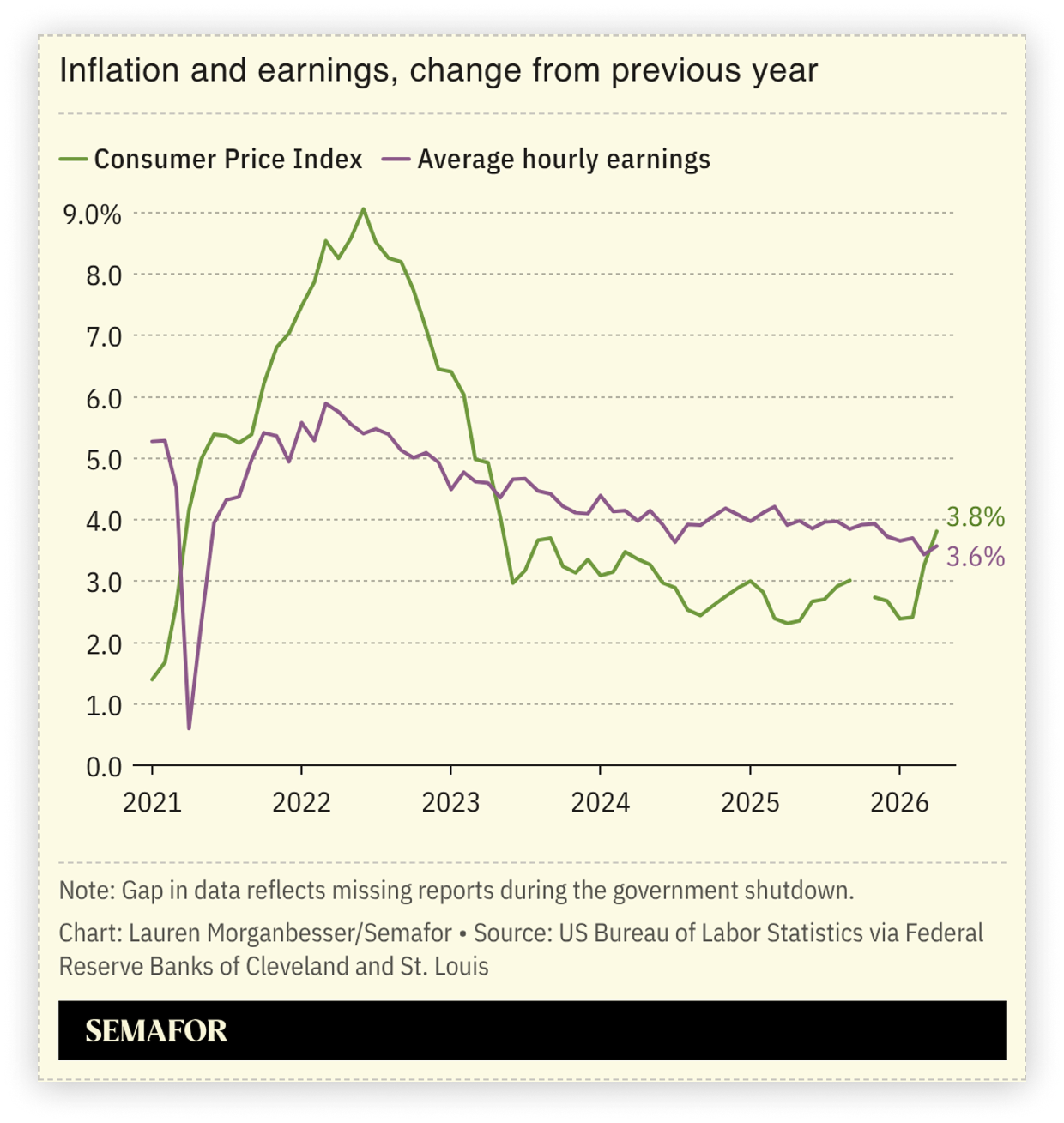
The leading cause for the spike is fuel, which remains above $4 per gallon at the gas pump and is at least partially responsible for a 27% jump in domestic summer airfare. As Bloomberg reports, high gas prices are the most reliable way to tick off Americans en masse,1 an all-purpose proxy for everything else that feels too expensive since the cost of everything else isn’t announced in two-foot-tall numbers on the side of the road. It’s worth noting that, amidst all this Big Gulp-lubricated roadside misery, these moments present convenient opportunities for wealth consolidation to US oil and gas giants. Following Russia’s invasion of Ukraine, Fernando Rugitsky writes for Phenomenal World, “more than half of the 2022 oil profits” accrued to “the richest 1 percent of individuals.”
It’s for this reason that I feel like Kevin Warsh, the new Fed Chair replacing J. Pow and a man who, if you recall from his nomination, has “the look,” just inherited the job inches from the dreaded glass cliff usually reserved for lady CEO candidates vying to lead a firm about to publicly announce staggering levels of fraud. When Warsh was nominated in January, analysts were optimistic we’d see at least two interest rate cuts in 2026, and Warsh was more than pleased to deliver them.
That was before all this business with the Strait of Hormuz. Now, after two months of climbing inflation and a relatively stable job market, it’s unlikely we’ll see a cut at all this year. Mortgage rates are already rising, per the Financial Times, as lenders “respond to increases in ‘governments’ borrowing costs,’” in effect betting that rates will be higher in the future. “The conventional tool of monetary authorities—an increase in interest rates—will do little to address the energy crisis,” Rugitsky writes. “It merely shifts the burden of adjustment towards the working classes, increasing unemployment to soften demand and try to mitigate the rise in the price level.”

This shift in the hard data is notable because, for the first time since 2022, numbers finally appear to affirm feelings. For years, the public sentiment captured in polls and the data pumped out of various government bureaus appeared at odds, giving us the unbelievably sticky invention of the “vibecession,” where the rules are made up and the points don’t matter.2 According to the numbers, people should’ve felt a gradual relenting of financial strain—that they were on the positive side of a gap between their growing wages and the cost of living, until this very moment. They largely didn’t.
There were many competing theories for this mismatch, and as such, many pundits at major papers busied themselves supplying theories of “justs”: People are just negative about the “cost of living” on social media (more on that shortly), which drives perspective more than material reality. Customers just don’t like paying more, even if their rising wages more than make up for it. People just think Joe Brandon3 is too old.
The serious publications I consulted in my weekly news binges seemed to pingpong dizzily between credulous expressions of concern for the average American and a subtle skepticism of the idea that things were actually all that bad.
But a new working paper4 from Evan Wasner argues that the optimistic picture painted by the CPI and wage growth data over the last several years was a “statistical illusion” driven by an erroneously low food inflation measure. (Wasner coauthored the “seller’s inflation” paper with Isabela Weber, an economic observation that would later be christened “greedflation.”) The story told about low-wage workers in particular—the group that spends the highest percentage of their income (around 30%) on “food at home” and for whom wages supposedly rose fastest—warrants an especially dramatic revision.
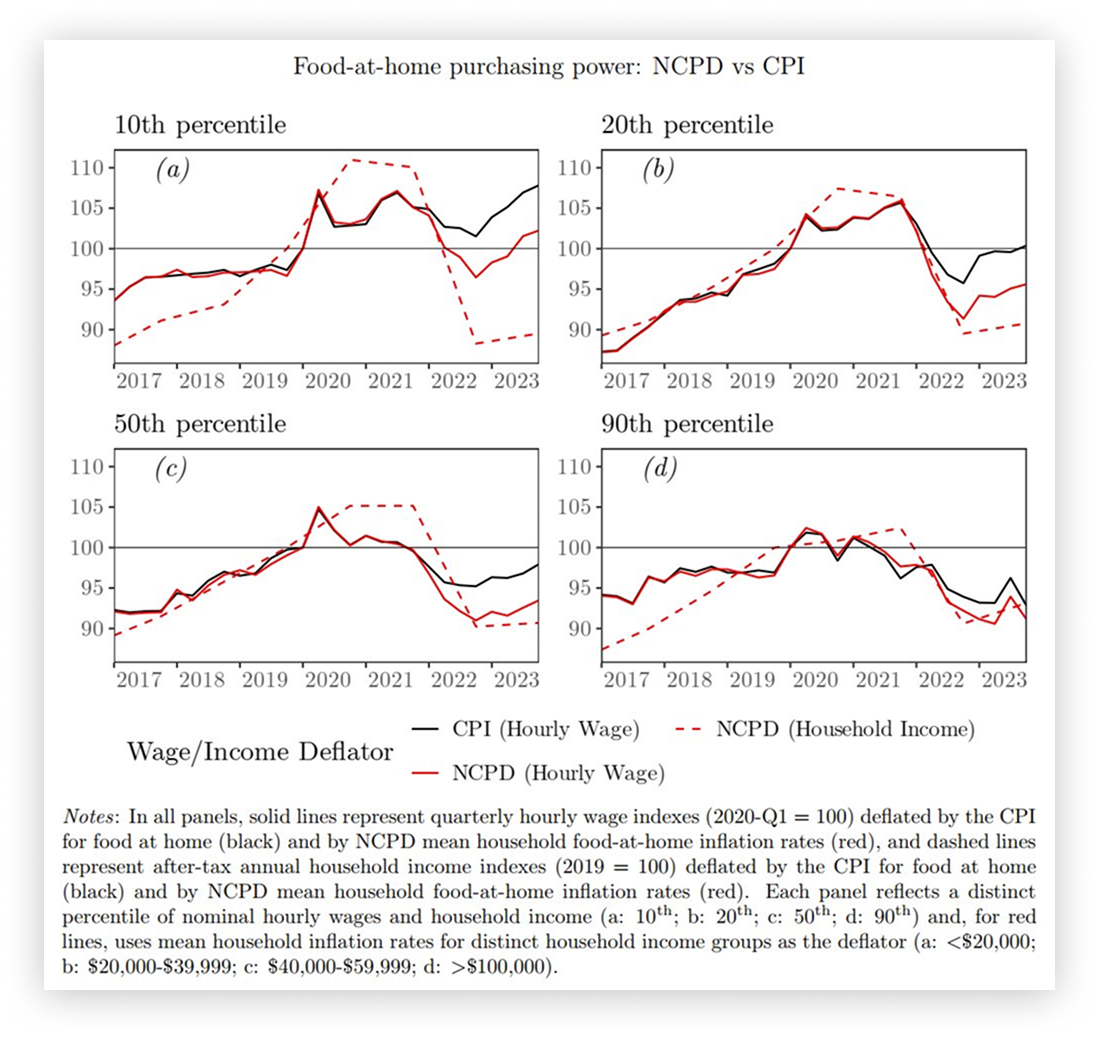
Using Wasner’s methodology, every income tranche actually lost “food-at-home purchasing power” over the period in question. He reminds us that the cracks were there all along: The share of households reporting that they lived “paycheck to paycheck” rose steadily from 2019 to 2024 for all income groups. Credit card defaults hit a five-year low in 2022, then reversed and began climbing again. Rates of homelessness eclipsed 2008 levels. The average savings rate has been falling, with some aberrant bumps around tax refund time, for years.
In retrospect, believing that real wages were broadly outpacing the cost of living required overlooking not just a bunch of people who insisted that wasn’t their reality, but a collection of counterintuitive data points as well.

When it was time to take out a loan this year for a big project, I started my lender search in the first place I could think of: my regular, national bank. The rates and fees were higher than I had anticipated, so I broadened my horizons and decided to try borrowing from a credit union instead.
Credit unions are member-owned, not-for-profit cooperatives that reinvest in their communities. They’re designed to provide people-first financial options—especially where traditional banks have left gaps (underserved areas, banking deserts, etc.).
The rate I was offered from my big national bank: 6.9%, with thousands of dollars in fees upfront. My new credit union offered 4.95% for the first year, with no upfront, early payoff, or annual fees. I’ll let you guess what I chose.
The sponsor of this week’s issue is Backbone, a coalition of credit unions nationwide (and the network that helped me find mine) united to ensure everyday Americans have access to the financial products they need: checking and savings accounts, loans, and more. Some even offer personalized support for members, like financial coaching or emergency loans.
To find a credit union in your community, check out the Backbone Coalition.
Perception is reality-ish
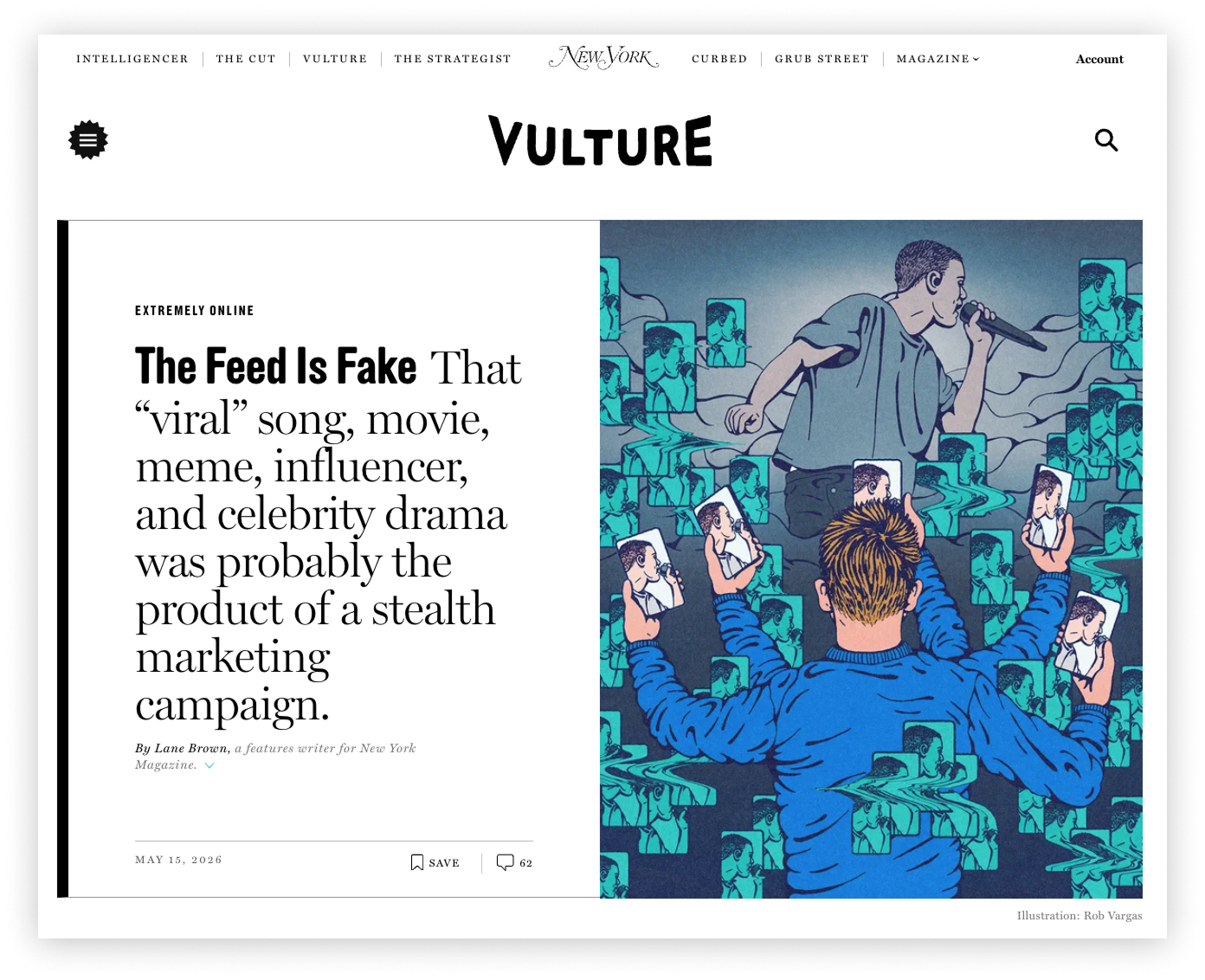
Improbably, this financial reality/data mismatch seems spiritually consonant with some recent reporting in Vulture about how much of the internet is just one big covert advertising operation.
In some ways the internet bills itself as a prediction market, a place where it’s easy to assume the sum total of what’s expressed is representative of “the spontaneous consensus of the hive mind,” a meritocratic market for vibes, takes, and tastes where the most resonant cream rises to the top. But this piece quotes a source (more on the source momentarily) who estimates that up to 90% of what you encounter across social media is “advertising in disguise,” astroturfed approval or rage or discourse planted there by someone with something to gain from its relevance.
The mechanism by which this seeding occurs is called “clipping,” Lane Brown writes, or a paid video campaign designed to make something or someone go viral. These jobs in the clipping economy—which can involve the production and posting of thousands of video or audio “clips”—are “farmed out” to a shadowy “network of freelance clippers,” who are, according to Brown and his sources, behind virtually every viral moment of the last however-many years. “[T]here is so much spam and pretend hype on the internet that nothing cuts through without artificial help anymore,” the source tells Brown, “not even huge artists with real audiences.” We used to inhabit a proper worldwide web where a hit such as I smell like beef could titillate the 0s and 1s on the sheer upthrust of its greatness, but apparently no more.
Still, it’s critical to remember that the source in question owns one of these sentiment manipulation firms, so in a meta sense, this very article might serve as more covert advertising-as-self-fulfilling-prophecy—describing a future that doesn’t yet exist but may, by the nature of covering it as though it’s already happening, be legitimized into existence. Trippy stuff. You can even pay to manufacture comments sections, a strategy made effective thanks to the volume of content people consume in these spaces. There’s simply not enough time to form your own “first impression” of everything, Brown says, so you’re likely to adopt the so-called “wisdom of the crowd,” even if that crowd is bought and paid for.
If you think staying off social media will insulate you, consider that staid platforms like Wikipedia aren’t exempt. Paid page editors wage a war of attrition against the volunteer nerds who keep the machinery of Wikipedia operational, returning week after week and “subtly editing small points on their clients’ pages.” This might include “softening language” or “adjusting prominence” or “minimizing undesirable details” for a client. The “holy grail” for a “Wiki-launderer” is a form of circular citation where “false information is added to the platform and subsequently cited by a more traditional news source, before being re-cited back into the Wikipedia article, enshrining the falsehood as a fact.” Taken together, all of it slowly and methodically changes the story being told, and with it, the reality that story supposedly represents.
Mirroring the broader institutional distrust of the 2020s that often melts uneasily into conspiracy, there’s a more justified level of incredulity for what one experiences online, which is something I mostly know and then immediately forget the moment my amygdala gets tickled mid-scroll. Many times I have characterized “lifestyle creep”—the tendency for the costs associated with maintaining your lifestyle to inflate as you earn more money—as “natural,” that it’s “human nature” to consume more the moment you’re able to. But how much financial behavior is molded by the desire to keep up with the coordinated movements of these digital Joneses?

The U.K. passed a new smoking ban that prohibits people born after 2008 from ever buying cigarettes, prompting Sam Kriss to write that the generations affected will “always be too young to smoke.” Only one problem5 with this… (The New Yorker)
The Ambition Penalty, a new book from former The Money with Katie Show guest Stefanie O’Connell, is stuffed full of Post-It flags on my desk as I write this. Currently working on an episode of Diabolical Lies that tracks the “rise and fall” of the girlboss mythos, inspired by my brief foray into the anti-ambition theme for an essay a few weeks ago.
The sale of “sustainable” midmarket clothing brand Everlane to fast-fashion behemoth Shein for $100 million isn’t, ultimately, all that surprising. It seems endemic to the “ethical”-yet-still-suspiciously-affordable DTC 2010s fashion brand, whose supply chains were more similar to the Shein model than different. (Puck)
More than 90% of Kalshi’s trading volume is sports betting, making it “a sports gambling website with a small prediction market attached.” Shout-out to a reader named Lucia who finally identified the amoral gambling piece I had been pining for! TL;DR: Prediction markets could have utility if they comprised experts wagering on outcomes that guided decision-making, but since it’s mostly jabronis betting on memecoins and inflation readings (the latter of which economists already track and predict), they aren’t generating much novel or useful information. (Asterisk Magazine)
If you feel guilt about having a “bullshit job” because completing your work takes so much less time than you’re paid for, you might consider “tactical slacking.” I tackled this problem with pathological levels of overemployment, but this is probably healthier. (A Day Well Spent)
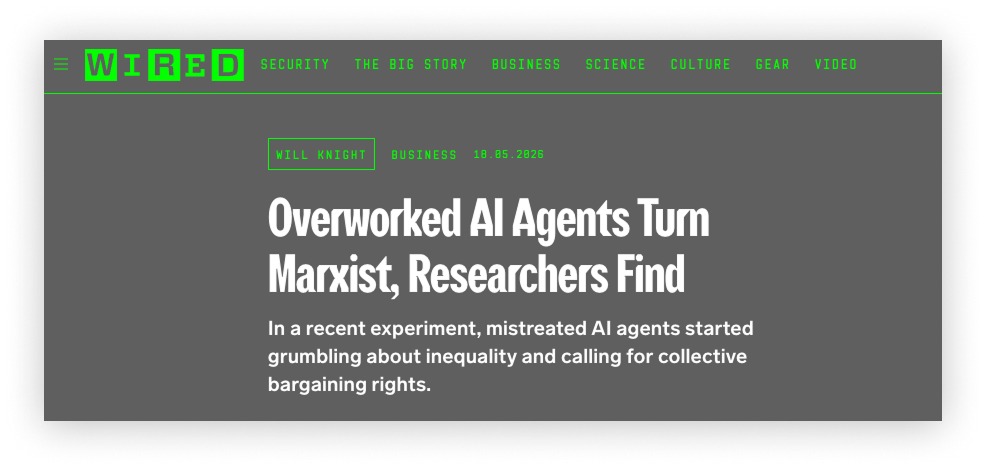
Headline of the week
They also reported that the average new car now costs $50,000 (!), up 30% from 2020. Feels like there’s a larger conversation to be had here about how financially ruinous our primary mode of transportation is...
In this metaphor, the “rules” are how people feel about their financial lives, and the “points” are inflation and wage data which purported to show a steadily improving situation.
(Biden) (Sorry, this nickname rocks)
It looks like the paper hasn’t been published in full yet—as of the time of this writing, there’s just a 22-part explainer on Wasner’s new Twitter account with a picture of the abstract. Can’t tell if he’s trying to tease it like a Taylor Swift album release but I spent way too long trying to find a live link. Still, I’m tempted to treat its (public) findings seriously because of his past work and association with Weber.
Thomas and I cannot be the only people who sporadically turn to one another, apropos of nothing, and go, “Mom, I wanna vape.”
In response to footnote 1: Brushing up against an urbanism hotbed! If you’d like to expand on this topic past the personal finance angle, I’d recommend checking out some of the work by War on Cars. Going even further into urbanism: car ownership is personally ruinous enough, the suburbia it’s synonymous with is ruinous for municipalities. I recommend NotJustBikes’ video about the growth Ponzi scheme, and his whole Strong Towns series is great.
“titillate the 0s and 1s on the sheer upthrust of its greatness” is now one of my favorite phrases