




IN THE YEARS BEFORE THE PANDEMIC, I made a 25-minute journey across Dallas every morning. Early in this commuting tenure I developed the habit of beginning my day with a then-brand-new New York Times podcast called “The Daily,” a show that was—coincidentally to me at the time—also about 25 minutes long.1 In the years since, it has achieved a level of popularity that consistently earns it the #1 spot on the Apple Podcasts app, a rarefied position usually reserved for shows about the gruesome unsolved murders of hot young women. Each of its five weekday episodes reportedly receives millions of downloads.
The genius of the show’s conceit is that it keeps all the analysis controlled within the Times ecosystem: One Times journalist (in 2017, it was still exclusively Michael Barbaro, with his trademark staccato delivery) interviews another about some breaking story. A good format is invisible, and it took me many hours of listening to notice the magic of the show’s engineering, in which the “interview”—and the information being dispensed by it—is staged to unfold in a predetermined way toward a particular set of conclusions, all while feeling casual and spontaneous. It’s well done.
To a politically and economically uneducated nine-to-fiver like me with very little time to read or think about the news, the show felt like eavesdropping on a smart, well-structured conversation conducted in The Room Where It Happens. Instead of merely glossing over the news (they’ve since added a podcast called “The Headlines” which ostensibly does just that), “The Daily” concerns itself with what some big story means; how we should think about and contextualize it.
My “Daily” habit died with my commute, but for years it was my trusted lens on the biggest story of the day. Though as I became more interested in media analysis, I often found myself side-eyeing framing choices when I would tune in, the way the subjective analysis blended so seamlessly with the reporting. I wouldn’t have classified its lens as explicitly ideological when I listened religiously almost a decade ago, albeit maybe blandly “liberal,” in that they didn’t outright scoff at ideas like pronouns and Black Lives Matter protests.2 But in a country that’s as profoundly small-c conservative as the United States, corporate media—even of the liberal variety—tends to skew conservative in its analysis, too, especially when it comes to economic issues.
LAST WEEK, “The Daily” produced an episode about two recent Democratic primaries in traditionally purple states with guest Nate Cohn, the paper’s “chief political analyst.” The episode’s title—“Are the Democratic Socialists Winning or Losing?”—baited me to listen while running an errand. I was curious how they would choose to cover an organization like the DSA.
The half-hour started unobjectionably enough. The host, Natalie Kitroeff, asked Cohn the program’s characteristic question: not just “what happened,” but “what to make” of what happened. A candidate named Abdul El-Sayed had won in Michigan against a moderate Democrat with tens of millions of dollars in funding. A candidate named Francesca Hong had lost in Wisconsin to a no-name moderate opponent.
After parsing some data about the age of voters, they transitioned to the part of the conversation that prompted me to white-knuckle my steering wheel. Building momentum, Kitroeff tees up Cohn: “What else does the data say about the divides here, the coalitions?” Cohn responds with the show’s characteristic confidence. Here’s the first part of his response, the “what happened”:
“In both states, [...] high-income voters stand out as a major area of strength for moderates, with income in general just being one of the key fault lines here. In neighborhoods where people make $150,000 or more, there were often cases where the moderate candidates won by two to one.”
With the exception of classifying households earning $150,000 as “high-income,” this explanation is an objective description of the voter data. But what comes next is how the intrepid commuter should interpret this outcome, what they should “make of” it:
“I don’t think this should be terribly surprising. If the progressive left in general, and these candidates specifically, really stand for anything in terms of policy, it’s to take on the billionaires, corporations, and wealth inequality in the country, and it makes sense that high-income voters would be particularly hesitant to embrace those candidates.”
There are a few assumptions embedded in this framing that don’t withstand even the gentlest scrutiny, but in the breezy dialogue of the episode, the notion that households earning $150,0003 would “be particularly hesitant to embrace” candidates who want to “take on the billionaires, corporations, and wealth inequality” is a reality that “should [not] be terribly surprising.” Implicit is the premise that hesitancy among this group is rational, justified. It’s presented as a given that this group’s alignment with moderates is an accurate reflection of legitimate class interests.
There’s no mention of the fact that a household income of $150,000 is solidly within the “middle-income” range4 of the distribution, nor is there an indication that this is precisely the group—middle-income wage workers—that would likely stand to benefit most from rebalancing the power in corporations, the entities which control and exert downward pressure on those wages.
Since at least 2000, labor’s share of national income has been steadily declining. Corporate profits as a share of GDP are at record highs. Had wages kept pace with productivity, a 2020 working paper coauthored by economist Kathryn Anne Edwards found, the 2018 median income in the US would’ve been almost doubled: $92,000 rather than $50,000. Edwards and her coauthor estimate that income for those in the “90th percentile” would’ve been 67% higher “had income growth since 1975 remained as equitable as it was in the first two post-War decades.” You wouldn’t know any of that from this analysis.5
This rhetorical flattening of class interests in our political discourse is powerful and ubiquitous, so much so that we rarely recognize it as ideological at all, reinforcing as it does the class confusion that makes middle-income people identify with the interests of “billionaires” and “corporations.”
This essay is continued after a message from our partner, Domain Money.

One of the questions I’ve received most over the years that I’ve felt least qualified to weigh in on confidently is the question of the mystical 529: How much precedence should (or shouldn’t) this take when other goals (retirement, childcare, housing) often feel more urgent? Tuition, adjusted for inflation, has risen roughly 197% since 1963*, and it’s not at all clear whether these trends will continue, which means there’s a lot of pressure and uncertainty around the decision.
Understandably, a lot of new and expecting parents feel pressure to fund a 529 right away—but sometimes this comes at the expense of protecting their own retirement contributions.
Fortunately, starting early and saving modest amounts consistently while a kid is young (or even while you’re still planning for parenthood!) tends to matter more than the total dollar amount, because of how many years that money gets to grow.
The bigger risk is overcorrecting and prioritizing education savings at the expense of retirement contributions during years that matter most for a parent’s own compounding, too. A Domain Money CFP® professional can help strategically sequence both goals together, instead of forcing a choice between them.
If 529s are on your mind, catch Domain Money’s webinar—How to Pay for College Without Wrecking Your Own Retirement—tomorrow, August 20, at 3 PM EST.
Meet with a Domain Money CFP® professional.
And now, back to the essay:
There’s some acknowledgment of this reality elsewhere in the episode when Kitroeff and Cohn observe that moderate Democrats seem to be adjusting their phrasing, if not their policy priorities. Inspired by the populist rhetoric of the “far left,” they note, establishment presidential contenders like Gavin Newsom—a man who looks like an AI-generated response to a prompt for American Politician™️—have adopted the expression “it’s not right vs. left, it’s top vs. down.” As a clumsy sentiment about the source of division, I agree, but it’s critically important to clarify where “the top” is. A picture, as they say, is worth a thousand words. Those represented in the chart by the blue line are households earning an average of $132,000 per year, the closest in the data set to the “high-income” voters discussed in the episode whose hesitancy shouldn’t be terribly surprising:
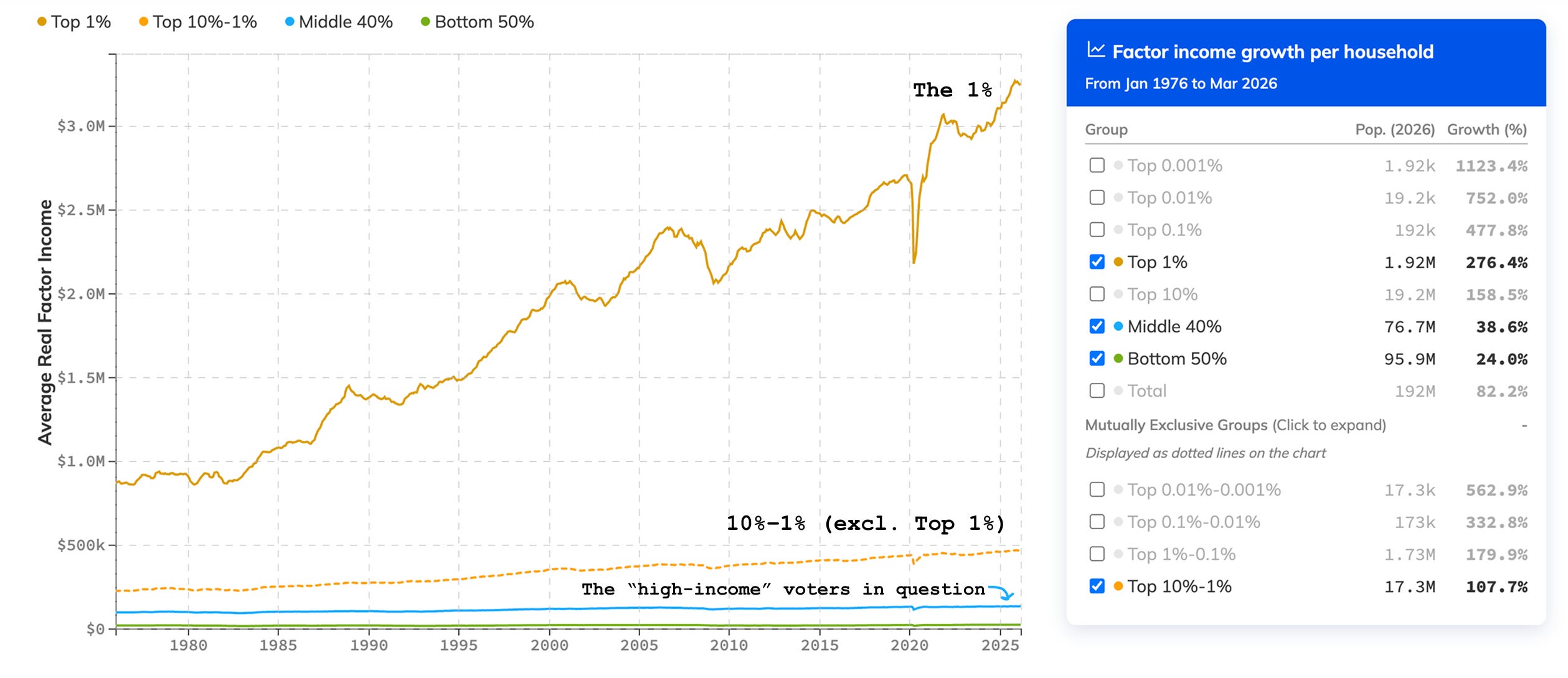
These are the realities that had me audibly responding to Cohn in my empty car, asking, “Does it?” when the chief political analyst at the largest and most well-funded news organization on the most popular podcast in the United States explains that it “makes sense” that “high-income” voters—a group one can demonstrate visually with the blue line above—would be “hesitant” to “embrace” the economic policies of the progressive left, which he accurately describes as “going after wealth inequality.”
THERE ARE A FEW PLAUSIBLE EXPLANATIONS. Maybe it was an inarticulate oversight. Given the production value of the show and this particular segment’s function as a supporting beam of the episode’s argument, I find this relatively unlikely. (The credits for this episode in particular list nine people; the show’s overall credits list 51.)
Maybe nobody among the show’s team of fact checkers, the crew of producers and editors, or the chief political analyst himself felt this data about income inequality and the declining labor share of income was relevant enough to challenge this framing.
Maybe the sentiment—that high-income people feel threatened by politicians who want to address wealth inequality, and for some reason households earning $150,000 appear to count themselves among this group—didn’t strike anyone in the room as a politically interesting phenomenon in and of itself, the kind of quirk that would, amid historic income inequality, seemingly present a far more interesting angle for a show billed as diving into the biggest stories of our time.
Maybe it didn’t occur to anyone that it was a perfect opportunity to distinguish for their millions of listeners what “high-income” actually means and whose interests are actually under threat by the ascendant left; maybe nobody thought it useful to resurrect that favored phrase always applied so readily when the voters in question are working-class conservatives showing up for Republicans: that people are “voting against their own interests.”
Or maybe this framing—and its implication that definitionally middle-income voters would be hurt by candidates who, if they “stand for anything in terms of policy,” want to “take on the billionaires, corporations, and wealth inequality”—was intentional, a reinforcement of the very confusion that analysis is supposed to clarify.
To echo the favored semantic setup on “The Daily,” what, then, should we make of that?

Do we like Sterling Point? Critics seem to love it. I’m one episode in and it seems fine so far. (Slate)
Currently reading Notes from No Man’s Land: American Essays by the incomparable Eula Biss. Doggy-eared this page in an essay about Mexico and NAFTA:

If this foldable iPhone is real, unfortunately I must cop to the obnoxious tug of desire. It costs more than a MacBook Pro. Ugh. (YouTube)
🎓 Meet with a Domain Money CFP® professional, who can help strategically sequence your future retirement and college savings goals together. If you want to get a sense for their vibe, check out their free 529s webinar tomorrow, August 20, at 3 PM EST.
*Based on the “College Tuition Inflation Rate” Report from EducationData.org. Money with Katie is a promoter of Domain, a real client, and receives compensation in connection with sponsorship of this newsletter. This compensation creates a conflict of interest because it may influence the content presented, including the featuring of Domain Money or its advisors. The views expressed by the promoter are their own and do not necessarily reflect the views of Domain Money. This communication is for informational purposes only and should not be construed as a recommendation, offer, or solicitation for the purchase or sale of any security. All financial planning and investment strategies should be tailored to the unique circumstances and objectives of each client.
I learned after the fact that the show’s length was intended to mirror the average commute length. They really thought of everything.
If you asked a random person on the street how they perceive its political intent, they’d probably tell you it’s liberal; a Fox News viewer would probably insist it has a radical-left bias.
Based on the show notes it’s not clear what demographic polling data was being used for the conversation, but income statistics of this nature are almost always collected at the household, rather than individual, level.
The upper bound for the “middle” is usually defined by doubling the median.
Complicating this argument is the fact that our tax system actually works fairly progressively through approximately $600,000 per year in labor income, leading some who generate (relatively) high incomes from wages alone to assess that they’re already paying a substantial percentage of their incomes in federal, payroll, and state ordinary income taxes. They are. Often, they’re paying a far higher percentage of their labor income than those earning astronomically higher incomes from capital, who pay, at most, 20%, and often much less when income is produced by borrowing against wealth at low interest rates and no taxable gains are realized.
The $150,000 household thinking it's under threat from wealth inequality policy is engineered confusion, not organic anxiety. The iconic example of this has always been the estate tax. Virtually nobody at $150,000 will ever owe a dollar, but the wealth defense industry has spent decades marketing the estate tax as a threat to "family farms" and "family businesses" and they have been so effective that families nowhere near the threshold are scared to death of the tax. People making $150k may have privileges but they folding them into the wealth conversation is disingenuous. The question is whether it is intentionally so!
oh, also, Sterling Point was great! A lot of unaddressed inheritance problems, but that's okay.
Absolutely not the point here but “Gavin Newsom—a man who looks like an AI-generated response to a prompt for American Politician™️” is way too accurate.