



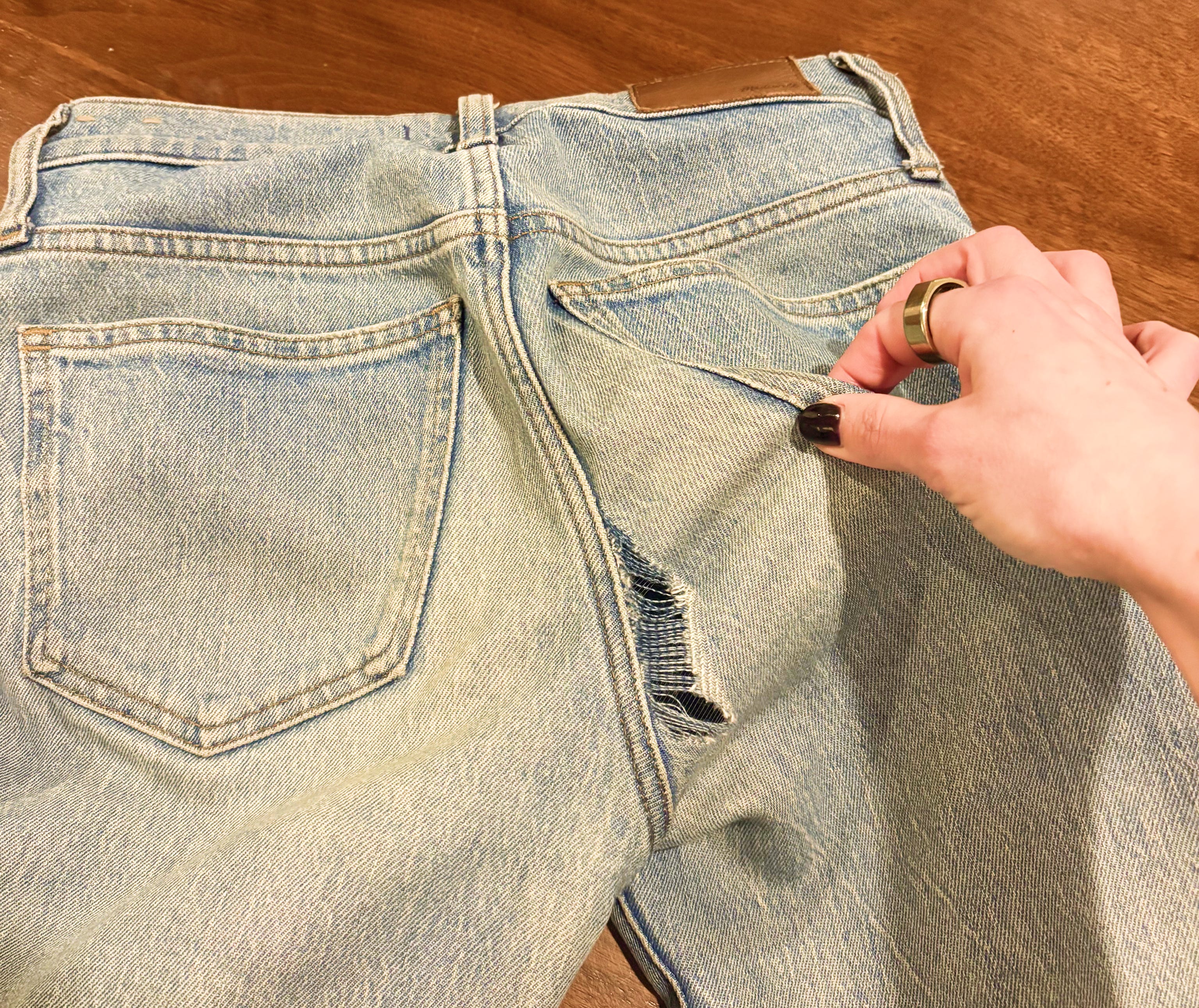
Late breaking news out of Money with Katie HQ: another casualty of my enduring need to Drop It Low™️ in the course of my daily activities. Is now a good time to mention I recently PR’d my deadlift?
In today’s issue:
The theory that says our understanding of inflation (and how to prevent it) is backward
What it costs to build a TikTok star
How Deloitte extracts billions via the means-testing industrial complex
Ivy League universities offering free tuition for “middle-class” families, and what the income cutoff tells us
A new Fed Chair nominee who “has the look”
And tucked away at the end as a little treat for exercising your attention span: a petty, low-stakes personal grievance in which I tone-police one of the more privileged journalists in new media. (What can I say? Sometimes a girl needs to let her hair down.)

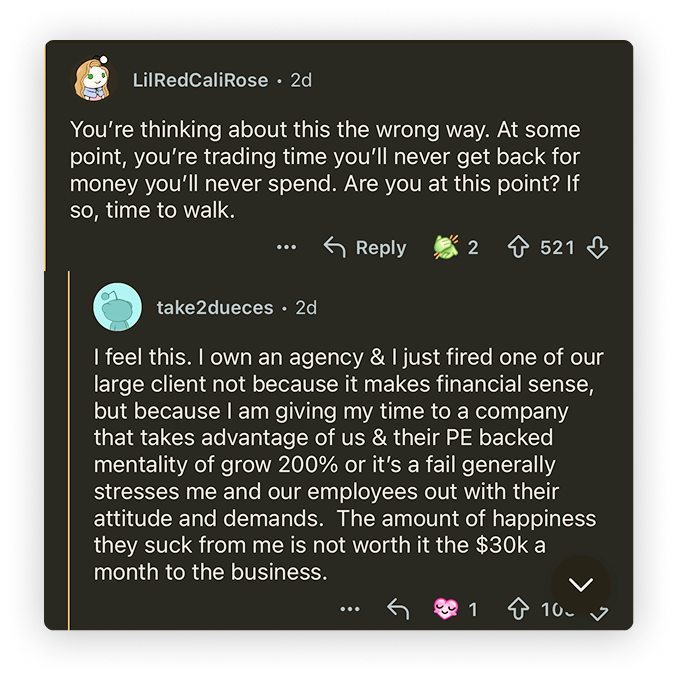
⏳ First things first: This heater of a quote I spotted in the r/FatFIRE Subreddit on a thread asking when it’s no longer worth it to work a toxic high-paying job. “Trading time you’ll never get back for money you’ll never spend” is officially my new retirement threshold.
🔮 Modern finance relies on a collective belief in upward mobility. Consider this: If people didn’t finance their aspirations with debt, there’d be no way to earn interest on your savings to keep pace with inflation. Banks lend out your deposits, get paid back with interest, and then pay a little of that interest to you. In this way, Catherine Nichols argues, social mobility itself—or the promise of improving one’s class standing via borrowing to buy assets like a home or education—is critical for modern finance to function. (More on this later.)
While agricultural economies can operate with very little social mobility, a financialised economy does better on the back of public education, universal healthcare and elder care: the various social structures that allow people to leave the circumstances of their birth. Fights for the rights of the working class are, of course, hard won and necessary – yet they also benefit the entire stockholder economy, as we see among countries that voluntarily adopt these structures in order to financialise their economies. (Aeon)
📌 Pinterest plans to lay off 15% of its workforce by September, explicitly citing AI in its rationale. (TechCrunch)
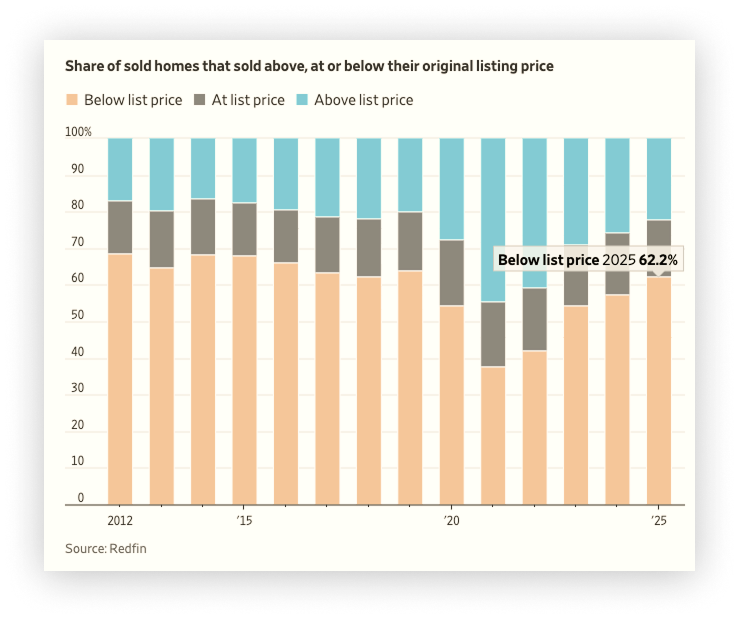
📉 The highest proportion of home buyers since 2019 purchased at a discount last year—an average of 8% below list price. If Denver is any indication, homes definitely seem to be sitting on the market longer than at any point in recent memory. Zillow cruisers, it might be time to restart your engines.
The U.S. housing market had over 600,000 more sellers than buyers in December, the biggest such gap on record in seasonally adjusted data going back to 2013, according to Redfin. (Wall Street Journal)
🎓 Yale is the latest elite institution to join Harvard, Penn, and MIT in offering free tuition to students whose families have household incomes below $200,000 per year, prompting a wave of self-conscious coverage about whether the “middle-class” goalpost has officially moved. Listen, I’ve done just fine for myself with my free SEC school degree (in 2013, out-of-state tuition at the University of Alabama was covered if you scored 32 or higher on the ACT—now you need a perfect 36 to get a full ride), but the commenters claiming that employers “don’t care if you went to an Ivy” or that “brand-name schools no longer impress employers” are coping. It seems to me the only recent graduates with a strong chance of entry-level employment in a job market saturated with large language models are those with pieces of paper from “brand name” schools. (Marketwatch)
💋 Speaking of my SEC school degree: This is the best exposé I’ve read about how a Bama Girl becomes a TikTok Star (and the resulting aesthetic creep for the impressionable population of the student body). When I recall the machinations of my underdeveloped prefrontal cortex, the prospect of broadcasting my freshly sorority-pilled desires to 1.3 million followers is dizzying. The panopticon effect was already unbearable enough in Greek life at Bama; adding a million strangers online would’ve inflicted permanent brain damage. It’s healing to read a British journalist clock the culture of Alabama sororities and fraternities so readily, though I can’t deny conditions have deteriorated considerably in the 13 years since I was a freshman in Tuscaloosa. This piece is what the HBO documentary should’ve been. A particularly harrowing excerpt:
Everyone wants to look as good as possible, and what good looks like is not subjective. At the University of Alabama, being beautiful is the most important thing a girl can do and be.
The pressure to succeed in this sexual marketplace is immense. I talk to a girl whose last real meal was on Thursday night, two whole days ago, to look better in game day and going-out photos. Hunger is kept at bay with packs of candy, stashed in purses for quick access at the bars. “It gives you quick energy and keeps you from throwing up when your mouth starts watering,” she says breezily. Another girl says that everyone’s on Ozempic, paid for by their parents, because it’s cheaper than the cost of food.
Apparently, Bama Cash—the monopoly money parents must deposit onto university-sanctioned student debit cards—is accepted at med spas in town that offer Botox and filler, which means there’s a degree of direct institutional support. Dark stuff. In case there was any doubt, the Hot Girl Hamster Wheel is a memoir. (The Face)

🎯 If I were starting a business today with the intent to make money quickly, I’d target rich people. Unfortunately, the majority of my interests center themes like “wealth inequality” and “class relations” (not exactly favored topics of the .1%), so this ship has sailed for me. By now, you know that half of all US consumer spending comes from the top 10%, and HSBC estimates that “luxury sales” to US consumers will grow by 8% this year. In a “K-Shaped” economy, peddling overpriced wares to the minority of people with money to blow is a promising business model. (Financial Times)
I asked Amy Odell—the author of the Anna Wintour and Gwyneth Paltrow biographies and a journalist covering fashion and culture in an “anthropological study of the 1%” way—about the current spending habits of the affluent. She told me surgical interventions are the new Birkin bag:
The luxury industry is in a precarious position right now. I hear from VICs [the 2 percent of shoppers accounting for 40 percent of luxury sales] that they’re struggling to feel excited about fashion these days. They cite price increases (while they can afford them, they feel like they’re being taken for fools by brands) and a lack of innovation.
I think the ultimate status symbol for this group now is a new face. There are seemingly endless luxury plastic surgery and aesthetic treatments people can spend lavishly on. I think a Kris Jenner facelift is the new “It” bag for this group.
There’s a thinkpiece just begging to be written about conspicuous medical procedures becoming class signifiers.
✂️ Odell wrote more about the consequences of fashion’s myopic focus on the ultra-rich. Simply put: “Fashion mirrors the damaging silo-ing of society writ large.” (Back Row)
Brought to You by Copilot Money

What are you saving for in 2026? Whether big or small, exciting or practical, Copilot Money’s “Goals” feature makes saving (or investing) for your next vacation or car repair surprisingly fun. With my switch to full self-employment this year, I’m using the Copilot Money “Goals” feature for the first time to track my monthly contributions to my SEP IRA (a retirement account for the self-employed)—something that was predictable and automated before this year, because it was handled for me by paycheck contributions to my employer 401(k).
My goal for 2026 is to contribute the maximum allowed by dollar-cost averaging into it every month (in essence, recreating the conditions of my old 401(k) contributions), so I’ve set a “Goal” for the estimated total amount and a target completion date of December 31, 2026.

With smart categorization of every transaction and data-driven recommendations for how to rebalance your budgets based on your actual spending, you’ll be able to see where every single dollar you earn—whether spent or saved!—is going. I think this is especially valuable if you’re relatively new to the magical world of personal finance and are still getting the hang of the delicate balance between motivated saving and guilt-free spending.
I’ve been using Copilot Money religiously since 2020, and it’s the rare good habit in my life that I’ve had no trouble sticking with. Once you use the app for a few days and practice categorizing transactions or setting new goals, I’m confident you’ll be hooked, too.
🤖 See how Copilot Money can help you reach your financial goals this year with an extended free trial. Use code KATIE2M at checkout to get two months free.

🇺🇲 The US government will spend almost as much on immigration between now and 2029 as it spent in the 27 years between 1986 and 2013. Why does nobody ever ask, “How will we pay for this?” Based on my calculations using the Committee for a Responsible Budget’s accounting, around 2.4% of your federal taxes will fund Kristi Noem’s goon squad. If you earn $150,000, you’ll pay the Department of Homeland Security around $3,005 over the next five years.1 This data is putting me in danger of becoming a libertarian. Of 2026’s total tax revenues, a staggering 84% will come from personal income, consumption, and payroll taxes (i.e., you), just 8% will come from corporate income tax, 3.7% will come from “production and imports” (tariffs?), and .06% will come from “taxes from the rest of the world.” (“Everybody’s Business” from Bloomberg)
🏛️ If the Modern Monetary Theory folks were here, they’d caution me against using “taxpayer logic.” The premise of Modern Monetary Theory is that conventional wisdom about the relationship between inflation, interest rates, taxation, and deficit spending is wrong, because in a modern financialized economy, the limiting factor isn’t “money,” it’s productive capacity. For example, universal healthcare is out of reach not because the money doesn’t exist to pay for it, but because we don’t have the health infrastructure or medical professionals to provide healthcare to everyone—so access to medical care has to be rationed by cost.2
Modern Monetary Theory suggests that the government always spends money out of thin air, then taxes money out of existence. Instead of clumsily wielding the crude instrument of interest rates, MMT advocates say, policymakers should prioritize strategic interventions that maximize productive capacity, maintain full employment, and strengthen financial regulation. I asked Michael Lewis (not that one), a public money researcher and colleague of Stephanie Kelton, to explain why this theory is especially relevant right now. Here’s what he said:
Often, the left is too quick to say that everything in our agenda will be financed by taxing the rich. [Modern Monetary Theory proponents] would argue that of course we need to tax billionaires out of existence to reduce their undue power and influence over society, but we don’t need their money to finance our economic agenda. Doing so sets up a trap where paying for big-ticket items becomes dependent on rich people as a revenue source in perpetuity, which means they have to effectively stay rich forever in order for our economic agenda to remain solvent.
If you find Modern Monetary Theory compelling, you may be interested to know that it prescribes a permanent near-zero interest rate policy. The primary driver of asset bubbles is lax financial regulation, Nathan Tankus argues, rather than low interest rates, a claim he supports by pointing to bubbles which occurred when rates were high. (Modern Money Network)
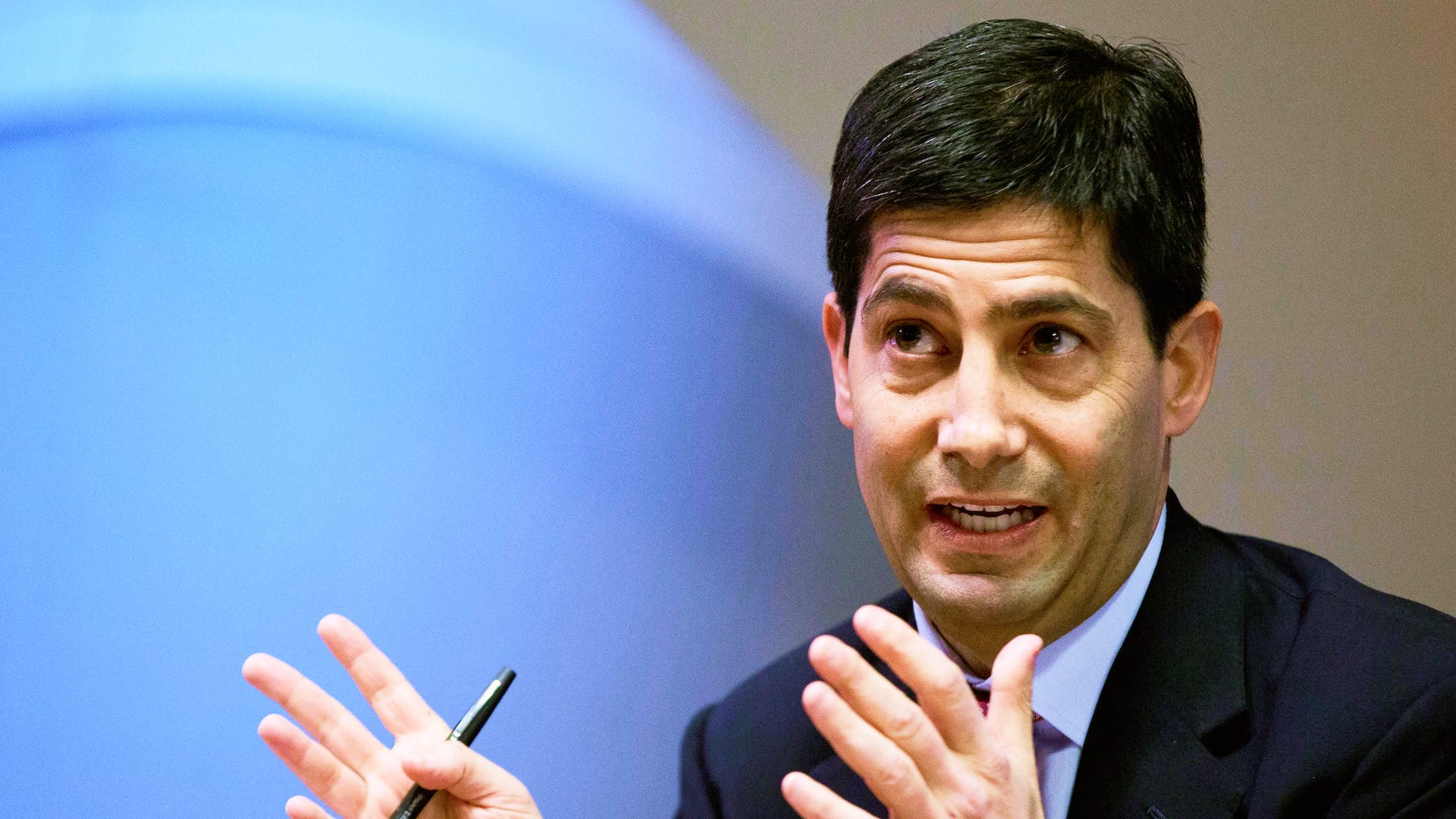
🪙 That brings me to: the new Fed Chair nominee. The first person I wanted to hear from when I saw the news was Paul Krugman, and he didn’t disappoint. In his piece “A Bad Heir Day at the Fed,” he attempts to correct the record on Kevin Warsh:
As I write this, many media reports are describing Warsh as a monetary hawk. That’s a category error. Warsh is a political animal. He calls for tight money and opposes any attempt to boost the economy when Democrats hold the White House. Like all Trumpers, he has been all for lower interest rates since November 2024. (Paul Krugman)
The mention of “lower interest rates” made me reflexively nervous given my understanding of their relationship with inflation, but spending the weekend reading Modern Monetary Theory papers made me wonder if maybe that specific concern is misplaced. It should also be noted that Trump’s announcement noted, bizarrely, that Warsh is from “central casting,” a comment he later doubled down on in a regrettably hilarious exchange with reporters: “He’s very smart, very good, strong, young, pretty young…he was the central casting guy that people wanted. Looks don’t mean anything, but he’s got the look.” Everyone’s a character to be cast when the primary mission of governance is spectacle.
🎈 Oh, by the way, the Bureau of Labor Statistics isn’t collecting inflation data right now. (Semafor)
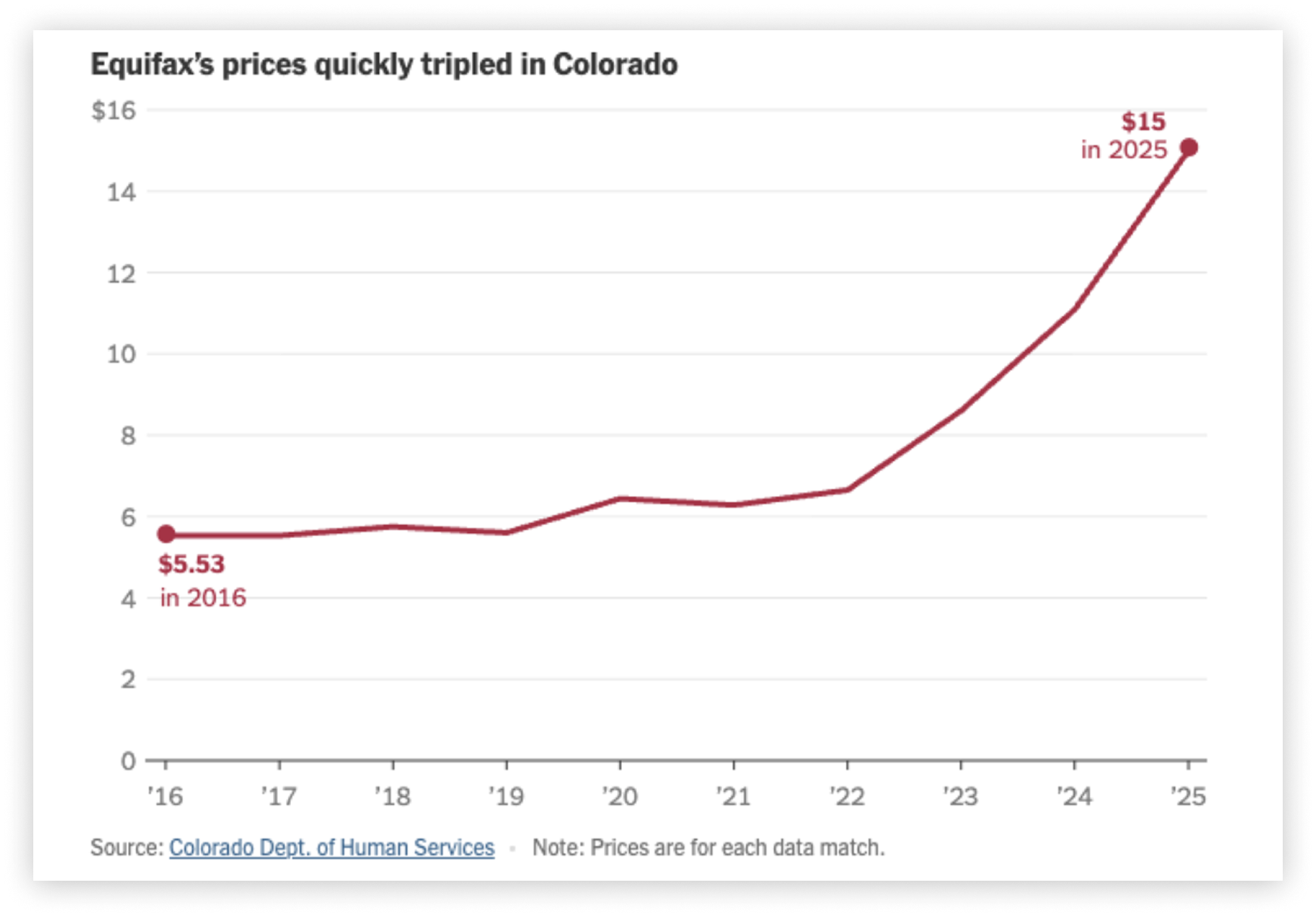
☑️ Have you ever wondered how the government checks income eligibility for (or “means tests”) recipients of programs like SNAP and Medicaid? If you assumed it was some hum-drum IRS database manned by the agency’s four remaining downtrodden employees, I have news for you: These income checks are outsourced to private data brokers like Equifax and Deloitte, which have near-monopolies on the data. When more programs require means testing (or the frequency of checks increases, as happened last year), each agency pays Equifax for every single data pull, which means the same person’s income might be checked three times by three different agencies. Every check costs money. It’s estimated that Equifax makes around $800 million per year on these checks; Deloitte’s contracts are worth at least 7x that amount. This is one of the primary financial arguments for universal programs like Medicare for All—or at the very least, building a publicly owned data source—which would have far lower administrative costs. (The Law and Political Economy Project)
👀 When surveyed, those who identify as Christian nationalists express the most hostility not toward immigrants or Muslims, but socialists. This makes sense as Jesus Christ was—famously!—pro-empire.3 (The New Yorker)
🌏 What would happen if the United States matched the average performance of our 31 peer nations? We’re not talking about the “pleasure to have in class” Nordic region you’re all tired of hearing about, just average. Get a load of this:
The average American household would earn $19,000 more per year and be $96,000 richer
50 million more workers would be unionized
26 million more people would have healthcare, despite the country spending $2.1 trillion less on it
Intergenerational social mobility would be twice as high
Childcare costs would be 60% lower
Life expectancy would be 4.1 years longer
“We don’t need to become a shining city on a hill to transform Americans’ lives,” Adam Bonica writes. “We just need to become average. [...] Those who say these problems can’t be solved are really saying they can’t be solved here—confessing a belief that Americans are uniquely incapable of what dozens of other democracies have achieved.” This perspective is a double-shot of motivation. (On Data and Democracy)

🛰️ Describing Melania’s director as “summoning all the artistic ambition of a local Realtor who just got a drone” is the most lethal drag I’ve ever encountered in a movie review. A reported two-thirds of those who worked on the film asked to be omitted from the credits.
Whatever “Melania” is, and whatever numbers it ends up doing, it will never be able to compete, for sheer reach, with the sickening scenes that the Trump regime’s ICE is starring in day after day. Coming soon, to a street corner near you. (The New Yorker)
🤓 The “consensus model” used to maintain Wikipedia is a form of Quaker deliberation, or direct democracy. It’s incredible that Wikipedia is not only free, but seems to be one of the only corners of an increasingly seedy collaborative internet untainted by the general breakdown of consensus fact. This is both sweet and sad:
A lucky stroke of historical coincidence likely came from the systematic defunding of most other intellectual forums in twenty-first-century America, from universities decimated by financial austerity measures to local newspapers bought out and shut down. Unemployed geeks and nerds of all stripes make for enthusiastic editors. (The Baffler)
👙 Couldn’t agree more with Tana Mongeau’s theory that someone on Sydney Sweeney’s team hates her. Set aside her new lingerie line’s mid-2010s tech start-up-ass name (“Syrn”) for a moment. Don’t these people know that men, her core demographic, don’t buy lingerie? The website claims everything is sold out, but I don’t buy it. (TikTok)
👠 There’s something a little sad about the state of the film industry when sequels of popular movies are being made 20 years later. Am I going to watch The Devil Wears Prada 2? Yeah. Am I going to feel like a high schooler trying to relive her glory days while I do? Also yeah. Much like And Just Like That… taught us, the world we live in today simply can’t recapture the magic of early aughts entertainment. Happy to be proven wrong! (YouTube)
🗽 This inside-baseball explanation of the New York Times union’s negotiations in Puck—including entirely reasonable requests like “A.I.-related protections that would entitle their members to a cut of the Times A.I. licensing deals”—is written with such bewildering condescension and hostility that I almost didn’t link it. I’d like to comment on the hostility specifically. Puck is a boutique media outlet with fewer than 20 (public) columnists, each of whom, according to the LA Times, are “given equity in the business and, in addition to salaries, receive bonuses based on the number of subscriptions their work produces. They also receive compensation based on IP development.” During a round of 2022 fundraising, Puck was valued at around $70 million on a reported $14 million in revenue (a 5x multiple for a subscription-based media company is aggressive). All that to say: It’s disappointing to see one of their senior writers mock requests for benefits that are, to my mind, less generous than the ones he already receives—particularly because said requests are being posed to a billion-dollar news organization. Why sneer at others trying to access perks commensurate with what you already have? I was so convinced I must be missing something that I emailed Dylan Byers, the reporter, to pose these questions directly to him. I haven’t heard back. (Puck)
See you next Wednesday (or this Sunday for the next episode of Diabolical Lies),

The rare earnest footnote to show my rationale: The US government is estimated to collect around $5.5 trillion in tax revenue in 2026 and projected to spend more than $7 trillion. Around $170 billion of the budget is allocated to DHS, or 2.4% of the total spent, and around 3% of the total collected. The federal tax liability (excluding payroll taxes, which go toward Social Security and Medicare) on $150,000 is around $25,000. If you assume 2.4% of all monies collected go to DHS, that means 2.4% of $25,000, or $601 per year, will fund the agency, x5 years = $3,005.
aaaaand there’s your callback to the “elective surgery as status symbol” thesis
he and Pontius Pilate just had a minor misunderstanding
This independent MWK newsletter era is absolutely lit. This week I sent no fewer than three screenshots to my wife of stories and takes that made my jaw drop.
Although I am the opposite of Katie (male, old, southern, uninterested in fashion which is a side effect of age), I thoroughly enjoy her writing and I'm always excited to see her in my emails.