



It’s been a thrilling few weeks for Annoying People Who Love Pop Culture and Finance. I originally had a little reflection on Strangers by Belle Burden to share as well, but decided to keep working on it and see if the spirit still moves me next week.
Spoilers ahead; don’t be a baby.
Layoffs on the Big Screen
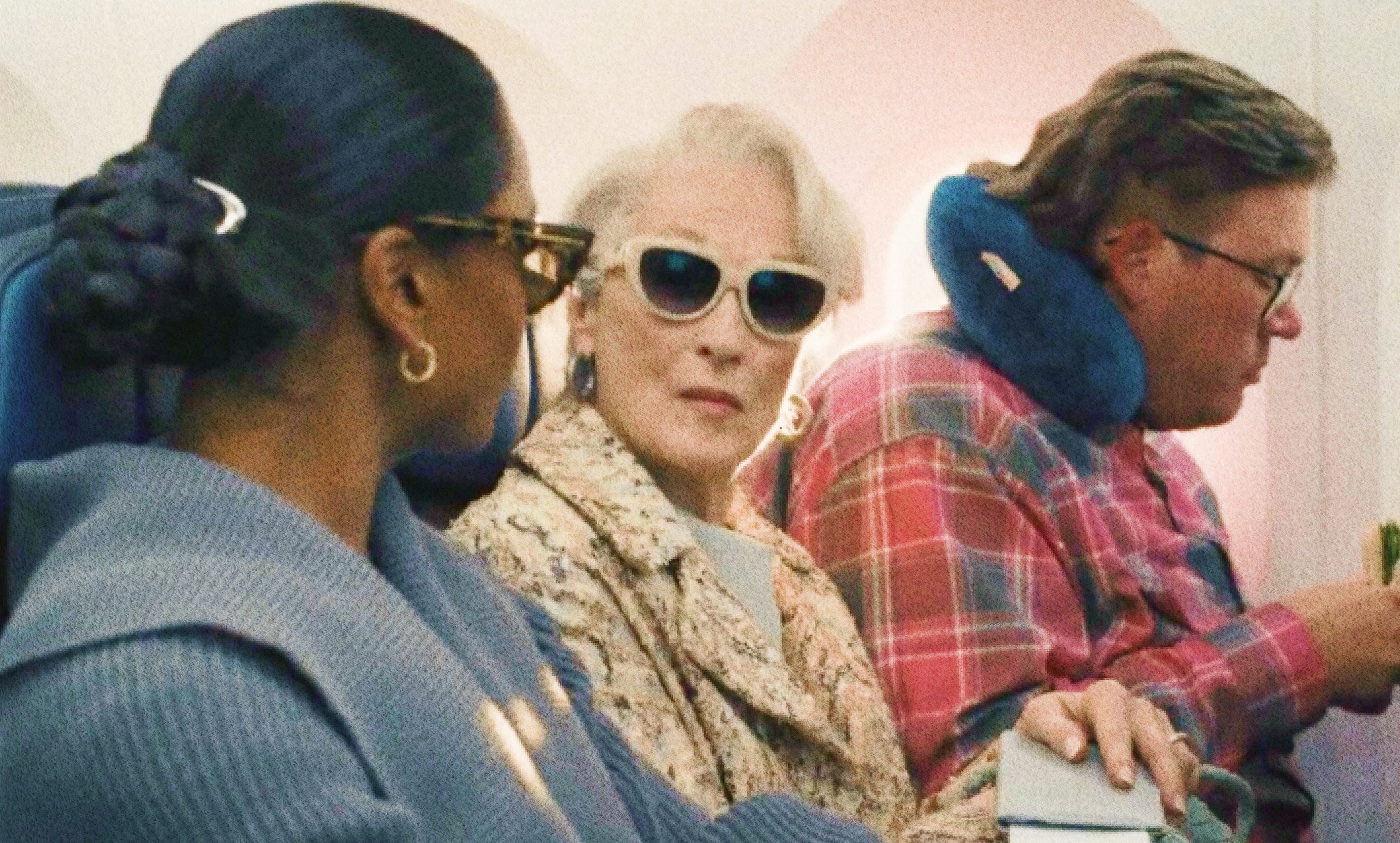
A few weekends ago, I saw The Devil Wears Prada 2 in theaters. I paid $19 for my ticket and another $19 for a bag of chocolate-covered flash-fried strawberries and a small greasy tote of mustard-yellow popcorn. Snacks procured and seat reclined, I prepared to be transported.
The original Devil was a 2006 blockbuster with the lighthearted tenor of a romantic comedy, except instead of being about loving your crush, it was about hating your job—then emerging with refined desires, principles, and talents from a psychosexual1 battle of wills with your boss Meryl Streep. For me, a fashion-obsessed, terminally ambitious fourth grader, the hyperbolic toxic workplace of Runway read less as a cautionary tale of HR violations and more as a precise manual for my yearning. It introduced me to a glittering world of feminine adulthood defined by takeaway coffee cups and late nights at the office and laboring constantly on an adult scrapbook of aspiration The Book.
Part of the allure of watching films from this era—my other favorites include Two Weeks Notice (2002), How to Lose a Guy in 10 Days (2003), 13 Going on 30 (2004), and The Proposal (2009); basically anything with Sandra Bullock2 or a glossy Manhattan publishing office will suffice, but extra points for movies with both—is that they lift the velvet rope to a fantasy world.3 The plots often feature a plucky ingénue working at the epicenter of the once-eyewateringly glamorous worlds of fashion or media, offering perfectly unchallenging period pieces of early aughts escapism. These films exist in an alternate dimension where the worst fate that awaits a precocious girl in the Midwest with dreams of the big city is a pathologically demanding supervisor or accidentally time-traveling into the future and dueling with your bitchy childhood frenemy at your fancy magazine job while falling in love with Mark Ruffalo.
In the Devil Wears Prada sequel, we are reunited with Andy Sachs in the same way we meet her in the original: as a reflection. In the opening shot, we peer over her shoulder as her hand wipes the steam from her bathroom mirror to reveal her face staring back at us. I smiled into the darkness of the theater at this callback, snuggled for a moment in this other universe of exclusively hypercompetent women (a personal fetish) and big money media publishing (a societal one, apparently).
Except the world of Runway that Andy now inhabits is dramatically estranged from its 2006 counterpart, and yet nauseously recognizable to its 2026 viewer. Andy is late to a journalism luncheon where she receives an award for the sort of Serious Work she left Runway to pursue 20 years prior, during which a table of reporters is summarily and unceremoniously fired by mass text message—Andy among them—because their paper is downsizing. Indignant, she improvises a fiery acceptance speech that eviscerates the newspaper’s CEO for his $11 million compensation package. We see her speech at first in “real life,” then rendered on an enormous phone-screen-sized feed to convey that the polemic is going viral. This was an uncanny experience in the theater, as though my world of Bernie Sanders anti-oligarch TikToks had collided with a classic chick flick in a bespoke-for-Katie acid trip.
Runway, meanwhile, is dealing with its own crisis, mid-cancellation for publishing an accidentally fawning profile about a fast fashion brand à la Shein that uses sweatshop labor. The plot is, by this juncture, rapidly accumulating a résumé of Discourse Bullet Points. Everyone’s favorite terrifying boss, Miranda Priestly, is up for a “Global Head of Content” job, but this promotion is jeopardized by the fact that she is, in a different social feed, personally absorbing the majority of the fast fashion debacle heat via an infinitely refreshing supply of unflattering memes and GIFs. The plot of Devil 2 proceeds henceforth from this 2026ified premise. Runway needs gravitas and credibility; Andy, once again, needs a job.
When we revisit the offices of Runway (nostalgic until Andy realizes that not only did Miranda have nothing to do with her rehiring, but she doesn’t even remember her), we learn the magazine’s problems are much bigger than a bad news cycle. Miranda informs Andy that her seemingly random recruitment is nothing more than “a CEO’s latest whim,” overtly gesturing at a greater infrastructure of capital and decisions conspiring above her pay grade that was, for all intents and purposes, totally absent from the first film. The CEO in question is Irv Ravitz, a character who was allegedly in the original but whose role was so insignificant I didn’t remember him. In the sequel, it’s explicit that he pulls the strings—and his death is the second key plot device that signals we’re approximately two unprofitable quarters away from the arrival of private equity sharks who will commence circling Runway’s floating lifeless corpse. We are to understand that Irv’s son, a Kendall Roy-esque Vuori-clad B.J. Novak, is going to attempt to Deloitte-ify this struggling operation.
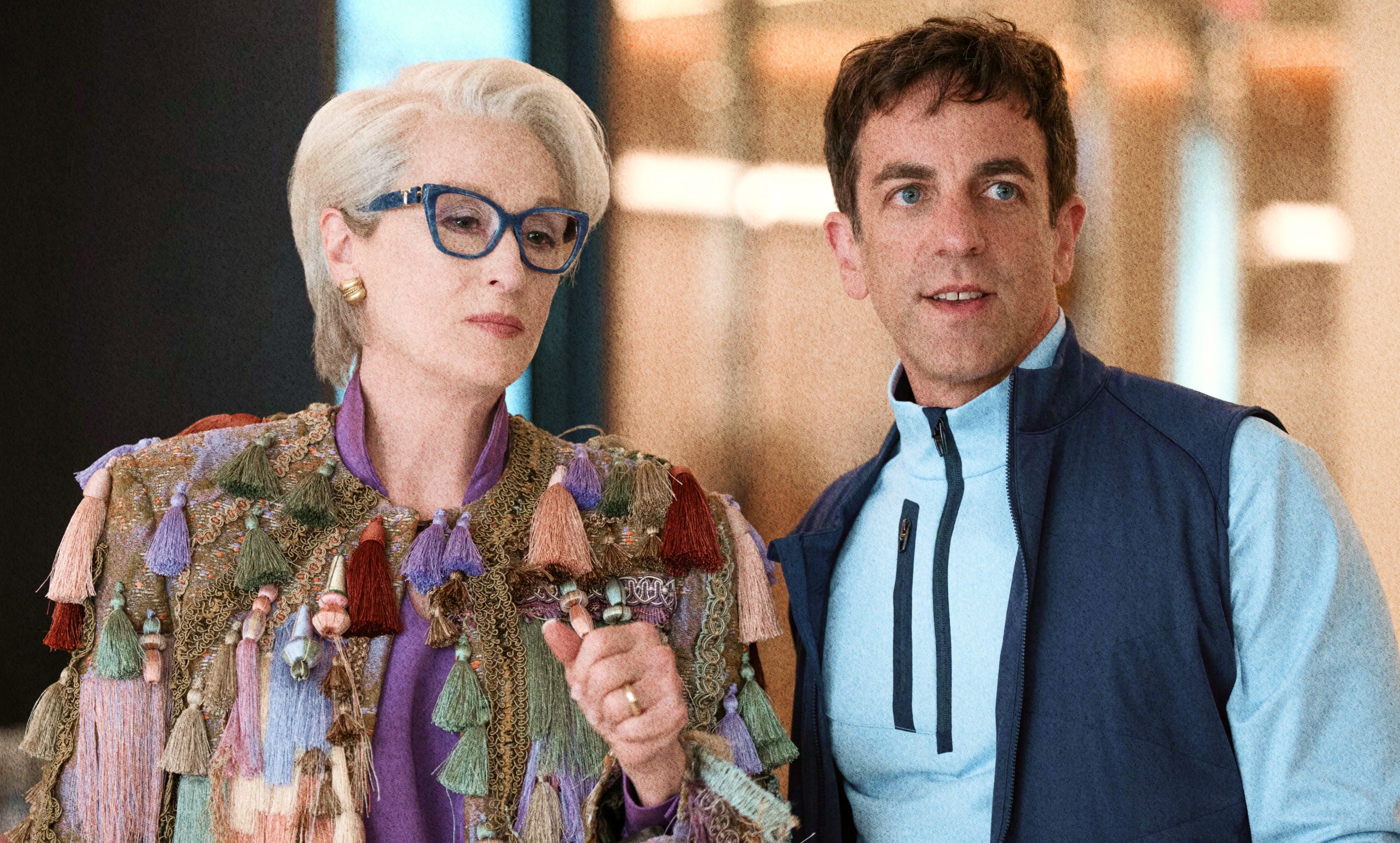
It’s strange to see Miranda Priestly on this side of a power dynamic, alternately sitting meekly before a table of drab Bain & Company pencil pushers or navigating the capricious whims of another, more powerful player who controls her future. She makes for an unsettling underdog. Miranda’s new first assistant4 is part-secretary, part-Woke Minder, interrupting her before she can say anything too explicitly fatphobic or racist (this was a funny bit). The movie depicts the indignities of cost-cutting in all its deflating specificity, like flying coach and eating in the staff cafeteria and taking Ubers instead of private car services. It is, in many ways, the photonegative of the golden age depicted in the first Devil.
As one Vulture review puts it, in The Devil Wears Prada 2, “the villain is corporate greed. [...] It’s — dare I say it? — late-stage capitalism.” The film’s screenwriter and director, for their part, describe the first movie to Kara Swisher as “what it is to be a young person and be figuring out who you are and finding out where the ethical and moral lines you draw exist.” When Andy and Miranda meet again in 2026, ethical and moral lines are, like Business Class seats and town cars, luxuries of the distant past, vestiges of newsrooms with meatier expense accounts. Now, the characters are “figuring out what it means to be somebody who’s in their forties and struggling to survive [Andy], or someone who’s running the thing and struggling to survive [Miranda].” That “struggling to survive” appears to be the unifying thesis across two characters who once existed worlds apart is noteworthy. Writing for Defector, Kelsey McKinney puts the film’s central tension more plainly: “The enemy for Andy is no longer a bad boss with a bad temper and impossible standards. Her enemy is society. It’s billionaires.” Measured against the vast scale of plutocracy, the film seems to say, Andy and Miranda are the same.
Oh, the billionaires, now inescapable even in this sacred sugar-coated genre, the tentacles of their tacky influence worming through the topsoil and poisoning the groundwater! In the film, the mechanism by which we meet our billionaires is Emily, Miranda’s former first assistant from the OG Devil and namesake for the eponymous Emilies, who’s shacked up with a doting and doltish tech tycoon so obviously intended to be an analogue for Jeff Bezos that I don’t remember his character’s name and can’t be bothered to look it up. It doesn’t matter. We’ll call him Beff Jezos. Beff’s ex-wife, his benevolent foil played by Lucy Liu, is made extremely wealthy by their divorce, a sort of reimagined MacKenzie Scott.
Lucy-MacKenzie is the Mommy Warbucks deus ex machina that “saves” Runway by the end of the film by buying it out from under her plotting ex-husband. In this way, the billionaires are not just the villains, but also the heroes. Miranda, for her part, isn’t foolish enough to think that their new owner will allow them total free rein—this woman has bought them more time, but she has not, Miranda understands, changed the underlying dynamics of the situation at hand. The clock is still ticking, just more slowly. This is a cynical twist on the expected fairytale-ever-after ending (the original Devil had Andy recommitting to her principles to do hard-hitting journalism). The once-mighty Runway is reduced to little more than a rook on the chessboard of a contentious Rich People divorce. Andy’s capitulation and pleading to a billionaire to save the magazine is one thing; watching Miranda Priestly do the same—this woman who loomed so large in my childhood imagination as a god-like figure dispensing power and taste at will—is quite another.
I began feeling antsy with about 30 minutes left, covertly checking the clock every few minutes and doing mental math with the run time. Walking out of the theater, I felt flattened, squinting into the 6 o’clock sun and licking my lips, cracked and tender in the corners from the popcorn salt. Somehow I felt more nostalgic for the original film than when I entered the theater two hours earlier. For about a week thereafter I felt annoyed at the filmmakers for tainting this cerulean time capsule of make-believe with the harsh realities of our grinding economic bullshit.5 That these structures6 are now so ineluctable is the meta-tragedy of the movie, soldering our feet to the floor and preventing our escape.
But it’s hard to know without a close rewatch of the original Devil whether what’s changed is Andy’s world or our own. Am I disappointed in the film or am I disappointed in reality? Entertainment of this nature is more like a mirror than a window; when we think we’re peering through and scrutinizing the characters and plot, we’re often just wiping away the steam and studying our own reflection. It’s not their fault I don’t like what I see.

Today’s issue is brought to you by Tello Mobile, a mobile provider built from day one around the belief that there’s no reason to overpay for wireless service. Their Unlimited plan (with 10 GB of hot spot included) is just $25/month—and with no contract or hidden fees.
If you’ve been meaning to get off your parents’ family plan for years (“You said it was cheaper for you if I was on the family plan!”), Tello makes it easy to switch. Use your device and bring your phone number with you, or choose to get a new one—either way, their friendly, live, and responsive customer service is here to make the process smooth.
Tello customers get reliable, nationwide 5G coverage on America’s largest network. Plan options include:
Unlimited data, talk, and text for $25/month
20 GB plus unlimited talk and text for $20/month
10 GB plus unlimited talk and text for $15/month

Back on my David Foster Wallace bullshit with “Up, Simba,” a piece he originally wrote for Rolling Stone covering John McCain’s failed 2000 presidential run. (This, however, is a bootleg PDF from what appears to be an online English class.) There’s something about his prose and observational style that I can’t stop returning to. There were parts—especially the idea that the media, rather than the American people, are the true intended audience for political fanfare—that reminded me of Joan Didion’s Political Fictions, a book of essays about the absolute circus of US presidential campaigning which came out around the same time. (Rolling Stone)
iOS 27 reportedly adds a new bill-splitting feature that uses a picture of a receipt. (Bloomberg)
What fairer system could realistically replace capitalism in our lifetime? Bhaskar Sunkara makes a compelling case for “market socialism.” (This is the basis for my “American utopia,” by the way.) This episode of Confronting Capitalism offered a satisfying explanation. I appreciate how this concept acknowledges the role of incentives and competition as useful and healthy rather than necessarily detrimental. (Jacobin)
And as a parting gift, our latest episode of Diabolical Lies:

📱 Brought to you by Tello Mobile. Try Tello’s Unlimited Everything Plan for just $25/month and get nationwide, 5G coverage on America’s largest network. Includes a 10 GB hotspot. No contracts or lock-ins.
not really but whatever
once, at a second grade sleepover, I asked my friend Megan’s mom if they “had anything with Sandra Bullock” and she laughed so hard I thought I had found a kindred spirit who was moved to giggles by the sheer suggestion of Sandra’s comedic genius (she said no)
(The Sex and the City television series falls into this genre as well)
Amari was the new character in the movie I found myself wanting more of. Can we go back to her apartment? See what she gets up to on the weekends? Need to know more about her.
the original film also had grotesque wealth, but mostly just the fun kind
(which existed in 2006, but seemingly with less urgent ubiquity)
They really missed an opportunity here not making Andy's first chef boyfriend become a Shake Shack style PE backed darling who comes for a cameo to smirk at Andy while serving them 300 dollar sea bream caviar mousse or whatever at a charity event.
Thanks for putting into words (the perfect ones) the dread and disappointment I felt at the end of the movie. Couldn’t shake it off for days.