

This is one of those “terminally online” essays for which you are probably Too Employed. I hope you enjoy it anyway.
IT IS NOT NEWS THAT PEOPLE BEHAVE PUNITIVELY ON THE INTERNET. As longtime readers will know, I once cataloged with great fascination the vindictive compulsions on display in the Wall Street Journal comments section.
The Journal is an outlet whose target audience is mostly upper-middle-class suburban empty nesters, so it’s expected, natural even, that they say things like Gen Z is Struggling to Grow Up, or that Mom and Dad Are a Little Too Involved in Gen Z’s Jobs, or that (bear with me) The Young MAGA Socialists Are Here. I don’t need to read any of these articles—or their comments—to catch the subtext. It’s rarely charitable.
Of course, parents raising kids in the 1950s complained their children were Going Soft now that life was all sockhops and soda pop and washing machines. That these anxieties are exorcised in the comments sections of articles like STUDY FINDS GEN Z ACTUALLY UNEMPLOYED OVERSIZED BABIES is merely the circle of life.1
Less explicable, though, is a variation of this same attitude on Gen Z’s home turf. This much-fretted-over populace, the multicultural, tooth-gemmed Youth2, is indigenous to TikTok. They are the supposed purveyors of trigger warnings and land acknowledgments and socialist politics. It seems noteworthy, then, that TikTok’s algorithmically mediated hive mind regularly swarms conclusions that vary so little from that of the Journalers. If you squint, these digital third spaces appear to be merging into one big contemptuous singularity of get a job and stop asking for handouts.
A few days ago, Matt Bernstein covered one such recent case of manufactured outrage on his podcast A Bit Fruity. At the center of the controversy was a creator named Jools Lebron, who you may know from her “very demure, very mindful” viral rocket ship a few years ago, a video she posted while on break at her job as a grocery store cashier.
To go from a private person to a public figure in mere days—your likeness carpet bombed all over the For You page according to the whims of a proprietary recommendation engine—has to be destabilizing.
Lebron had a (now-somewhat predictable) trajectory: working-class person goes viral unexpectedly, is overwhelmed with a barrage of seemingly life-changing opportunities, then the circus picks up and moves towns. Their 15 minutes are up. A minority3 of people manage to transmute this surreal experience into a sustainable career in entertainment, but sustainability is largely at odds with how virality is designed to operate, where something becomes virtually inescapable and then, just as quickly, vanishes. (Remember Hawk Tuah? Me neither.)
Lebron has been “going viral” again, but this time, not in a way that ushers in partnerships with Dunkin’ Donuts or spawns clumsy tweets from airlines trying to siphon off a little clout juice. After recovering from drug addiction, she says in a now-deleted video, her teeth were “falling out of her head.” Because this is America, the reconstruction surgery she needed cost tens of thousands of dollars, which she did not have. She shared a GoFundMe, asking her followers for help.
The consensus was, apparently, that this request was an unthinkable affront.
Most of the A Bit Fruity coverage focused on clarifying the volatile creator business—the scourge of net-60 payment terms, the instability of freelance income and the complexity of taxes—but it was the collection of sample clips Bernstein shared at the top of the episode summarizing the public response that felt most reminiscent of a good ol’ romp in the Journal comments:
“Asking your 2.4 million followers to help you get new teeth is wild to me.”
“I think I’m really starting to hate influencers, because what do you mean you have over 2 million followers and you’re begging for donations to get your teeth fixed? Get to work. Get to work. All that screams to me is laziness.”
“You want us to pay $40,000 for you to keep your fucking reality alive?”
Videos of this nature, as Bernstein and his guests pointed out, were regenerating at an unbelievable clip, some collecting hundreds of thousands of likes. Each example Bernstein included came from a person who looked no older than 30. As is tradition, some videos took a broader tack, suggesting that, actually, Jools Lebron has ALWAYS been a bad person, as though asking for help to afford healthcare was the last straw, the smoking gun. We got her, folks.
I won’t pretend to be surprised by this reaction. The backlash comes amid a broader cultural renegotiation with influencers; a debate about whether it’s a real job; a collective scoff at the vacuous claim that influencers are discriminated against; a suspicion that they’re all just doing ragebait.
But more relevant to the fallout is, I think, the fact that Lebron is asking for help at a time when a lot of people who aren’t internet-famous need help, too. The ACA marketplace enrolled three million fewer people in 2026 following the expiration of tax credits that offset premium costs. These are often the Americans whose jobs don’t provide healthcare, but who aren’t poor enough to qualify for Medicaid. Too rich for the “free” program, too broke for “premium” insurance. That’s not to say having health insurance would have mattered in this situation; your teeth are, of course, not considered part of your otherwise-insured body.
A quick scroll through these missives and the chatter pooling around them reveals that many feel her primary offense was not “capitalizing on demure” when she had the chance. The anger seemed aimed not just at the perception of her relative financial privilege, but at her inability to convert her internet fame into more privilege—that she, in other words, blew it.
It’s not just the ambient precarity of American life, then, but the specter of vast opportunity that appears to exist simultaneously—that magic portal in your pocket theoretically capable of bibbidi-bobbidi-booing your stagnant paycheck-to-paycheck life—that waters the long-ago-planted seeds of a neoliberalized work ethic.
SO IMAGINE: There you are, scrolling away your lunch break at your middle-income job, and what should appear on your screen but a content creator—someone who gets paid to use the app you use for leisure—asking for money to afford dental surgery. How dare you? you might think, You need to get a job like everyone else.
You’d probably forget, as you scanned the incensed comments suggesting Lebron go back to the grocery store, that even the average white-collar nine-to-five job would not be able to pay for a $40,000 medical bill, since the average income in the United States is around $70,000 before taxes, or around $55,000 after.4
You probably wouldn’t be reflecting on the bleak fact that a reported 10 million Americans have, at some point, engaged in dental tourism, finding it preferable to go to another country for dentistry, particularly because most dental insurance plans stop paying after around $2,000 in expenses per year.
You’d probably hear the chorus of comment cops sounding off about how she should’ve been more financially literate with her demure lottery winnings and find yourself nodding along, agreeing that, had it been you, you surely would’ve capitalized by shilling a Very Demure, Very Mindful eyeshadow palette.
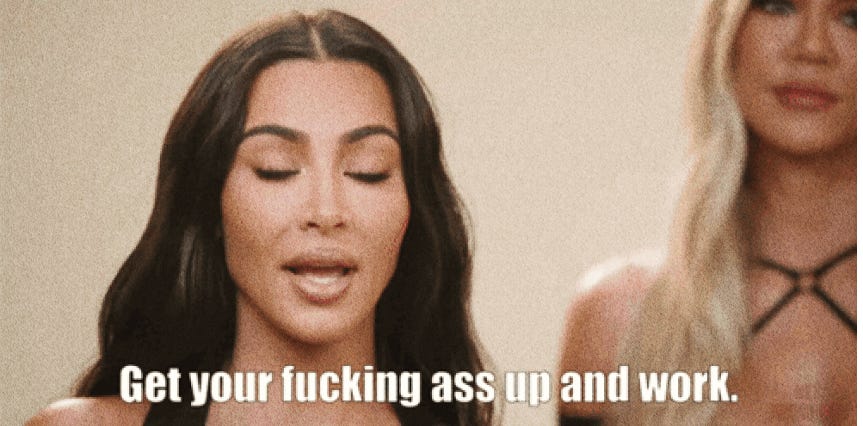
After all this, you might even start to understand where one Kimberly Noel Kardashian was coming from a few years ago when she stared down the barrel of that long lens camera and declared you needed to get your fucking ass up and work because it seems like nobody wants to work these days, an assertion for which she was burned at the stake back in the gentler pandemic haze of 2022.
You might just think—sorry, what was it that one gal said?—Get to work. Get to work. All that screams to me is laziness.
Now you’d be really nice and worked up at the audacity, and it’s at this point that you’d notice the room had been spinning the entire time, signaling that we’ve officially done a 180 on our journey that began with being pissed at Kim about Get Your Ass Up and Work, all that business along the way about class consciousness and structural insecurity and mutual aid sucked clean out the open window by the tornado of reactionary economic politics. Never mind that Jools Lebron, a fat and trans woman of color from a low-income background, is practically a composite sketch of the marginalized identities that received approximately four years of semi-earnest attention in workplace sensitivity trainings before being command-F-deleted from federally funded research databases. None of that shallow sympathy ends up mattering when the person in question appears to fumble the rare opportunity to escape the “rat race,” and then has the gall to ask for help.
Lebron opened an algorithmic candy bar, found a golden ticket inside, and still ended up begging for money on the internet to pay for a major health procedure. This isn’t supposed to happen to someone who “makes it.” And if it can happen to her, that small voice buried beneath all those years of get to work programming might whisper, what’s to stop it from happening to you, too?
And it’s true: We don’t know if Lebron would still be in this position had she made all the “right” decisions back when the ByteDance gods smiled upon her. But we do know that rates of poverty in the US are “unexpectedly high” for “those who ‘play by the rules,’” according to 2023 research, and that while the US has below-average incidence rates of poverty “risk factors” (the so-called wrong decisions) like unemployment and low education, it also has an above-average poverty rate.
This is, when I step back, maybe the clearest proof in recent memory that a punitive demand for individual AccountabilityTM from the comparatively privileged (Lebron, in this case; considered a rich person who mismanaged her money) is a distraction, the shared wet dream of billionaires and the lawmakers who refuse to do anything about them. It’s certainly a far less effective driver of solidarity than a recognition of our shared class interests, our shared fallibility, our shared human bodies that break down in new and inventive ways every day.
This issue was brought to you by Betterment.

Paid client. Views may not be representative. See App Store & Google Play reviews. Learn more. Investing involves risk. Performance not guaranteed.
Betterment recently released its annual Retail Investor report, and while there was a lot that probably wouldn’t surprise you—concerns about inflation, a lack of confidence about retirement, etc.—there was one actionable finding that I want to highlight.
Routine and structure can create momentum in a positive direction. Investors who use a digital investing platform report retirement confidence at 68%, compared to just 39% for those who don’t—a nearly 30-point gap that I don’t think is explainable by selection bias alone.
Based on Betterment-sponsored survey as of 4/3/2026.
Moreover, the survey found that investors who report the most retirement confidence have a set of financial habits and have designed an intentional structure for their money—for example, investors who use digital investing platforms consistently report higher financial awareness.
I wrote more about my thoughts on the report, as well as the current state of my own financial structure and routine, including what parts I do—and don’t—automate, here.
If you’re looking to build that kind of structure for yourself, get started in minutes with Betterment.

One word: Bobby.
Oura Ring users are suing the company for misrepresenting the accuracy of its sleep data tracking. I started using an Oura Ring in 2020 because back then there wasn’t much to do beyond collect biometrics on yourself like a sad little lab rat, but now I’m feeling like a guinea pig. “A coin flip’s chance of being accurate”? My ass got played (if true), though my husband Thomas says he thinks this lawsuit sounds like a cash grab. Either way, it feels like the pendulum is swinging on optimization culture. Is there a thinkpiece there? (TechCrunch)
Watched the original Jackass: The Movie (2002) for the first time over the weekend. I’m so happy they made 12 of these. What cinema!
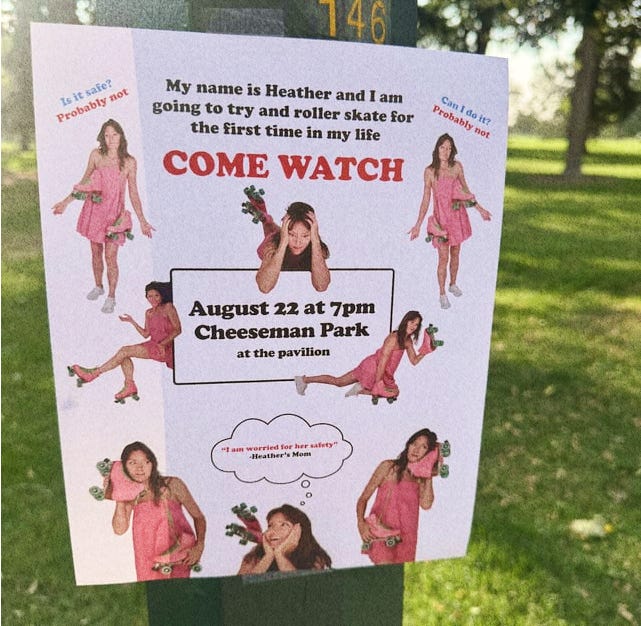
A 34-year-old Denver woman named Heather Walker invited strangers, via handmade posters, to bear witness to her first time roller-skating. It turned into a massive party. You really can just do stuff. (Westword)
Americans are zooted out of their minds on energy drinks, regularly using all manner of stimulants not for pleasure, but for work. I’d never reflected before on how dark this habit is. (Current Affairs)
The radio in my car somehow ended up on a Christian rap station. The tagline promises that it’s IGNITING THE KINGDOM LIFE INSIDE OF [ME]. And you know what? Fair. Talk about an email job anthem:
God gave me the keys so I’m lockin’ in,

Had to get off TikTok, watch how I be clockin’ in

Felt the Holy Spirit on the stage when I was walkin’ in

If you got a problem with me, you gon’ have to talk to Him
An episode about doing donuts in the parking lot of injustice for 40 years; also known as, motherhood’s shifting PR strategy. A public episode of Diabolical Lies:

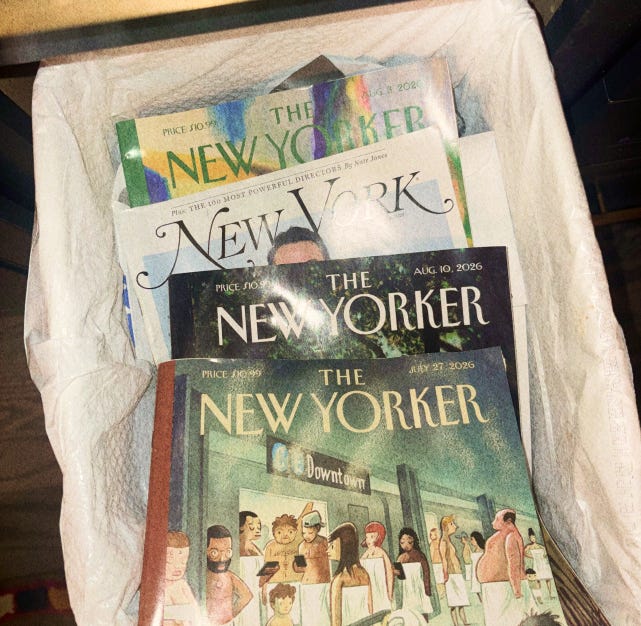
Sometimes you need to declare print magazine bankruptcy, accept you’ll never catch up with the issues you’ve been accumulating, and recycle the backlog. This is what being brave enough to accept failure looks like:
🤖 People who use digital investing platforms are more confident about retirement. Get started investing for your future in minutes with Betterment and feel the difference.
I would love to Reverse-Bari-Weiss the Journal’s Opinion section and be the sole leftist diversity hire writing for “Free Expression.” What fun we could have!
The oldest Gen Zers are now 30, but whatever.
And by “minority,” I mean Brittany Broski.
For Columbus, Ohio. Selected at random.
I've effectively learned to tune out the latest social media uproar and wait for MWK, DL, or any of my other trusted sources of information's more nuanced, charitable, and compassionate read of the situation.
I've subscribed to my own version of Katie's "if it weren't for social media would I know about this" for a long time and it's been very useful in helping me figure out what is (the people in power ruining our lives and damaging society from multiple fronts) and isn't (influencer having to resort to online pan-handling due to the fuckery caused by the aforementioned people in power) worthy of my outrage.
Thanks for another great article!
The New Yorker dump is the realest thing in the world. I wish they did a monthly digest with the best of the month.
Also ugh you are such a good writer. Really enjoyed this.