

How I’ve been feeling since I last saw you:
Seeking interior designers who feel comfortable working with “intellectual goon cave”1 as the aesthetic direction for a home office.
In other news, a follow-up from last week’s request for disclosure about your most shameless luxury fantasy: There are usually trends in the answers to questions like this one, but this response from a reader named Caroline was so off the wall I starred it immediately to make sure I’d remember to share it with you all.
If money were no object I would 100% buy the turtleneck that Christine Lagarde wore at Davos. It’s probably more than my entire yearly clothing budget. Or go on a shopping spree where she (or her personal shopper) purchases clothing. I do feel a little rude that I only remembered her name because I liked her turtleneck.
“I do feel a little rude that I only remembered her name because I liked her turtleneck” is a phrase that feels like it was salvaged from the cutting room floor of the original Mean Girls screenplay. This is a woman who’s seen things:

All right, you filthy animals, back to Business™️.
Today:
The “human premium” for work
A YouTube star acquires a finance app
Gen Z’s inability to clock out
Another American city introduces almost-universal childcare
…and, at the end, an exciting (to me) update.

🪞 For the second time in the 2020s, Glossier is laying off one-third of its staff. What I would give to see this business’s books. Fifty-four employees will be impacted by the downsizing, which is fewer than were impacted by the 80-person cut in 2022, the same year founder Emily Weiss transitioned from CEO to Executive Chairwoman. Deductive reasoning: Glossier had roughly 240 employees in 2022, was down to 150 by 2026, and is now trimming to around 100. Exact revenue figures aren’t known, but it appears to be somewhere in the $100–$250 million per year range. In any other world—which is to say, not our world, where Glossier was valued as a technology company2 during the WeWork Era of hallucinogenic valuations—this business would appear extraordinarily healthy. Approximately six weeks into running Money with Katie independently, I already have a tail-between-my-legs flicker of empathy for businesses that make mistakes which eventually lead to downsizing. Revenue forecasting—and determining what you can spend long term—is, it turns out, challenging. (Cosmetics Business)

🤳 The world’s biggest YouTube star is buying a finance app for young people. Spectacle magnate Monsieur Beast, a man who once “monetized the seven days he spent buried alive,” as Semafor points out, is expanding his imperial reach from the realm of clicks and chocolate bars to…financial services. “The reality is that mandatory nest eggs, whether through bygone corporate pensions or nationalized retirement schemes, have a long track record of actually working. Gamified behavioral nudges don’t.” Can you imagine seeing this face every time you open your budgeting app? (Semafor)
👀 Speaking of YouTube stars, a free business idea: A wealth management and tax-planning firm specifically geared toward content creators. (If any entrepreneurially inclined CFPs are interested in starting this, you know where to find me.) A recent H&R Block survey found that 25% of influencers cite taxes as their biggest business stressor, and having met non-finance creators before, I’m always fighting off the urge to extol the virtues of the SEP IRA as the perfect vehicle for insulating your future from the fickle mistress of online relevance. (Wall Street Journal)

🪜 Anybody else find Gen Z’s tendency to approach side hustles as creative outlets (that double as insurance against the pitfalls of the traditional career path) commendable, even if the underlying economic drivers are dark? Sure, I could saddle up Old Faithful (a materialist analysis, structural precariousness, etc.) and that critique would be true enough, but the silver lining connoisseur in me reads some of the quotes in this article and thinks, On some level this must be preferable to clocking in and out for the same employer for 40 years, right? (“From watching our parents’ generation pour everything into work, as a generation, we realized we need to pursue something we love and feel fulfilled,” and “Compared to my retail job, my side hustle gives me a sense of accomplishment […] it’s more challenging, creative and mentally stimulating and I can have a real impact.”) Tell me if I’m snorting copium. (The Guardian)
🤖 Spotify says its best developers “haven’t written a line of code” since December. In a maneuver that bears a remarkable resemblance to digging one’s own grave, the developers are having AI code for them. It officially seems we’re past the point where AI doomerism is productive or interesting (if it ever was), so instead I’d like to share an observation which might produce a worthwhile debate: As large language models become increasingly proficient at performing basic tasks, there seems to exist a “human premium,” where the mention of something being done “by a human”—even if that “something” is otherwise menial or rote—elicits reflexive praise or suggests the work has a higher moral value. The implication being: We’d still prefer that humans do the labor, rather than machines.
What drives this preference?
Is there something intrinsically valuable about labor (a “work has dignity” lens), such that taking it away from humans is de facto degrading?
Is it about environmental concerns (in which case, if AI were eventually powered by renewable energy, the aversion would go away)?
Or is it *silently pushes a comically large copy of The Communist Manifesto for Dummies across the table* private, concentrated ownership of the machines that are taking the jobs, and therefore the resources those jobs create, that feels so unjust?
If it’s primarily #3, I offer that the animating factor of the collective disdain for large language models may be more specific to the capitalist mode of production than is immediately obvious. (Ah, Old Faithful! Nice to see you!) (Tech Crunch)
🧅 What’s the over/under on how much time it will take for this Onion headline to become real? More importantly: Has anyone read anything genuinely novel lately about prediction markets like Kalshi and Polymarket or the proliferation of sites like DraftKings? Every “take” I read about gambling seems (a) fundamentally reactionary and (b) more or less the same, and I’m hungry for a wacky, Big Brain analysis. (The Onion)

Brought to You by Betterment

I have a confession to make: Despite transforming my entire identity into that of Personal Finance Personality, I haven’t had a traditional “emergency fund” in years. I was living fast and loose with my money either (a) in my checking account or (b) in an investment account set to a 90%+ stock allocation, with no in-between. Because of this, I never had any real reason for saving meaningfully in a dedicated high-yield cash account.
With my major lifestyle shift to self-employment, that changed in 2026. Now I’m absolutely lousy3 with high-yield cash accounts, each earmarked for its own special use case: my taxes, for one, now that I’m setting aside a whopping 30% of everything I earn. It would pain me too much to watch that money rot in checking, earning nothing.
With Betterment’s high-yield cash account called “Cash Reserve,” you can:
✅ Earn up to a 3.90% variable APY with a qualifying deposit—that’s nearly 10x the national average—on the same platform where you’re growing your investments.
🤩 Save with no fees or minimum balances.
👼 Feel assured that up to $2 million is FDIC-insured (though I can’t think of any scenario in which I’d ever recommend keeping $2 million in cash; go with God, comrade). That’s 8x what most banks offer.
(The standard insurance amount of $250,000 per depositor, per insured bank, is provided by the FDIC and is subject to FDIC requirements.)
Open your Cash Reserve account today and start saving for tomorrow. You can even create multiple savings goals and use Betterment’s automated tools to help you achieve them.
🥳 Put your cash to work with Betterment Cash Reserve and earn up to a 3.90% variable APY with a qualifying deposit.
Paid non-client. Views may not be representative. See App Store & Google Play reviews. Rate is subject to change. Learn more.

❤️🩹 San Francisco is following in New Mexico’s footsteps and making childcare free for families of four earning less than $230,000 per year and providing 50% coverage for families making up to $310,000. While I’d prefer we stop playing America’s treasured means-testing pastime “Who’s Middle Class” and just make this shit universal, you won’t catch me complaining. Few investments would yield higher societal returns than guaranteeing every child, regardless of background, an enriching early childhood education. Your turn, Denver. Do it, cowards! (The San Francisco Standard)

🥓 Tragic update: The K-Shaped economy might be coming for the complimentary hotel breakfast. Positioning the breakfast as “free”—when ostensibly it’s factored into room rates in some capacity—probably makes ditching it (or continuing to chintz-ify it) look like an easy way to recoup a couple points of margin. Of note: Best Western and Holiday Inn Express remain steadfast in their commitment to the waffle maker even as broader industry trends tempt them away from it. Since we’re here, it’s worth sharing Breakfast Buffet Math, or: how to construct the optimal breakfast buffet experience if you’re a sociopath. My sister-in-law has her own strategy (maximize high-value fruit and meat consumption; avoid filling, low-value carbs), but my ideal all-you-can-eat romp is just one long, unrequited attempt to recreate the magic of the Waffle House All-Star Special. I found a 2007 Waffle House menu on Reddit; this breakfast was $5.89. We used to be a proper country. (CNBC)

📈 If economics is the study of how societies allocate scarce resources to satisfy unlimited wants, does it make sense to exclude child rearing from that analysis? Public policy researcher and journalist Stephanie Murray argues something is lost when we insist that familial relations are simply too intimate for economic metrics, or that assigning a value “reduces” them to a transaction. This piece is a response to the criticisms she hears most in her work—all of which I’ve received before—but it was satisfying to see her perspective collected into one frustrated “thwap” at naysayers. Prior to the rise of wage labor in Great Britain, “wives and mothers” constituted a distinct occupational class. Also, this:
GDP skews our understanding of economic growth by failing to account for shifts between market and nonmarket activity. Because the child care provided by a stay-at-home parent (usually a mother) counts for nothing in our national accounts, the increase in GDP that results if that care is outsourced and she returns to the formal labor force will be exaggerated. By one estimate, we’ve been overstating America’s annual economic growth by somewhere between a third and two-thirds of a percentage point since 1975. (Family Stuff)
💯 The Democratic Socialists of America, or DSA, is officially 100,000 members strong. This makes it the largest socialist organization in the US in the last century. In the announcement, national co-chairs Megan Romer and Ashik Siddique wrote:
So many people are joining DSA today because we are a fully member-led and member-funded mass organization. Over 220 local chapters are growing because we represent a real alternative to the corporate oligarchy of our political system. [...] Some of our fastest-growing chapters are in places you might not expect, like Corpus Christi, Birmingham, Southern Idaho, Middle Georgia, and Eastern Kentucky. (DSA)
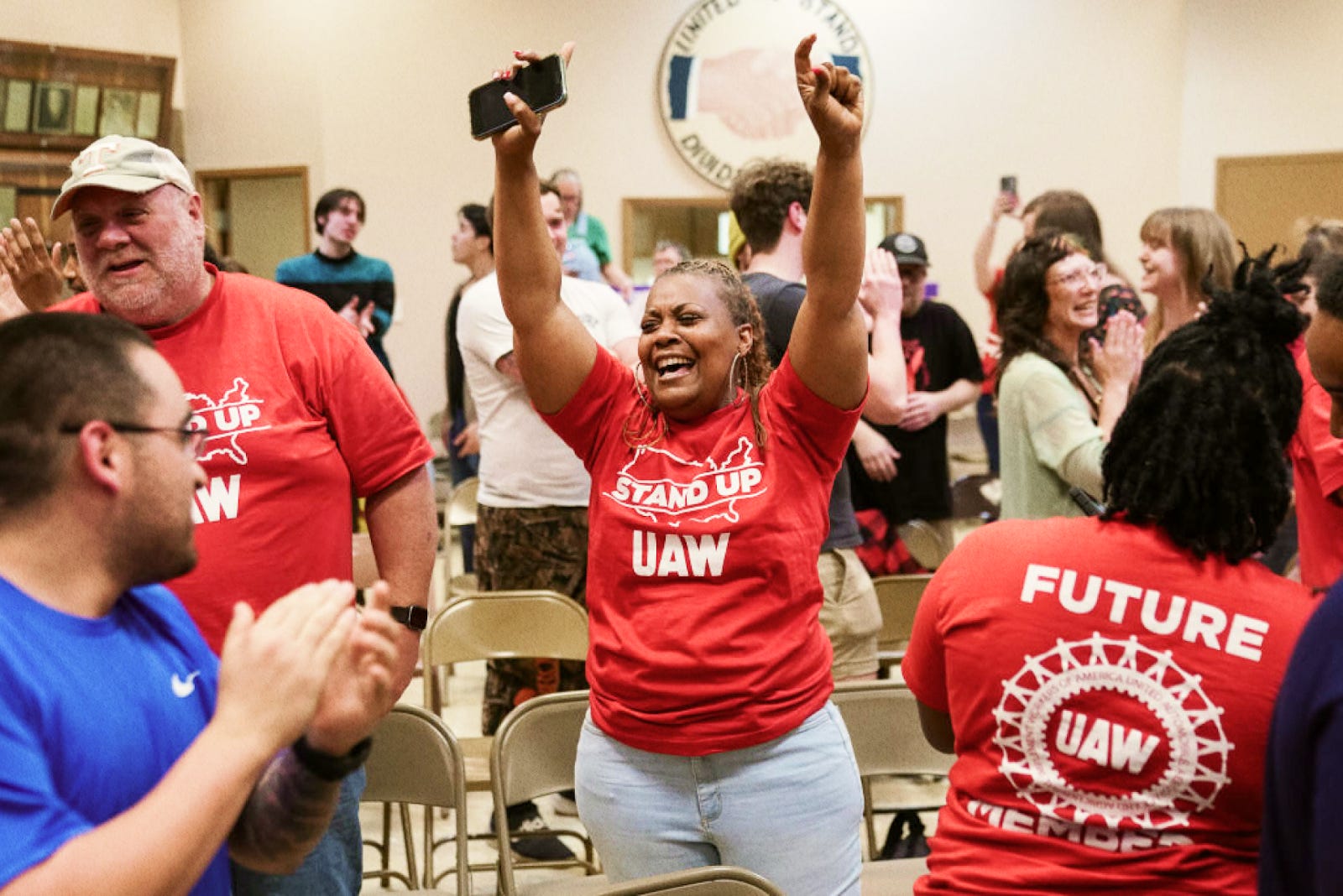
🚘 Speaking of solidarity, Volkswagen workers in Chattanooga, Tennessee won a contract after more than 500 days of bargaining. By the sounds of this story, the Tennessee plant workers and their negotiators outmaneuvered the second-most profitable auto company in the world. (Jacobin)
🧐 The ultra-wealthy have little need for offshore bank accounts when the American tax system already provides ample opportunities to avoid taxes, the author of The Second Estate told Anne Helen Petersen in a recent interview. Can’t help but think of that 2021 Wall Street Journal article called “Buy, Borrow, Die” which blew a hole through my understanding of what it means to be “rich.” We’re gearing up for the time of year when I become temporarily conservative (tax season) and this interview made me feel briefly less guilty for being annoyed by my bill. Sharing this blurb with all of you because past reader surveys tell me you’re a relatively high-income group who may find this distinction serves an exculpatory function4, assuming you share my flare of frustration:
This confusion has been compounded by discussions about “the 1%,” a phrase that purports to refer to one group of people when it really refers to two: the top 1% of income earners and the top 1% of wealth owners.
When it comes to top income earners (high-paid lawyers, doctors and business people) they really do pay a lot of income taxes. Indeed, the top 1% of earners pay 40% of all income taxes. However, this group is not the same as the top 1% of wealth owners [...] who are able to avoid income taxes by avoiding taxable income. Indeed, these high wealth owners are just as likely to be among the 40% of Americans who pay no income taxes as they are among the top 1% of income earners who pay 40% of the income taxes. (Culture Study)

🔥 Physics is what you get when you turn spirituality into math. This six-minute video about the “thermal time hypothesis” made me feel dumb (complimentary). Is time real? “Our sense of past and future arises from the physics of heat.” Agree with the commenter who said, “If I could understand any of this, it would blow my mind.” Humbling stuff. (Quanta Magazine)
🍸 Margaret Qualley was fantastic as Alex in Maid and the younger, “souped-up” Demi Moore in The Substance, but this cover profile struck me as strangely empty. The entire time I was reading, I kept thinking, it seems like this journalist couldn’t get much out of Qualley and decided to make Qualley’s reticence the story, but the end result feels too much like “trying to pass off writer’s block as writing,” to quote my favorite critic, Andrea Long Chu. So when I scrolled back to the top and saw the author was Marisa Meltzer—veteran chronicler of culture who can typically locate a juicy angle with ease—it surprised me. Maybe Qualley really is a steel trap. (Vanity Fair)
📑 I’d like to close today with a quote from Becca Rothfeld’s recent piece in the New Yorker about the brutal budget cuts that led the Washington Post to shutter its book reviews. “A consumer is a person whose preëxisting5 tastes you strive to satisfy over and over; a reader is someone you hope to change, convince, and surprise.” Thanks for being a reader. On that note, after panicking for months that my brain was broken, I finally have an idea worth writing about:

See you next week.

If you don't yet know what a goon cave is, guard your innocence.
The fact that they have products with names like "Balm Dot Com" and "Bubble Wrap" is begging for a Dot Com bubble callback.
OK, I have two. Still, that’s an infinite increase over zero.
Or—equally likely—you might just be a better person than I am. I blame being an only child.
I'm going to start putting this bitchy little ë at the end of my name to sound more high-brow. Money with Katië.
As a former private banker who has seen tax returns from hundreds of the ultra wealthy, I was radicalized when I realized how few of them claim much income (and therefore pay little to no tax). They are all broke on paper, having siphoned their millions/billions into complex entity and trust structures. I’d also like to note that “the 1%” is not a fixed group! Many taxpayers get there once, or occasionally, in the year they sell a business for example. Which should possibly matter as we plebes argue about what tax rates should be while the real wealthy evade the whole system.
Top 1% of income earners =/= top 1% of wealth owners 💡💡 this explains so much.