


Revisiting “The Troubled American,” almost 60 years later
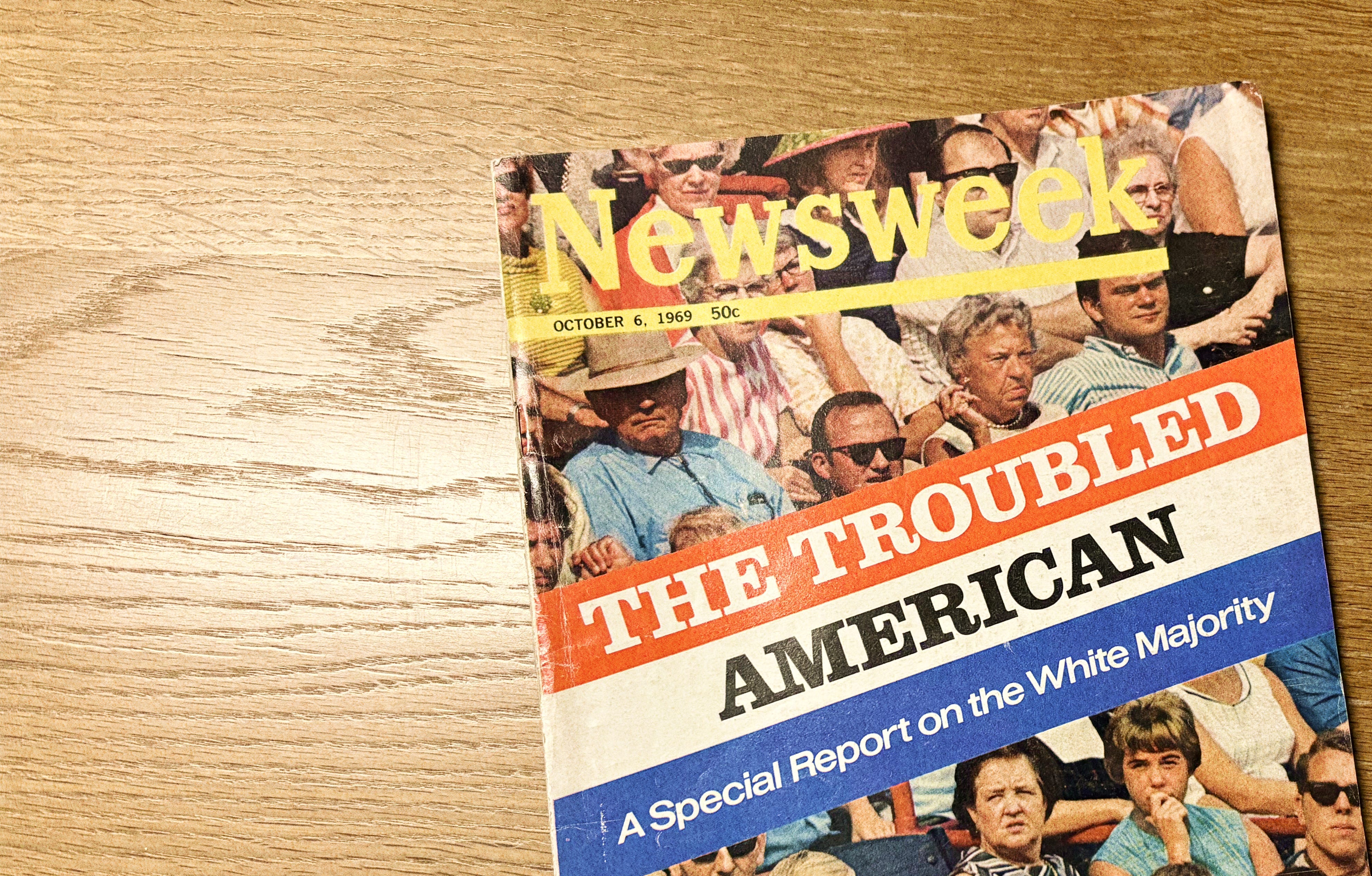
I recently bought, for $29.02, a 1969 issue of Newsweek on eBay. The purchase was the last stop on a procrastinatory research detour, all the scowling, sepia faces on its cover urging me to Buy It Now.
The feature story, a “special report,” is called “The Troubled American.” Its thick, yellowing pages, sweet with the scent of decaying paper, are saturated with an unholy number of old-timey tobacco and liquor ads, which were, of course, just “timey” in 1969.
There are references to Vietnam and shockingly plain instances of racism (like a chart depicting public opinion on integration titled, hand to God, THE BLACKS: TOO MUCH, TOO SOON?) that clearly date parts of the article. But large swaths speak to a pervasive sense of economic powerlessness that I can only describe as surreally modern. Take, for example,
“The Middle American malaise cuts much deeper—right to those fundamental questions of the sanctity of work and the stability of the family, of whether a rewarding middle-class life is still possible in modern America.”
The cited sources of instability are likewise familiar. One interview with “HUD Under Secretary Robert Wood” reveals that “[b]lue collar and white collar alike still live too near ‘layoffs,’ ‘reductions,’ ‘strikes,’ ‘plant relocations’ to be personally secure,” their lives too exposed to the whims of factory owners and bosses to ever feel safe. Another source speaks to “a deep-seated fear that the whole system is somehow failing, that the quality of life is declining and that the middle-class citizen’s own place is no longer secure.”
I was spellbound by these parallels, chuckling to myself and even strangely heartened, at points, by the notion that our modern grievances may in fact be timeless—maybe perceiving and confronting insecurity is the human condition!—until I noticed the anecdotes accruing into a grim trend.
For all the striking similarities to today’s “average American” outlook, most remarkable are the references to long-lost economic territory framed as the bare minimum for a dignified life:
“With little equity but his mortgaged home and his union card, the white worker is especially resistant to integration efforts that appear to threaten his small stake in the world.”
This description is roughly as anachronistic as print advertising for cigarettes. Today, the worker in a similar writeup would be a renter collecting 1099 income in the gig economy.


The piece splits its interviewees into the white-collar middle class and the blue-collar working class, the bigotry more red-faced and less thinly veiled in quotes from the latter cohort. This was, as Barbara Ehrenreich writes in her 1989 book Fear of Falling, somewhat typical: Blue-collar workers were (and remain) a useful megaphone for projecting reactionary beliefs shared more quietly by the upper classes. “The working class became, for many middle-class liberals, a psychic dumping ground for such unstylish sentiments as racism, male chauvinism, and crude materialism,” Ehrenreich writes, “a rearguard population that loved white bread and hated black people.” And so it is: Spirited, n-word-laden exchanges are reproduced in full in this portrait of the “white majority.”
But even the descriptions of the disgruntled “traditional working class”—those “families whose breadwinners have at most a high-school education” and “hold blue-collar jobs”—betray just how much things have changed. Their incomes, referenced in the piece as up to $10,000 per year, would be equivalent to around $94,000 today—well above the overall median of around $65,000 for full-time work, let alone the median for those with only a high-school diploma of around $49,000.
Still, each interviewee expresses some variation of the same sentiment: fear of losing their economic security. It’s hard not to feel, reading this throwback, like we’re living in an accelerated hyperreality of the situation described in these pages, politically weaponized racial tension included. (Replace every mention in this story of a Black worker with “immigrant,” and it could easily pass for a period piece from election coverage in 2024.)
Back in February, Greg Ip mused for The Wall Street Journal that today’s most valuable companies pay extraordinarily well—they just don’t employ many people. IBM was one of America’s most profitable companies in 1985, he offers by way of example, and it had 400,000 employees. Today, Nvidia is worth 20x as much as IBM, but with about 10% of its workforce. “That simple comparison says something profound about today’s economy,” he concludes. “Its rewards are going disproportionately toward capital instead of labor.”
The winner-take-all dynamic of the economy writ large might be most salient within the AI story: Anthropic’s IPO, for one, is expected to create seven billionaires and 50 centimillionaires, while at the same time representing yet another cocksure step toward a future where full-time “knowledge work” as we know it may cease to exist. But I’d amend Ip’s claim: The rewards have been “going disproportionately toward capital” for a long time—much longer than the last couple of decades. The Newsweek feature is something like proof that the comparatively secure midcentury workers recognized this, too, even if they mistook integration, rather than concentrated ownership, to be the threat to their postwar gains, a grave miscalculation which continues to reverberate through our economy today.
Reading articles like this one makes clear that the atomized, self-aware middle class has long understood its stability as synthetic, conditional, and fragile, because what is bestowed by those with wealth and power can just as easily be revoked.
This snapshot from the 1960s—in which workers who own their homes, belong to unions, and live on single incomes express indignation about the creeping sense of precarity and powerlessness they feel—is at once hauntingly familiar and dispiritingly remote. If nothing else, it clarifies that we don’t actually want to go back—we want to go somewhere better.
AI founders, meditation retreats, and the “moral injury around what they’ve built and how it’s impacting others”
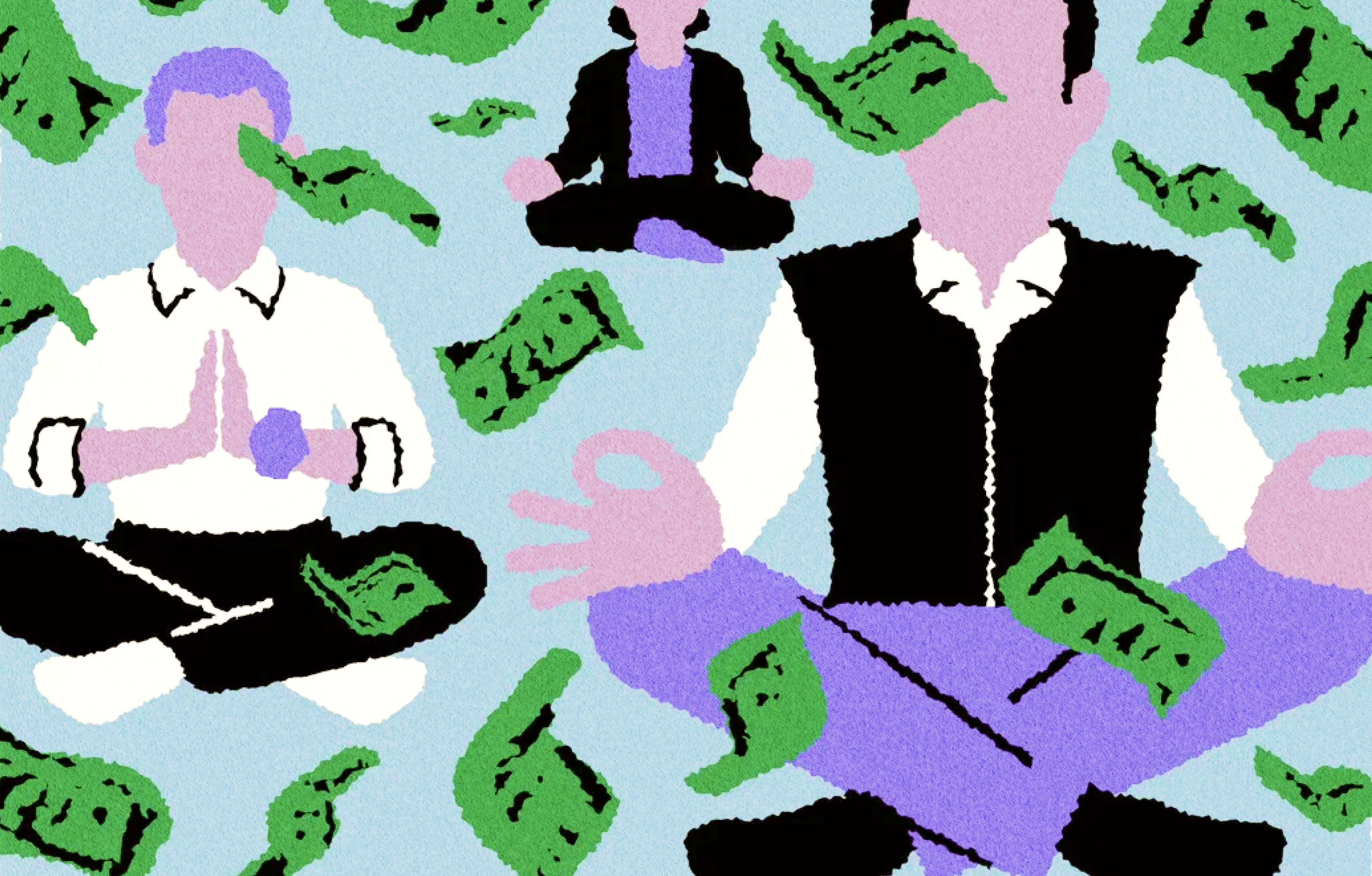
In the photonegative of Newsweek’s 57-year-old “forgotten white majority” report, we have Bloomberg’s recent piece about “tech’s nouveau riche.” In this uncanny audit of the other side of the insecurity ledger, tech founders are “suffering” in droves from “sudden wealth syndrome.”
The reporter, Tiffany Ap, attributes this phenomenon—and the resultant marketplace dedicated to shepherding this 0.1% through their existential malaise—to the speed and scale with which AI companies are creating vast fortunes. The intensity of the ennui downstream of becoming “post-economic”—when money is so plentiful it no longer seems real—is, evidently, hard to overstate; within just a few paragraphs, sources talk about being suicidal.
Money, after “about $20 million,” stops feeling real, creating a “delusional effect on someone’s psychology,” Ap writes. This article seems to accidentally make the case that, for all the oft-discussed downsides of wealth inequality, we have neglected to depict leveling the scales as something that might be good for the rich, too, whose brains are presently melting out of their noses.
One of the founders profiled grew up in poverty, an experience which functions like a foil to support the piece’s broader thesis: You think being broke is hard? Try being rich. The struggles summoned from his past are more clearly legible as such: no money to fix a family vehicle, homelessness abated by—no kidding—the generosity of Tibetan monks. The founder, having recently taken a bullet train to the opposite end of the distribution after selling his company for $110 million at age 31, reflects that when he was a kid, money was “a constant source of pain.” And yet: He characterizes the “state of aimless ennui” brought on by his wealth as “darker than the poverty he’d survived.” Things are even bleaker for those getting rich from artificial intelligence; one therapist specializing in the particular neuroses of tech founders said the AI contingent are experiencing “moral injury” regarding “what they’ve built and how it’s impacting others.” The data, where it exists, would appear to confirm these experiences: Only 15% of this cohort were assessed to be “thriving.”
The argument builds toward the controversial claim that extreme wealth is a psychologically painful experience—and if that’s the case, it seems noteworthy that these are the conditions of triumph for which our broader social cohesion is being sacrificed.
The implicit bargain which powers the status quo is this: In order to incentivize self-interested geniuses to invent the things that benefit the majority, the majority must exist in varying degrees of scarcity and powerlessness.
But if the benefits of the inventions are dubious, and even the “winners” find that their grand prize introduces a host of problems so bad they begin questioning their will to live, wouldn’t it be better for everyone—the extremely rich included—if our economic system didn’t lurch toward extremes?
In the end, hilariously, the advice offered by the cadre of wealth consultants to ethically conflicted billionaires isn’t to stop creating technology that makes them feel morally compromised. Instead, in a pivot that feels straight out of Silicon Valley, it is suggested that they “Airbnb the mansion for a few months” before buying it and cultivate “a sense of humor” about their situation, which “helps.”
For his part, the rags-to-riches entrepreneur describes finding peace not in wrestling with the absurd extremes of his life and their implications, but in “making online content” and “spending time with Richard Branson,” whose “natural exuberance” has, evidently, only been enhanced by his billions, which he has deployed, in part, to buy an island full of baby kangaroos (an “unapologetically whimsical” choice, the founder observes admiringly). If I didn’t know better, I’d assume Bloomberg was doing high-concept cultural criticism.
Having achieved financial freedom beyond all reasonable limits, this group now turns toward quasi-spiritual retreats designed to teach them how to lead “more deeply fulfilling lives.” (“The number of members who are daily meditators would blow your mind,” reports one person who runs a support network for the ultra-wealthy.)
Perhaps hearing the distant creaks of the guillotines being wheeled out of storage, the article’s conclusion nods at the possibility that the coming superabundance ushered in by AI—the technology making a few thousand people so rich and morally compromised it depresses them—might just foist these problems of “post-economic life” on the rest of society, too.
By now this promise is familiar: It’s the “freedom from economic necessity for all, but me first” argument. These assurances of future widespread prosperity seem to spill involuntarily from the open mouths of technocrats. Not now—never now—but at some point in the unspecified middle distance, through some similarly unspecified process. For now, the freedom from economic necessity is guaranteed only to those exiting the AI companies.
Having all the money they could ever need, Ap describes the post-exit founder as free of earthly obligations, forced instead to confront the precarious tip of Maslow’s hierarchy, “a small, well-funded group finding out, ahead of the rest of us, what a person does when nothing is required of them.” Those made ultra-rich by the boom, then, are in a bit of a paradoxical spot: They are the first to grapple with life after “nothing is required of them” thanks to their supposed contributions to our superabundant future, but also those for whom the value of their wealth is somewhat dependent upon that superabundant future never coming to pass. Converting AI into a public good would neuter the valuations tied to its private ownership, to say nothing of the fact that a world of superabundance is one in which nobody can be coerced by your money into doing what you want them to do.
But this tossed-off conflation of no longer needing to work for money with owing nothing to anybody ever again strikes me as the most telling sentence in the piece, and the likeliest source of the “existential rupture.” Our obligations to others—family, community, humanity—tether us to reality. If one interprets extreme wealth as a permission slip from duty of any kind, I can understand how that would make you depressed as hell.

I have a confession to make: Despite transforming my entire identity into that of Personal Finance Personality, I haven’t had a traditional “emergency fund” in years. I was living fast and loose with (a) my checking account and (b) an investment account set to a 90% stock allocation. No in-between. If money wasn’t getting spent immediately, I just punted it to the brokerage.
With my major lifestyle shift to self-employment, that changed in 2026. Now I’m absolutely lousy* with high-yield cash accounts, each earmarked for its own special use case, like my taxes, as I have to set aside around 30% of everything I earn. It would pain me too much to watch that money rot in a business account earning .01%.
It’s nice to know that the money I’ve set aside for taxes can earn variable interest while it waits for the tax man.
With Betterment’s high-yield cash account called “Cash Reserve,” new customers can:
✅ Earn up to a 4.25% variable APY with a qualifying deposit—that’s 11x the national average—on the same platform where you’re growing your investments.
🤩 Save with no minimum balances.
👼 Feel assured that up to $8 million (joint) or $4 million (individual) is FDIC-insured (though I can’t think of any scenario in which I’d ever recommend keeping millions in cash; go with God, comrade).
Paid client. Views may not be representative. See App Store & Google Play reviews. Rate is subject to change. Learn more.
Betterment doesn’t rely on any third parties to track customer deposits. They follow stringent compliance processes to ensure proper custody and recordkeeping of customer funds, so you know your cash is secure and insured.
*OK, I have two. Still, that’s an infinite increase over zero.
Caleb Hammer’s tabloidization of personal finance
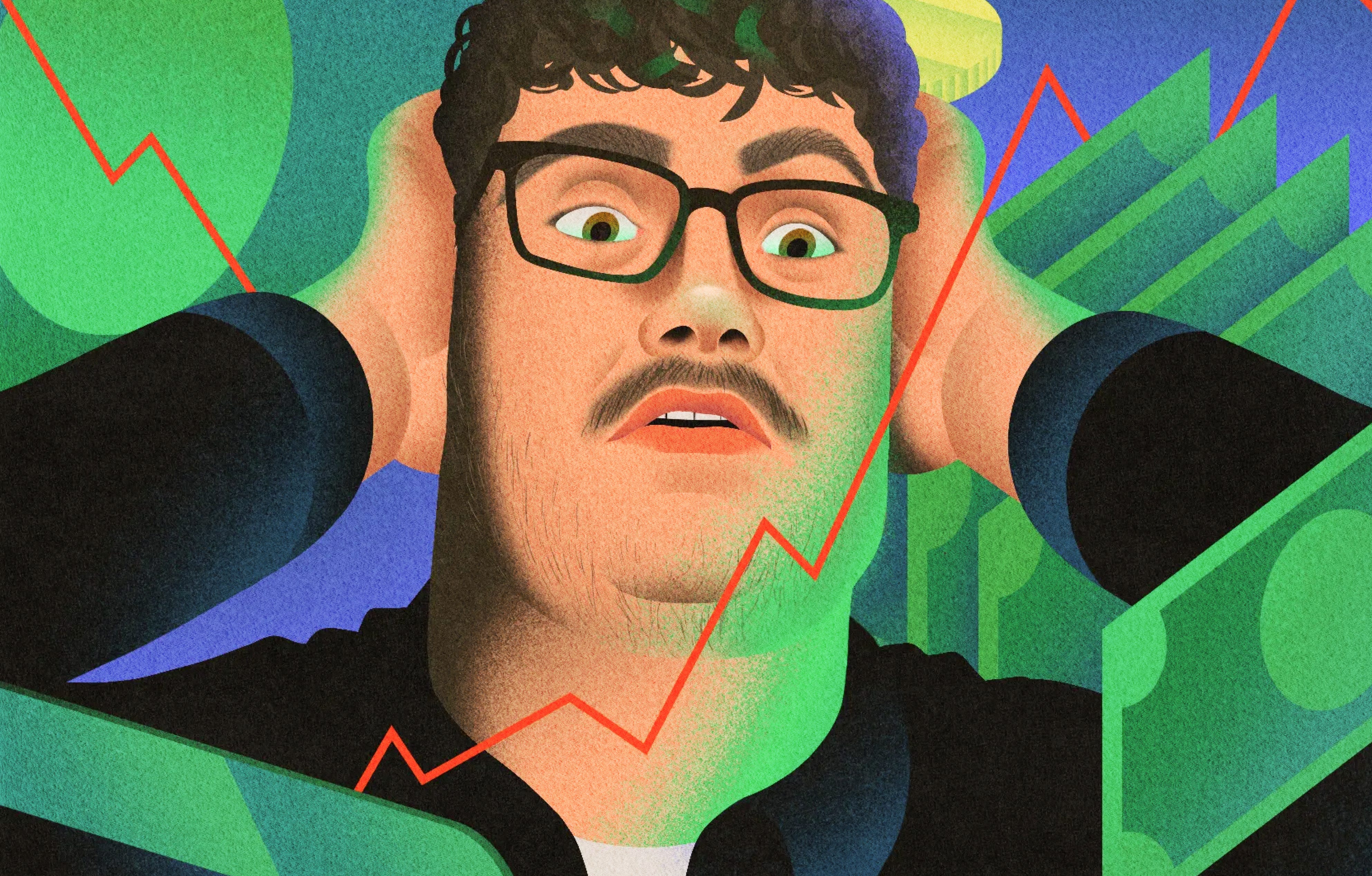
Reading an analysis of Caleb Hammer’s viral “Financial Audit” series in The New Yorker felt a little like seeing the most problematic kid in your high school on your favorite show. When the article appeared on my browser—a cartoon rendering of his square-shaped head surrounded by neon-green cash and jagged red lines intended to invoke stock trading—I felt like the Leonardo DiCaprio-pointing-at-his-TV meme. It’s surreal to watch other financial personalities (albeit ones with very different philosophies) be studied as worthy objects of cultural analysis.
Over the years I’ve come to see personal finance not as an amoral set of tactics, but a powerful national ideology. Hammer’s approach is what you get when you take that ideology and amplify it according to the demands of the internet’s outrage engine. It’s financial literacy meets redpill Jerry Springer, to stunning success.

In the last three months alone, for example, there are at least five Financial Audit videos—four of which are part of HAMMER ELITE, the paid membership subscription—that promise to EXPOSE a PREDATOR (the word “pedophile” is censored using the PDF icon in the video’s introduction to avoid YouTube demonetization), their lurid sex crimes and OnlyFans-mediated infidelity woven into routine budgeting breakdowns at a biweekly clip.
It’s funny, then, that this humiliation-fetish content—which, as Brady Brickner-Wood points out, mostly amounts to calling his indebted and mentally ill interviewees the r-word—is technically the top of a standard marketing funnel for such insipid products as a budgeting app (“Dollarwise”), a four-course “education bundle,” “SIGNED” (?) meal plan, and PDF (Portable Document Format, in this instance, not pedophile) download of a cookbook.
That this strategy has transformed the formerly low-income, student-loan-indebted Hammer into a millionaire is surely part of the allure. I only wish the article had been about 3,000 words longer.
🤓 Earn up to 11x the national average on your savings. No minimum balances, and up to $8 million (joint) or $4 million (individual) in FDIC insurance. New customers can earn up to a 4.25% variable APY with a qualifying deposit. Start saving for tomorrow, today.
Thinking about how humans just want to be understood by each other—How could you even understand others when you yourself are in that “aimless state of ennui?” No wonder the billionaires think they’re gods. They forget how to understand humans.
Having just watched https://en.wikipedia.org/wiki/God%27s_Country_(1985_film) its wild to see how much America hasn't changed